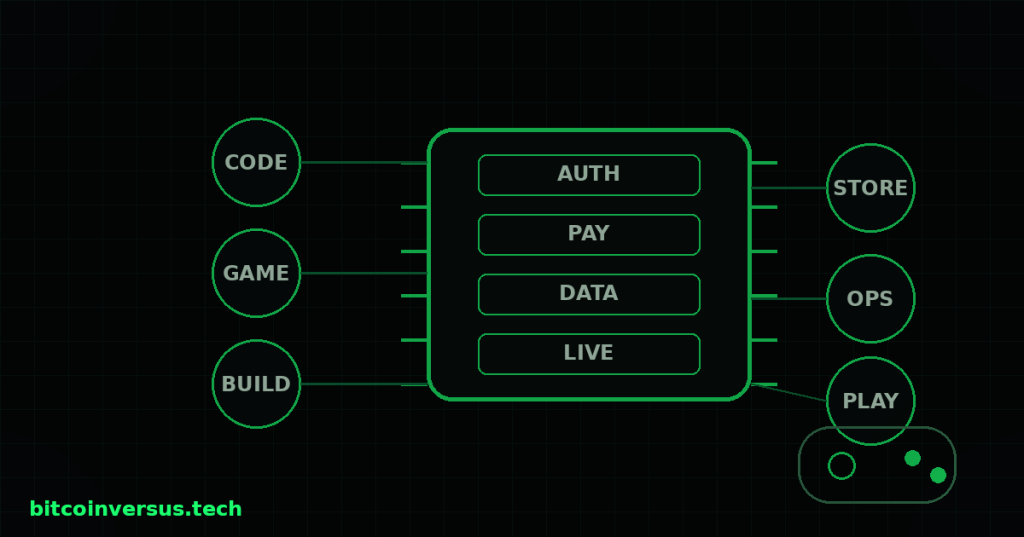
Building a playable game is only part of shipping one. Authentication, payments, player data, analytics, maintenance controls and LiveOps usually arrive next—and that backend work can slow a small team down fast. Com2uS Platform’s newly launched Hive Axyl is aimed directly at that gap by letting developers connect game-backend functions through normal code or natural-language requests handled by an AI coding workflow.
Hive’s official Axyl page describes the product as an AI-native full-stack platform for game development and live operation, with managed services for unified identity and payments, push/mail/coupon-based LiveOps, server-side access-control policies and analytics.
The Interesting Part Is the Coding Interface
The coding angle is straightforward: developers can still implement backend integrations manually, but Axyl also exposes a plugin workflow where a developer describes the needed integration in natural language and the AI writes the connection code. Inven Global’s launch report says the platform launched September 30 and that its plugin is currently available for Codex, with support for additional AI tools planned later.
That matters because game backends are repetitive but unforgiving. A login flow, payment event, coupon system or analytics hook may not be visually impressive, yet a broken integration can stop a release. Axyl’s pitch is that AI can handle more of the glue code while the platform supplies the managed service underneath.
From Prototype to Live Service
This is the same bottleneck exposed by recent AI game-building experiments. BitcoinVersus.Tech covered SWE-Game’s benchmark of coding agents building playable games, which showed that generating a game is already measurable as an engineering task. But a benchmark project can stop at “playable.” A commercial game must also sign players in, store data, collect telemetry, process purchases and survive updates.
That difference between “the game runs” and “the game operates” is where backend platforms become strategic. Axyl is trying to compress that second phase by giving an AI coding agent a standardized surface for common production services instead of asking it to invent every backend from scratch.
AI Agents Are Moving Deeper Into Game Toolchains
The broader trend is bigger than one platform. BitcoinVersus.Tech recently examined Universal-Modder turning coding agents into PC-game modders, another example of agents being plugged directly into game-specific workflows instead of operating as generic chat assistants.
At the engine level, the same pressure is showing up in better refactoring and iteration tools. Godot 4.8 dev 7’s safer symbol renaming and faster C# calls are conventional engineering improvements, but they point at the same end goal: reduce the time between an idea, a code change and a working build.
What Hive Axyl Does Not Eliminate
Natural-language integration does not remove the need for backend engineering discipline. Authentication still needs threat modeling. Payments still need error handling and reconciliation. Analytics schemas still need sensible event design. LiveOps controls still need permissions, rollback plans and testing. AI can write integration code faster, but the production system still has to be observable and correct.
That is why Axyl is more interesting as infrastructure than as a “make a game with one prompt” product. The platform is trying to give coding agents a bounded, production-oriented backend surface where common services already exist and the generated code has something concrete to integrate with.
Why It Matters for Small Game Teams
For a small studio, every backend system competes with actual game development for engineering time. If platforms like Hive Axyl can reliably turn natural-language intent into tested integration code, the biggest advantage may not be replacing programmers. It may be letting a two- or three-person team reach the operational baseline that previously demanded a much larger stack of specialists.
The next test is not whether an AI agent can write a login call. It is whether teams can use these agent-connected platforms to ship and operate real games without creating a maintenance mess behind the scenes. That is the line between impressive coding demos and durable game infrastructure.
BitcoinVersus.Tech
Advertisement
Editor’s Note
We volunteer daily to ensure the credibility of the information on this platform is Verifiably True. If you would like to support to help further secure the integrity of our research initiatives, please donate here: 3C9o19EH5HSiwEPyCTmEKzxhNCbo2X6TTb
BitcoinVersus.tech is not a financial advisor. This media platform reports on financial subjects purely for informational purposes.


Leave a Reply