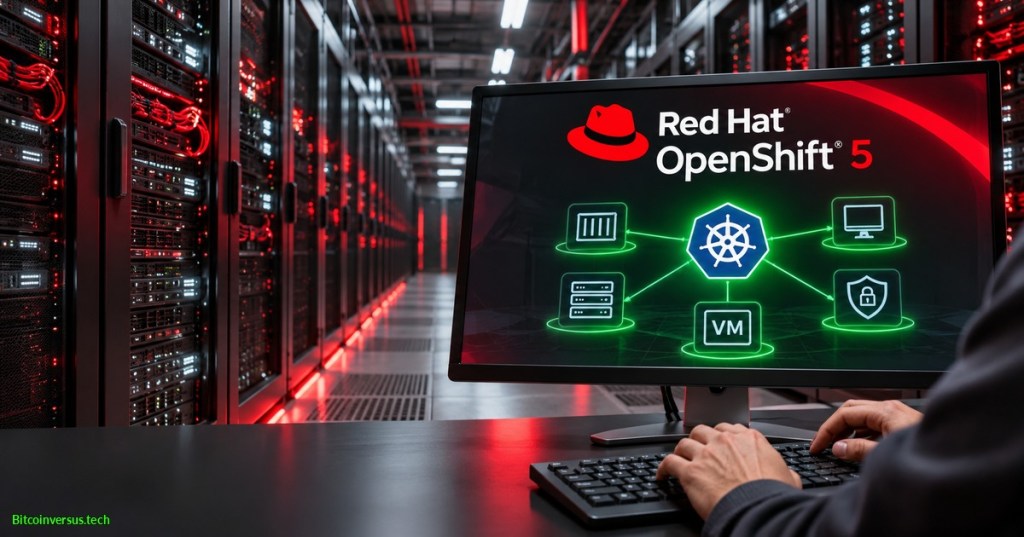
Red Hat released OpenShift 5 on November 9, 2026, adding agent-assisted troubleshooting, post-quantum security controls and a revised support schedule to its Kubernetes application platform. Announced at KubeCon in Salt Lake City, the release supports containers, virtual machines and AI workloads across on-premises infrastructure and cloud providers. Its most consequential operational change is not fully automatic repair: administrators retain approval authority for changes proposed by an AI assistant.
Red Hat official OpenShift 5 product demonstration: building Perses monitoring dashboards from natural-language requests. The video is embedded in Red Hat’s November 9 technical explanation. Independent playback verification remains pending.
Guided Diagnosis Is Available; Autonomous Investigation Is a Preview
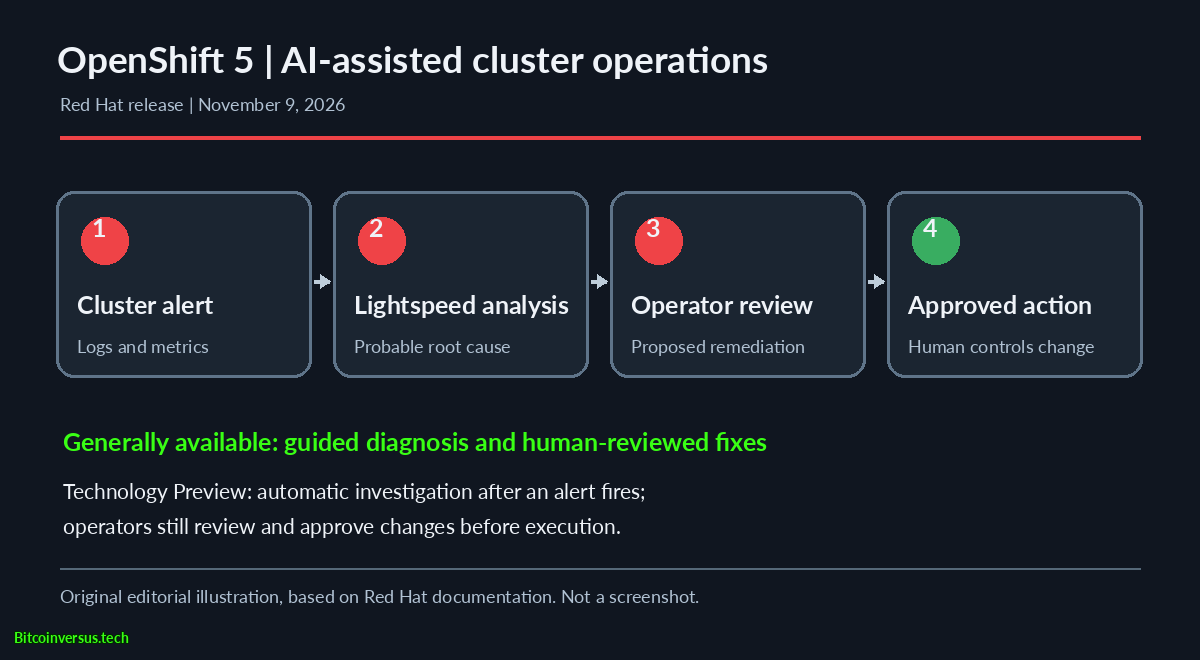
OpenShift 5 runs on Kubernetes 1.36 and CRI-O 1.36. Red Hat OpenShift Lightspeed can evaluate cluster symptoms, correlate logs with metrics and suggest remediation. Red Hat says augmented troubleshooting, update risk assessments and chat-generated Perses dashboards are generally available. By contrast, automatic investigations triggered by alerts and agent-led cluster update workflows are classified as Technology Preview.
The distinction matters in production. An agent might identify a malfunctioning deployment or incompatible operator, but approval gates and existing access policies still determine whether a change executes. Red Hat also describes Model Context Protocol (MCP) server and gateway capabilities for governed connections to platform services. Related Cisco network-operations agents demonstrate why traceable permissions and supervised actions matter across infrastructure tooling.
Red Hat demonstration accompanying its official OpenShift 5 technical article, illustrating Lightspeed-assisted cluster investigation. Recording identity is grounded in Red Hat’s embedded video; live playback has not been independently tested.
Five-Year Support Is Conditional, Not the Default
The standard support window increases from 18 to 24 months, according to Red Hat’s lifecycle explanation—a six-month or 33.3% extension. The separate Extended Life Cycle model promises up to five years for designated releases, beginning with OpenShift 5.2; the extended three-year period is an add-on beyond included support. Describing every OpenShift 5.0 installation as automatically supported for five years would misstate the program.
Existing OpenShift 4.22 clusters have an in-place update path to 5.0. Their upgraded nodes remain on RHEL CoreOS 9, while newly installed 5.0 clusters default to RHEL CoreOS 10. Mixed operating-system nodes are a future objective rather than an immediate upgrade requirement. For operators assessing kernel or memory behavior, Kubernetes swap-density experiments provide related context, but not a performance benchmark of OpenShift 5.
Post-Quantum Controls and Virtualization Face Real-World Tests
Red Hat reports post-quantum cryptography support for control-plane communications, more consistent TLS policies and tighter network isolation for multi-tenant clusters. Those protections do not establish quantum resistance for every application or external dependency. The underlying post-quantum cryptography principles still require algorithm selection, interoperability tests, key management and an inventory of legacy endpoints.
Virtualization updates include memory-aware balancing and QEMU change-block tracking for incremental backups. Both address practical costs: memory placement influences VM density, while copying only changed disk blocks can reduce backup traffic. Earlier Linux hypervisor reporting and a NUMA memory-locality guide explain adjacent architectural constraints. Actual performance will depend on workload profiles, storage systems and configuration.
Operational Value Depends on Measurements
Red Hat has not established a universal percentage reduction in outages, incident response time or infrastructure spending from OpenShift 5. Teams evaluating adoption should compare identical clusters before and after upgrade, measuring alert-to-diagnosis time, approved remediation success, operator compatibility and backup recovery. Security review should verify permission boundaries independently. The release offers new administration tools, but claimed benefits remain conditional on deployment and controlled testing.
Primary sources: Red Hat launch release, November 9; Red Hat technical feature briefing; Red Hat Lightspeed explanation and official videos; Red Hat lifecycle details; Red Hat developer documentation.
BitcoinVersus.Tech Editor’s Note
Published November 10, 2026. Red Hat’s official announcements establish general availability of OpenShift 5, while autonomous troubleshooting and agentic update features remain in Technology Preview. The standard 24-month lifecycle must not be confused with optional five-year coverage for designated future Extended Life Cycle releases beginning with OpenShift 5.2. The original featured cover is a conceptual illustration, not an authenticated product screenshot or deployed customer installation. The embedded videos originate from Red Hat’s November 9 technical article; iframe rendering and independent playback testing are reported separately. Any visual description of the workflow is explanatory rather than a measured test of OpenShift reliability.
We volunteer daily to ensure the information on the BitcoinVersus.Tech platform is Verifiably True. Independent technical reporting and research use dated sources, transparent distinctions between released and preview capabilities, and corrections where needed. Readers may support the research using the original QR code below.

An optional 5,000-satoshi contribution supports independent research. Scan the QR using a second screen and a Bitcoin wallet, or open a saved image with a compatible QR scanner on mobile. Confirm the receiving address 3C9o19EH5HSiwEPyCTmEKzxhNCbo2X6TTb and payment amount before sending; Bitcoin transfers cannot be reversed.
BitcoinVersus.Tech is an independent, volunteer-run technology and research publication. Its coverage is informational and educational, not financial, legal or investment advice.


Leave a Reply