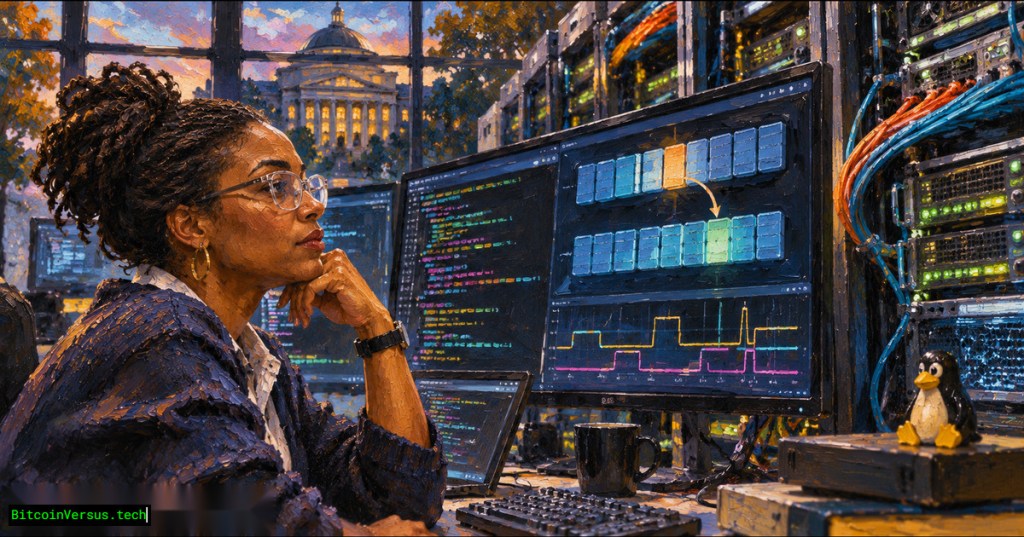
Columbia University researchers have developed an experimental Linux kernel interface that reduces custom page-fault handling latency by factors of 2.8 to 6.1 in selected benchmarks. Named bpf_fault, the project received both a Best Paper Award and a Distinguished Artifact Award at the 2026 ACM Symposium on Operating Systems Principles. Columbia highlighted the results on November 13. The implementation remains a research prototype, not a feature already shipped in standard Linux distributions.
A page fault occurs when software accesses virtual memory that has no usable mapping for the requested operation. Faults can be normal: Linux may allocate a page, load data, or enforce copy-on-write before allowing execution to resume. The difficulty arises when applications want specialized behavior, especially during virtual-machine snapshots, dynamic linking, or memory inspection.
Original Linux Plumbers Conference presentation, October 6, 2026: Columbia researcher Tal Zussman explains bpf_fault, page-fault latency and its experimental use cases. Credit: Linux Plumbers Conference / official YouTube recording.
Why page faults can slow cloud applications
Linux already exposes userfaultfd, allowing a user-space process to respond to some faults. Yet handing control between user space and the kernel introduces scheduling and communication overhead. A frequently triggered fault handler can become a bottleneck even when the underlying data operation is small.
The Columbia team, led by doctoral researcher Tal Zussman and professor Asaf Cidon with collaborators, instead uses eBPF to execute verified custom logic inside the kernel when eligible faults occur. The approach aims to avoid repeated handoffs without requiring every application to maintain a permanently customized Linux kernel. Existing kernel extensions already support other narrow optimization tasks, including the KNOD proposal for Linux network-packet processing.
In the team’s measurements, bpf_fault reduced page-fault latency by 2.8–6.1× relative to the studied userfaultfd path. The ratio is a specialized fault-handling comparison, not an overall server throughput increase. Results depend on the benchmark, system configuration, and fault behavior.
Virtual machines, linking, and memory savings
Researchers integrated the interface with Firecracker and QEMU virtual-machine snapshot workflows. Handling selected faults inside the kernel reduced the tail-latency disruptions associated with snapshotting, which matters for short-lived cloud workloads. Related infrastructure pressures appear in Red Hat’s AI-assisted cloud operations, although Red Hat has not announced deployment of the Columbia interface.
Another experiment moved portions of dynamic linking to the moment a memory page is accessed. Deferring relocations cut dirty memory usage by up to 50% in tested applications such as Chrome and Clang. Dirty memory describes pages modified relative to their backing state; reducing it does not mean total application RAM or power consumption falls by 50%.
The team additionally evaluated Java memory reclamation and a debugging allocator. Taken together, the examples demonstrate flexibility beyond a single virtual-machine benchmark. Operators assessing memory bottlenecks also need to distinguish software policy from physical capacity: CXL memory-expansion hardware addresses a different layer of the problem.
Archival December 12, 2025 Linux Plumbers Conference presentation by Tal Zussman on cache_ext, a distinct eBPF approach for customizing page-cache eviction. Related Linux research background, not an additional bpf_fault benchmark. Credit: Linux Plumbers Conference / official YouTube recording.
Prototype status and next steps
The project is available as research source code and a reproducibility artifact. Its instructions use Ubuntu 24.04 with a modified Linux 6.17-based kernel, supporting eBPF tooling, and application-specific experimental builds. It is not a drop-in package users should install on production hosts without compatibility and security review.
eBPF verification places constraints on executable programs, but safety also depends on the kernel integration, helper functions, concurrency, access controls, and supported memory operations. Successful artifact evaluation strengthens confidence that reported experiments can be reproduced under specified conditions; it does not certify every deployment scenario.
The distinction between kernel memory policy and process resource limits remains important. Administrators can already inspect cgroups with systemd-cgls and create constrained services with systemd-run. Neither utility changes the custom page-fault code path.
At Linux Plumbers Conference in October, Zussman presented the research to kernel developers. The next technical milestone is review and potential upstream acceptance. Until then, bpf_fault demonstrates a credible route to lower overhead in specific memory-management workflows, while production adoption, general-purpose speedups, and system-wide energy savings remain unproven.
Primary-source references: Columbia Engineering announcement, November 13, 2026; Tal Zussman’s original bpf_fault Linux Plumbers Conference presentation, October 6, 2026; SOSP 2026 official awards; Authors’ public reproduction code and kernel modifications; 2025 cache_ext session and archived talk. Reported figures reflect the authors’ defined benchmark conditions; independent testing by BitcoinVersus.Tech was not performed.
Editor’s Note: The benchmarked 2.8–6.1× result describes selected page-fault operations and does not establish an equivalent improvement for all Linux applications. The “up to 50%” claim concerns dirty memory in specific dynamic-linking experiments, not total RAM. bpf_fault is experimental research using a modified Linux kernel, not an upstream production release. The 1200 × 630 fine-art oil-painting cover depicts a fictional systems engineer and is not a documentary photograph of the Columbia researchers. Its green-on-black BitcoinVersus.tech watermark follows the provided reference. Both embedded recordings are original conference media; the second demonstrates separate, earlier cache_ext work. Player availability on every browser remains untested.

BitcoinVersus.Tech is volunteer-run and publishes independent technical journalism. An optional 5,000-satoshi donation supports ongoing research. Scan the original QR from a second screen using a compatible Bitcoin wallet; on the same phone, use a wallet that can import a saved QR image when supported. Independently verify recipient 3C9o19EH5HSiwEPyCTmEKzxhNCbo2X6TTb and the 5,000-satoshi amount before sending. Bitcoin transfers are generally irreversible.
We volunteer daily to ensure the information on BitcoinVersus.Tech is Verifiably True. Technical and financial coverage is educational and informational, not personalized engineering, securities, tax or investment advice.


Leave a Reply