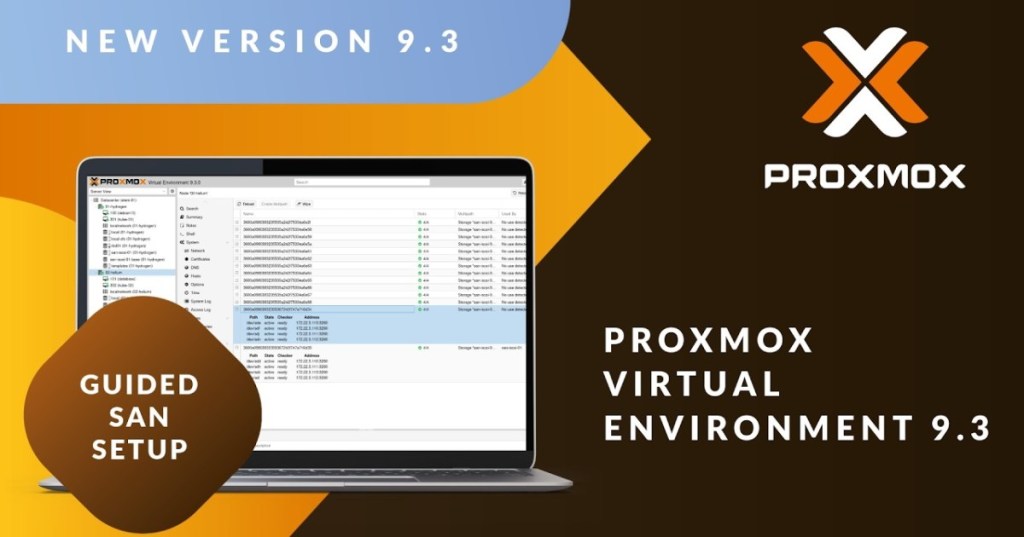
Proxmox Server Solutions released Proxmox Virtual Environment 9.3 on November 25, 2026, expanding the storage administration capabilities of its open-source virtualization platform. The update brings cluster-level storage path management, production support for snapshots on thick-provisioned logical volumes and persistent identities for virtual machines and containers. Proxmox combines KVM virtual machines with Linux containers, building on the architecture explained in our hypervisor fundamentals guide.
Managing shared storage across a cluster
A storage area network (SAN) presents storage devices to multiple servers over a dedicated or logically separated network. Logical unit numbers (LUNs) identify storage resources. Multipath software allows a host to reach the same resource through redundant connections, helping maintain access if a cable, adapter or switch fails. Redundant paths only protect against failures within their designed fault domains; they do not protect against every array failure.
Version 9.3 adds a centralized SAN inventory that displays path health across cluster nodes. Administrators can configure shared Logical Volume Manager (LVM) storage using a guided interface for iSCSI, Fibre Channel and NVMe over Fabrics. The change reduces the number of configuration tasks performed independently on individual hosts. Reliable failover still depends on consistent storage identifiers and correctly configured physical networks. Comparable availability principles appear in Oracle’s resilient networking architecture.
Snapshots and persistent virtual-machine identities
Thick-provisioned LVM reserves volume capacity in advance. Proxmox now designates its volume-chain snapshot implementation as production-ready. The mechanism preserves an earlier disk state and directs subsequent changes through a new layer. Administrators must explicitly enable the feature. Capacity accounting, deletion, restoration and performance should be tested on representative storage before relying on snapshots for production maintenance.
Snapshots are not independent backups. An array failure can affect both an active virtual disk and its snapshot chain. Persistent guest identifiers introduced in 9.3 help backup software recognize a workload even when its numeric VM identifier changes or it moves between clusters. Recovery automation must account for identity checks when restoring over existing guests. Other approaches to managing virtualized workloads include Sidero Labs’ Talos Hypervisor.
Enterprise storage and networking choices
The release is based on Debian 13.8, with Linux 7.0 as its default kernel and 7.3 available as an optional alternative. QEMU 11.1, LXC 7.0 and ZFS 2.4 form part of the updated software stack. Ceph Tentacle 20.2 is a stable storage option, while Ceph Umbrella 21.2 is a technology preview. Those version numbers identify software releases rather than measured performance improvements.
Software-defined networking now supports dedicated routing tables for Simple zones, and WireGuard fabrics expose tunnel and peer status. Additional management features include high-availability maintenance mode in the browser and structured system and API logs. Together, these changes address everyday infrastructure operations rather than introducing a new hypervisor architecture. Red Hat’s OpenShift development illustrates an adjacent approach to managing virtual machines and containers.
Operators can consult the official release discussion and installation downloads before planning upgrades. The appropriate acceptance tests include verified backups, guest recovery, storage-path failover and workload migration. The November release makes shared storage easier to administer, but actual reliability and throughput depend on the deployed infrastructure.
We volunteer daily to ensure the credibility of the information on this platform is Verifiably True. If you would like to support to help further secure the integrity of our research initiative, please scan the QR code below.

For mobile scanning, open the article on another display and scan the QR code with a Bitcoin wallet. The voluntary donation amount is 5,000 sats. Verify the receiving address 3C9o19EH5HSiwEPyCTmEKzxhNCbo2X6TTb before sending.
BitcoinVersus.tech is not a financial advisor. This media platform reports on financial subjects purely for informational purposes.


Leave a Reply