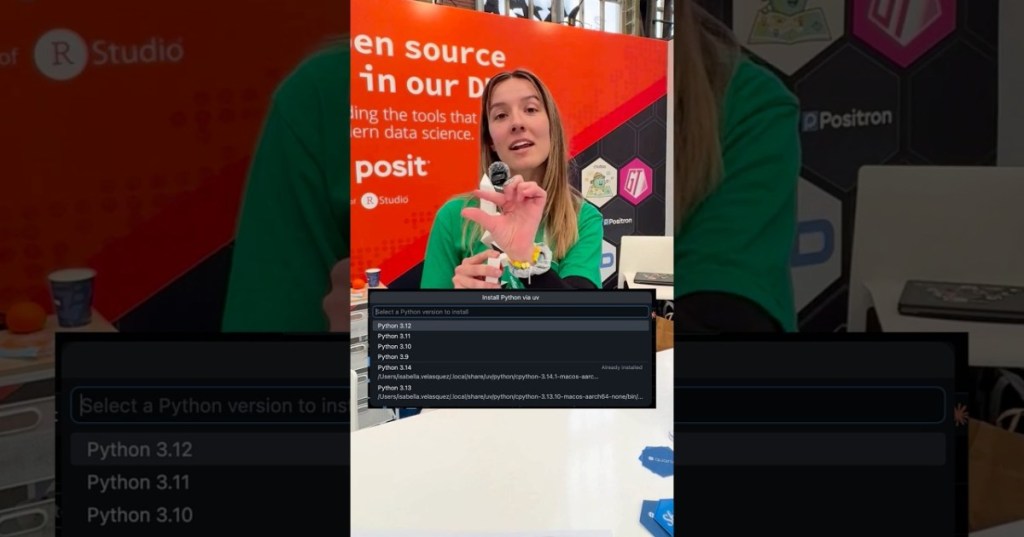
Posit has updated its data-science development environment with a graphical inspector for nested data structures, revised Python environment selection and expanded database tooling. The November 2026 edition of Positron also reduces its installation footprint. According to the official release notes, the current 2026.11.1 patch, issued November 9, resolves problems affecting Positron Server and Posit Workbench. The IDE supports Python 3.15, whose development and release engineering BitcoinVersus.Tech previously examined in its Python 3.15 release-candidate coverage.
Inspecting data beyond rows and columns
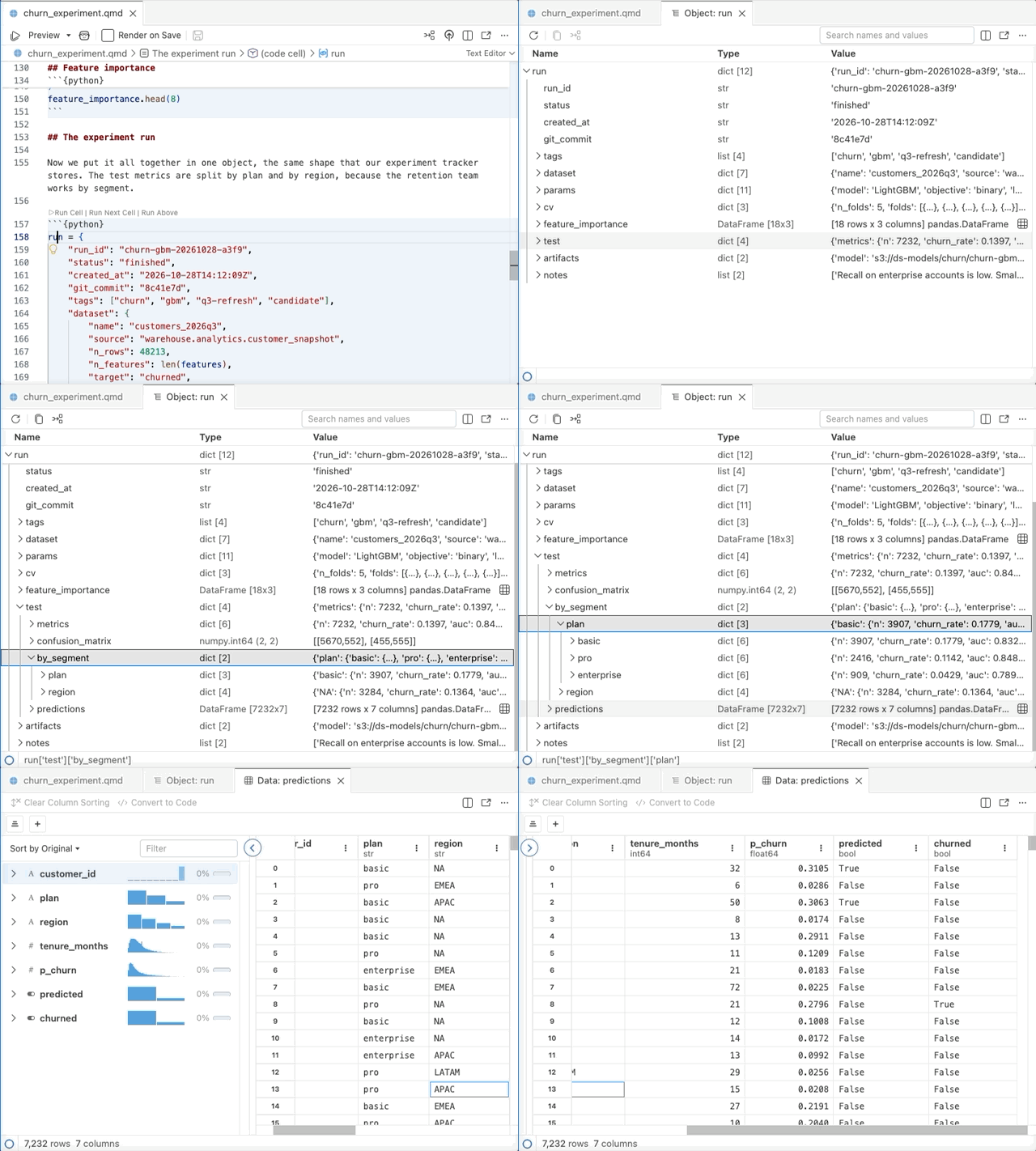
A conventional spreadsheet-like viewer is most useful when observations share a common row-and-column structure. A machine-learning experiment, however, might return a dictionary containing configuration parameters, arrays, validation scores and fitted model objects. Positron’s Object Explorer presents these structures hierarchically, allowing programmers to locate a particular field without manually printing each intermediate container. A copied accessor can then become part of a repeatable analysis script. Unlike a screenshot of a variable, a scripted expression can be executed again when the underlying dataset changes.
Selecting the correct runtime
The revised interpreter selection system prioritizes environments associated with the current project and can start a known project runtime without waiting for discovery of every installed Python interpreter. Positron adds Python 3.15 compatibility and drops Python 3.9 support. Environment isolation matters because libraries with incompatible versions may otherwise coexist in a shared installation. Our Python package installation guide explains why invoking pip through a specific interpreter helps developers control where dependencies are installed.
For a research team, reproducibility requires more than selecting a runtime in a graphical interface. The project should record dependency versions, source revisions, input datasets and execution parameters. Even identical Python versions can produce different results when library builds, hardware accelerators or numerical settings differ.
Reducing installation overhead
Posit reports an installation-size reduction of approximately 224 MB per platform through shared DuckDB dependencies. Its bundled Python kernel also contains about 1,900 fewer files. These figures measure different aspects of packaging and cannot be combined into a single percentage without baseline measurements. Eliminating duplicated libraries can reduce storage consumption and installation transfers. Reducing file counts may also help network-mounted installations, where metadata requests accumulate. Neither figure independently establishes a measured improvement in execution speed.
Connecting databases and coding agents
The update adds MotherDuck connectivity, experimental schema-aware SQL editing and improvements to decimal-value handling. Preserving decimal precision is especially important when working with financial records, where rounding introduced during inspection could obscure reconciliation differences. Posit also expands its experimental Model Context Protocol integration, allowing compatible agents to work with the interactive environment. Similar integration challenges appear in our coverage of programming interfaces for coding agents. Posit’s MCP technical overview describes the integration’s experimental status.
An agent’s access to runtime objects can help diagnose a failed calculation, but granting access to sensitive data or credentials introduces a separate security problem. As discussed in our CodeQL security analysis coverage, automated developer tooling does not eliminate independent review. Positron’s November changes offer useful infrastructure for inspecting and reproducing data workflows; teams should validate their own projects before relying on the new capabilities in production.
We volunteer daily to ensure the credibility of the information on this platform is Verifiably True. If you would like to support to help further secure the integrity of our research initiative, please scan the QR code below.

For mobile scanning, open the article on another display and scan the QR code with a Bitcoin wallet. The voluntary donation amount is 5,000 sats. Verify the receiving address 3C9o19EH5HSiwEPyCTmEKzxhNCbo2X6TTb before sending.
BitcoinVersus.tech is not a financial advisor. This media platform reports on financial subjects purely for informational purposes.


Leave a Reply