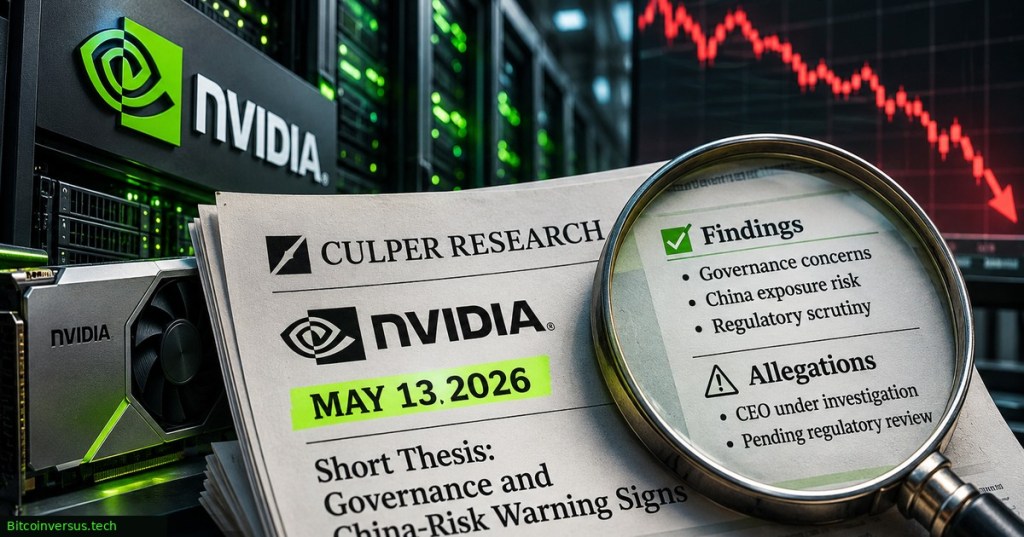
On May 13, 2026, short seller Culper Research publicly disclosed a bearish position in Nvidia and warned that the chipmaker had major China-related risks. Nearly six months later, Nvidia’s board opened an investigation into allegations involving chief executive Jensen Huang and a former executive of chip buyer Megaspeed. Nvidia shares closed November 9 at $178.67, down 4.27% for the session, even as the wider Nasdaq rallied. Culper’s earlier work now warrants scrutiny for what it identified, what subsequent reporting corroborated, and what remains unproved.
The warning came 180 days ahead of the selloff
Culper’s dated report, NVIDIA (NVDA): The China Problem, alleged that Nvidia’s exposure to Chinese demand continued through Southeast Asian intermediaries despite U.S. export restrictions. The firm estimated that more than 20% of fiscal 2026 compute revenue remained driven by China. That 20% figure is Culper’s estimate, not audited Nvidia revenue or a regulatory finding. The report also questioned financing and ownership links involving Megaspeed and Alibaba.
More consequential for the November news cycle, the research examined Jensen Huang’s interactions with Alice Huang, then linked to Megaspeed, and suggested their proximity created governance and security concerns. Culper identified the relationship before the later intelligence allegations drew widespread coverage. Its May publication did not prove espionage or predict the precise timing of a board investigation.
May 13, 2026: Culper publicly publishes its Nvidia short thesis.
November 8: Nvidia announces an independent board investigation.
November 9: Nvidia closes at $178.67, down 4.27%.
How accurate was the bearish market call?
Historical closing-price data put Nvidia at $225.83 on May 13 and $178.67 on November 9. The change is ($178.67 ÷ $225.83 − 1) × 100 = −20.88%. A hypothetical unleveraged short entered at the May 13 closing price and covered at the November 9 closing price would have gained about 20.88% of its initial sale proceeds before borrow fees, financing, dividends, commissions and other costs. That calculation does not establish Culper’s actual entry price, exit, position size or realized return.
The November decline also reflected wider AI-investment concerns. A price decline alone cannot prove every element of Culper’s thesis.
CNBC Television’s May 20, 2026 interview with Jensen Huang on China chip-sales restrictions, providing contemporaneous policy context rather than evidence of espionage. Credit: CNBC Television / YouTube.
Evidence, allegations and Nvidia’s response
On November 8, Nvidia’s board said independent directors and outside counsel would investigate reports that Huang was targeted by a foreign intelligence effort. The board said it had no reason to believe national security or company secrets were compromised. Huang acknowledged an extramarital affair, apologized and agreed to cooperate. China denied the allegations of an intelligence operation.
A November 9 TechCrunch review confirmed the chronology of Culper’s earlier warning. Separate Financial Times reporting described loans from Alibaba-related entities to Megaspeed. Allegations of chip diversion, improper knowledge by Nvidia executives and spying remain distinct questions; none can be declared established merely because an early critic highlighted the associated business relationships.
Our earlier Nvidia investigation coverage details the board’s announcement. Related reporting tracks H200 chip export restrictions, a separate adjudicated AI-server diversion case, and commercial chip-leasing exposure to China. Each involves different evidence and legal circumstances.
A model for early investigative reporting
Culper’s valuable contribution was to connect financial disclosures, customers, regional chip flows and executive relationships before investors broadly priced the risk. Yet activist short sellers have financial incentives to publish critical claims. Investors and journalists should test their documents, seek responses from affected parties, and track dated forecasts against verifiable outcomes. The open questions are whether Nvidia’s review finds any compromised information and whether independent evidence substantiates Culper’s broader revenue-diversion estimates.
Editor’s Note: Reporting checked against Culper Research’s May 13, 2026 original publication, Nvidia’s November 8 board statement, Associated Press coverage, TechCrunch’s November 9 chronology, and dated historical stock prices. Culper held a disclosed short position at publication and may benefit from a price decline. No judicial or regulatory finding is inferred from allegations or reported intelligence assessments. The price calculation is hypothetical and is not Culper’s verified investment result. The featured image is a generated editorial illustration, not a photograph or reproduction of Culper’s report. Social embeds are source references, not proof that allegations are true.

We volunteer daily to ensure the information on this platform is Verifiably True. If you would like to support the research, please scan QR code.


Leave a Reply