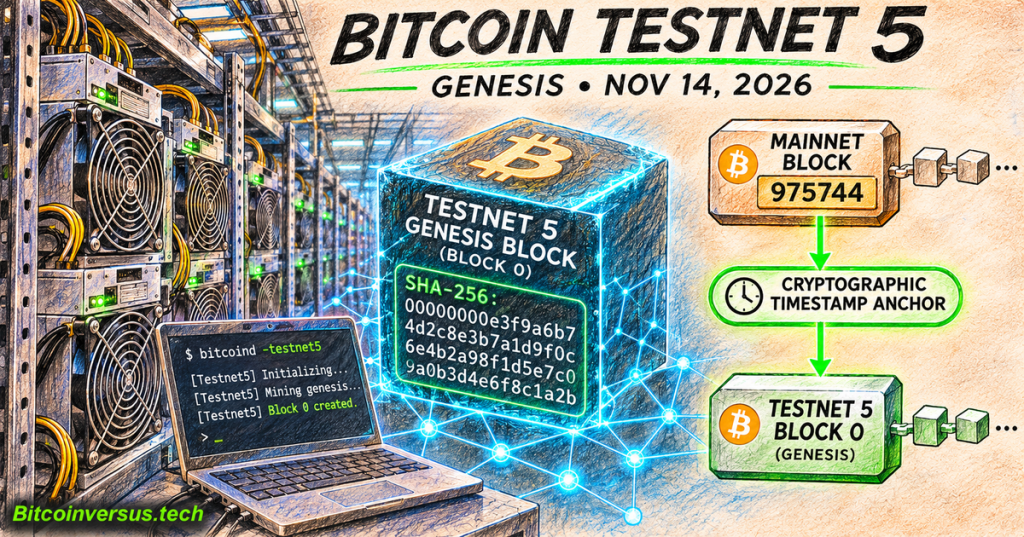
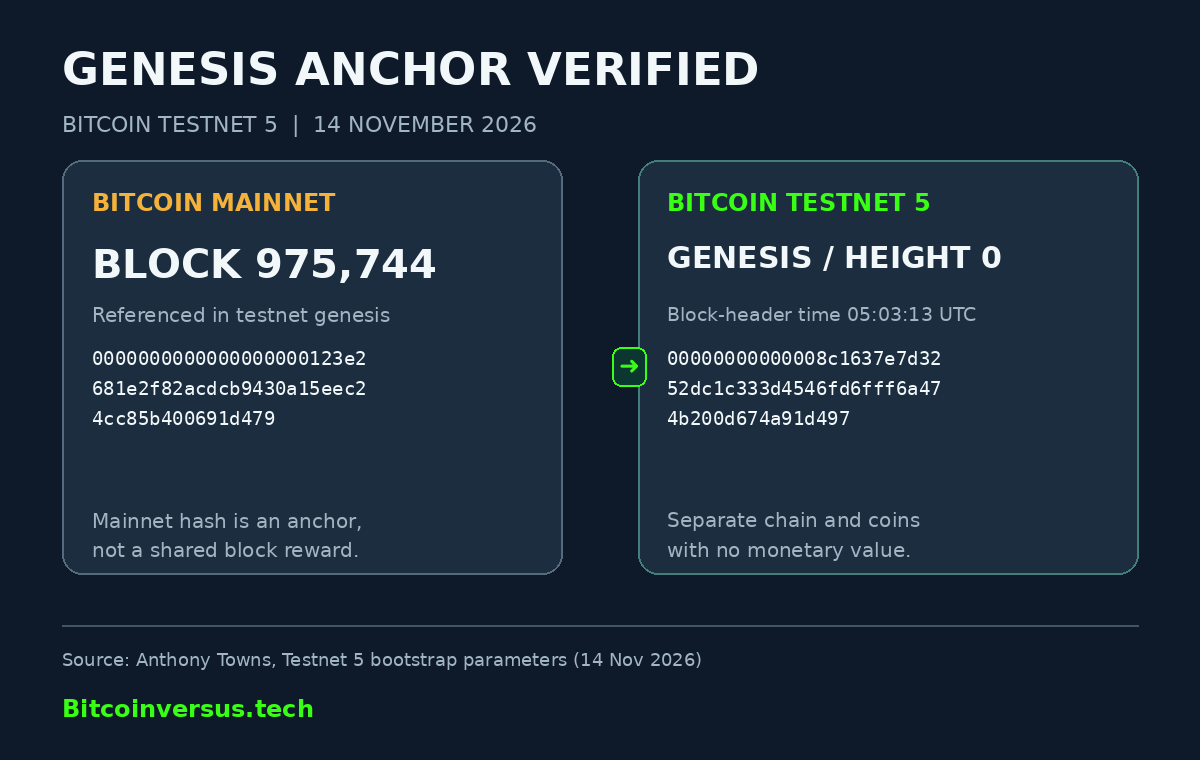
Bitcoin’s proposed fifth public test network has produced its first mined block. On November 14, 2026, miners created the Testnet 5 genesis block using SHA-256 proof of work, opening a separate environment for testing mining pools, nodes and future consensus rules. Developer Anthony Towns published the block data with a 05:03:13 UTC header timestamp and hash 00000000000008c1637e7d3252dc1c333d4546fd6fff6a474b200d674a91d497. The test coins are not BTC and have no monetary value.
The launch addresses a longstanding problem with Bitcoin testing: block-production exceptions allowed bursts of low-difficulty blocks and competing tips. BIP 95, still a draft, proposes retiring Testnet 4 in favor of a network closer to mainnet mining behavior, with different genesis data and independently maintained chain state.
Bitcoin mining developer Steven Roose announced the live Testnet 5 chain and reported 166 blocks during its first hour, alongside a P2Poolv2 deployment. Developer statement dated November 14; the first-hour count is attributed rather than independently reconstructed. View the source post on X.
A public ASIC pool instead of a private premine
Towns arranged a publicly accessible ckpool instance before launch so anyone equipped with SHA-256 mining hardware could attempt the first block. The pool initially advertised a zero-percent fee and waited for mainnet block 975,744 before issuing genesis work. Bitcoin Optech described the design on November 13 as an attempt to prevent a private mining head start.
Testnet 5 raises its minimum difficulty roughly one millionfold versus Testnet 4, making dedicated ASIC hardware the practical route for initial mining. A higher starting target threshold limits the sudden block floods associated with excessively easy test networks. It does not guarantee resistance to chain reorganization or establish the network’s eventual security budget. For context, BitcoinVersus.Tech recently explained Bitcoin mainnet’s November difficulty reduction, a separate adjustment with real miner-revenue implications.
Why the genesis block references Bitcoin mainnet
The genesis coinbase records the November 14 date, block height 975,744 and its mainnet block hash. By committing to information unavailable before the reference block existed, the new chain supplies an externally checkable starting condition. The commitment does not merge the two ledgers, transfer bitcoin, or allow Testnet 5 rewards to be redeemed on mainnet.
Anthony Towns noted a close calendar alignment between the Testnet 5 genesis timestamp and Bitcoin’s Taproot activation five years earlier. The observation is historical, not a consensus dependency. View the source post on X.
Mining software and network support are unfinished
BIP 95 eliminates the old 20-minute minimum-difficulty exception and activates the proposed BIP 54 consensus-cleanup rules from block one on Testnet 5. Those test-network rules do not activate BIP 54 on Bitcoin mainnet. The new network’s identifier, genesis hash and port must also be implemented by compatible clients. Towns lists Bitcoin Core integration, DNS seeds, faucets and explorers as outstanding work.
A public Libbitcoin mailing-list update on November 14 identified two connected nodes, while P2Poolv2’s project site now links a Testnet 5 share-chain explorer. Roose reported the first-hour block count; the project’s current dashboard is a distinct, changing operational view. BitcoinVersus.Tech previously covered P2Poolv2’s Lightning payout research and Stratum V2 mining-job software, two related but separate infrastructure initiatives.
OrangeSurfBTC shared an early screenshot of a Testnet 5 block explorer on November 14. Social-media screenshot is an early network snapshot, not a substitute for inspecting current chain headers. View the source post on X.
For operators, the immediate task is to isolate testnet wallets, node data and mining-worker configurations from production systems. Developers can exercise template creation, proof-of-work validation, peer discovery and pool accounting without risking mainnet payments. BitcoinVersus.Tech recently examined three separate Bitcoin Core attack surfaces; a functioning test chain can help catch implementation defects but does not certify deployed mainnet security.
The milestone is a publicly checkable genesis block and an emerging developer network—not an announced mainnet upgrade, a new cryptocurrency investment, or a finished Bitcoin Core release.
Primary documentation: Anthony Towns’s Testnet 5 launch record and genesis parameters, updated November 14; BIP 95 draft specification; Bitcoin Optech Newsletter #431, November 13; Libbitcoin network launch confirmation, November 14; Bitcoin Core Testnet 5 parameters PR; BIP 95 genesis data PR; P2Poolv2 website. Project claims and social-media activity are attributed.
Editor’s Note: Testnet 5 is a separate experimental network with coins lacking monetary value. Published genesis data establish the new chain’s starting record, but downstream software, explorers and pool infrastructure remain in active development. The source-based block-hash figure transcribes the public bootstrap parameters. Featured 1200 × 630 colored-pencil artwork is conceptual; decorative hash markings are not literal blockchain data. X posts are first-party developer or community material, and their embedding, platform permissions and mobile rendering require independent public-page verification.

BitcoinVersus.Tech is volunteer-run and publishes independent educational technology reporting. An optional 5,000-satoshi donation supports research. Scan the QR from a second screen using a compatible Bitcoin wallet; on mobile, save the QR image and scan it using a wallet with image import. Check address 3C9o19EH5HSiwEPyCTmEKzxhNCbo2X6TTb and the payment amount before sending. Bitcoin transfers are generally irreversible.
We volunteer daily to ensure information on the BitcoinVersus.Tech platform is Verifiably True. Coverage is for educational and informational purposes and is not financial or investment advice.


Leave a Reply