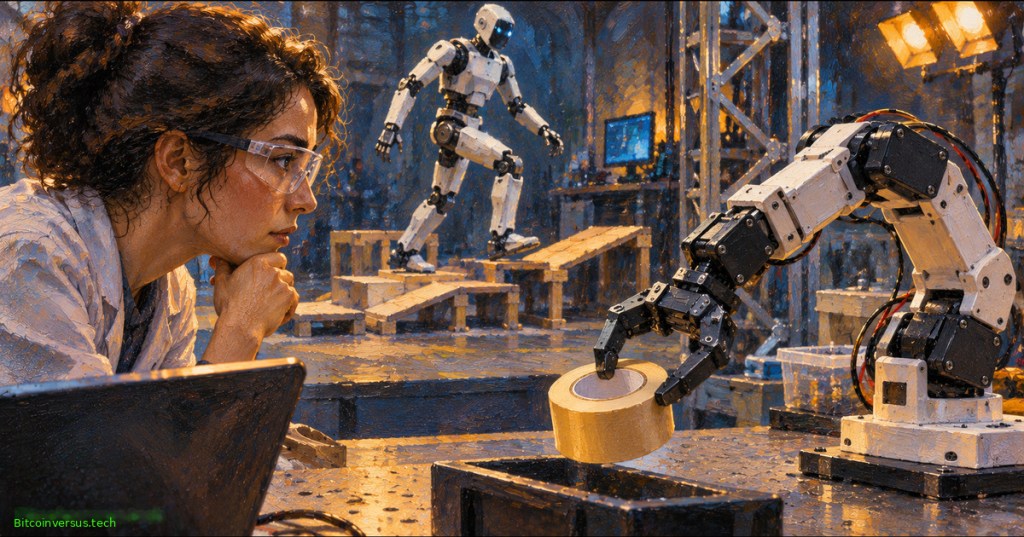
University of Michigan researchers reported that a neural-network component called PRISM increased simulated humanoid walking survival from 51% to 92.5% in a controlled benchmark. The team presented the work at the Conference on Robot Learning in Austin on November 10, 2026. A separate physical robot-arm experiment reached 94% tape-pickup success, compared with 68% for the baseline. Both figures measure specific experiments, not general robot reliability.
PRISM stands for Polynomial Representations for Interaction-Structured Motor Control. Its purpose is to make relationships between motion-related inputs easier for a learning system to represent. Joint angles, joint velocities, recent observations and movement commands interact as a robot pushes against the ground or grasps an object. A conventional multilayer perceptron, or MLP, must learn many combinations indirectly.
Official PRISM humanoid-walking simulation comparison linked by University of Michigan Engineering, November 10, 2026. Top-row baseline robots fall sooner than PRISM-controlled examples in the university’s demonstration. Credit: Yu Laboratory / University of Michigan Engineering / YouTube.
A smaller architectural change, not a bigger robot
The researchers introduced learnable, compact polynomial interactions in place of the initial input-processing layer. Their approach does not add a force sensor or require new training objectives. It also does not replace established robot hardware, safety systems or mechanical design. Robot dynamics and torque-control fundamentals explain why interactions among position, velocity, inertia and load matter.
In the Humanoid-Gym simulation, the standard network survived 51% of 24-second walking trials. PRISM reached 92.5%, a 41.5-percentage-point improvement, averaged across five training seeds. Making the comparison MLP roughly as large as PRISM yielded only 52.25% survival. The result supports the authors’ claim that input representation can matter more than increasing parameter count.
Generalization tests produced smaller, still measurable differences. On flat terrain with unseen friction, mass and payload settings, PRISM survived 92.3% of trials versus 78.3% for a parameter-matched MLP. On rough terrain, the corresponding figures were 87.1% and 80.0%. The studies used fixed evaluation checkpoints without retraining for the altered conditions.
Real hardware checks the simulation result
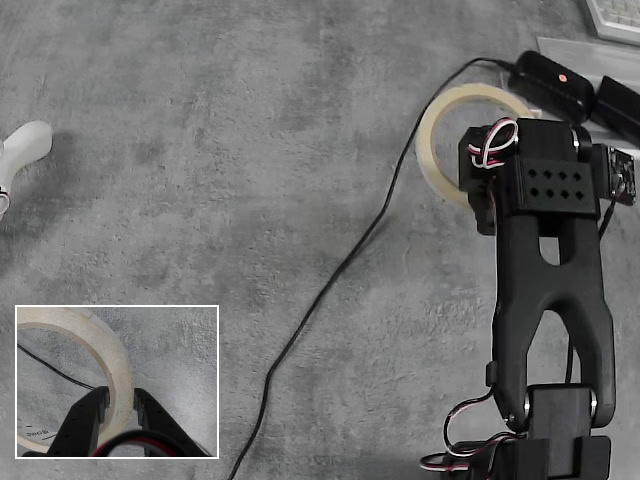
Crucially, the research included a physical test rather than simulations alone. An SO-101 robot arm attempted to grasp and lift a tape roll using policies trained from the same 50 demonstrations. PRISM succeeded on 47 of 50 attempts; the conventional ACT policy succeeded on 34 of 50. That is a 26-percentage-point advantage under the reported setup, not proof of identical gains on industrial assembly lines.
Researchers also deliberately disrupted a simulated cube-stacking task. PRISM finished 23 of 44 recovery attempts (52.3%) versus 18 of 44 (40.9%) for the baseline. Its contact response resembled compliant control despite lacking direct force-feedback input. Real physical contact and simulated contact remain distinct kinds of evidence.
Where a better controller still falls short
The findings complement NVIDIA’s robot-learning experiments and new fingertip sensing hardware, but PRISM addresses the learning representation rather than collecting more touch data. Researchers exploring humanoid contact planning face related questions about adapting policies to difficult surfaces.
The principal limitation is scale. Most reported walking and recovery numbers come from simulators; only the narrow tape-grasp benchmark ran on a physical arm. Neither long-term durability nor workplace safety certification was established. Deployed robots also face sensor faults, mechanical wear, unpredictable human contact and power constraints. Even a controller that remains upright in a simulated trial still needs independent safety validation.
The research offers a focused alternative to enlarging motor-control networks. Practical adoption will depend on reproduction by other laboratories, tests across different machines and longer missions. Boston Dynamics’ recent Atlas motor-control experiment illustrates the same broader challenge: impressive controlled demonstrations must ultimately transfer to robust physical operation.
Research sources: University of Michigan Engineering, November 10, 2026; authors’ original project and benchmark results; CoRL 2026 publication record; PRISM paper, arXiv:2607.23473. Comparisons are author-reported experimental findings, not independently reproduced results.
Editor’s Note: Numerical findings distinguish 24-second simulated humanoid survival, 20- and 60-second changed-dynamics evaluations, 44 simulated recovery trials and 50 attempts on one real SO-101 arm. The 1200 × 630 fine-art oil-painting cover is original conceptual artwork showing fictional people and machines, not a documentary image of the Michigan laboratory. The in-story SO-101 photograph and linked moving-image demonstrations are sourced to the research team. Rendered media markup is not proof of playback on every browser or handset.

BitcoinVersus.Tech is volunteer-run and publishes independent technical journalism. An optional 5,000-satoshi donation supports ongoing research. Scan the original QR from a second screen using a compatible Bitcoin wallet; on the same phone, use a wallet that can import a saved QR image when supported. Independently verify recipient 3C9o19EH5HSiwEPyCTmEKzxhNCbo2X6TTb and the 5,000-satoshi amount before sending. Bitcoin transfers are generally irreversible.
We volunteer daily to ensure the information on BitcoinVersus.Tech is Verifiably True. Technical and financial coverage is educational and informational, not personalized engineering, securities, tax or investment advice.


Leave a Reply