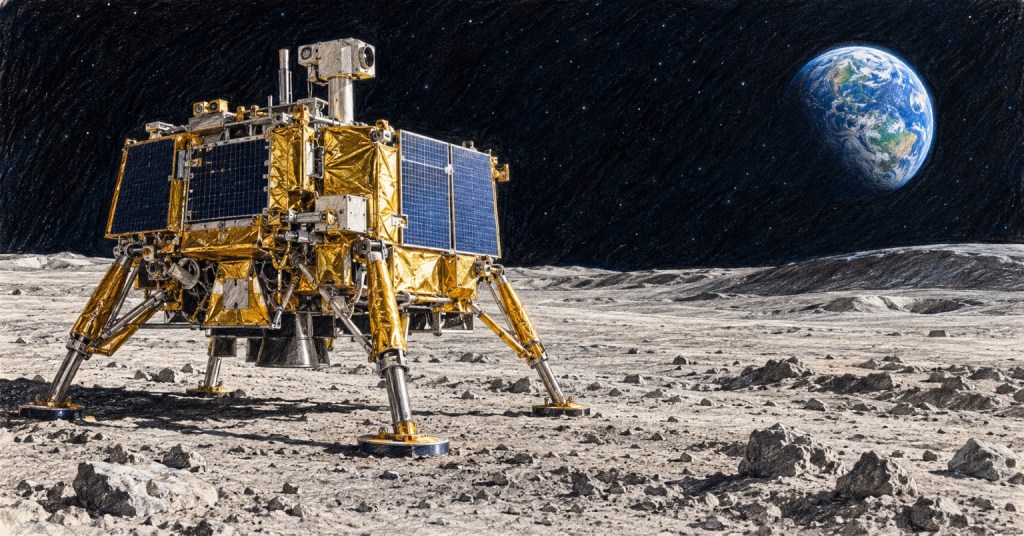
A lunar lander has to survive launch vibration, deep-space radiation, huge temperature swings, abrasive dust and a landing it must largely perform by itself. That makes the vehicle less like a simple spacecraft and more like a compact autonomous robot packed with hardened computing, sensors and power electronics.
The chips doing the work
One confirmed example is Astrobotic’s Peregrine. Its payload guide specifies a 32-bit dual-core LEON3FT flight processor, a fault-tolerant SPARC design, plus a pair of radiation-tolerant FPGAs for payload management. Error correction and upset monitoring help keep bad radiation events from turning into lost commands or corrupted data.
Firefly’s Blue Ghost carried NASA’s RadPC experiment, which uses redundant processors implemented on commercial FPGAs and can recover from radiation-induced faults. That was a technology payload rather than Blue Ghost’s primary flight computer, but it shows where lunar computing is heading.
Landing is a sensor-fusion problem
Modern precision-landing systems combine inertial measurement units, cameras, radar or laser altimeters, Doppler lidar and terrain-relative navigation. NASA’s SPLICE work adds hazard-detection lidar and an onboard descent computer that turns those sensor feeds into altitude, velocity and safe-landing decisions in real time.
Once on the surface, solar arrays and lithium-ion batteries feed DC-DC converters, avionics, radios and heaters. Thermal insulation, radiators and carefully managed heaters keep electronics inside their operating range while dust-resistant hardware protects exposed mechanisms and optics.
The next generation goes further. NASA and Microchip’s High Performance Spaceflight Computing processor is being developed for future Moon and deep-space missions with far more onboard computing for autonomy, hazard detection and data fusion. Lunar hardware is steadily becoming smarter because there is no technician standing nearby when something goes wrong.
That same infrastructure problem connects to lunar power, Moon communications and surface hazard mapping: landing is only the first step. Surviving long enough to work is the real engineering challenge.
BitcoinVersus.Tech Editor’s Note:
We volunteer daily to ensure the credibility of the information on this platform is Verifiably True. If you would like to support to help further secure the integrity of our research initiatives, please donate using the QR code provided

For best QR-code scanning results, please scan this donation code from a desktop or larger screen. Mobile screens may prevent camera recognition.
BitcoinVersus.Tech provides technical education and analysis for informational purposes only.


Leave a Reply