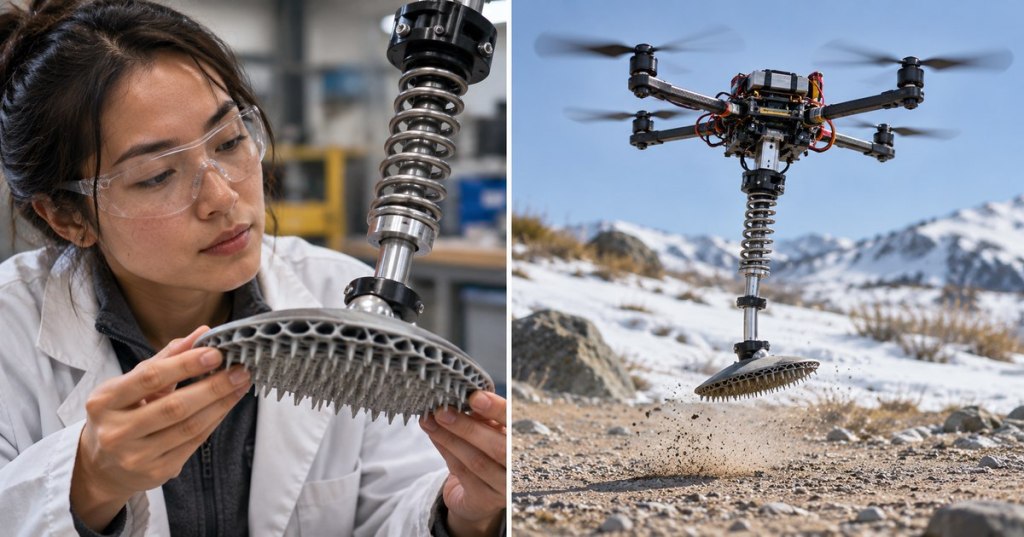
Researchers at the University of Toronto unveiled a flexible-foot upgrade for the Hopcopter, their spring-legged quadcopter, in an October 26, 2026 announcement. The peer-reviewed study, first published October 22, shows improved hopping over sand, rock and ice, potentially opening difficult terrain to lightweight inspection robots.
The Hopcopter uses propellers to control its motion and a passive telescoping leg to store and return impact energy. Earlier versions could rebound from concrete but slipped on angled rock and ice or became stuck in sand. Instead of adding another motor, the team changed how the foot contacts the ground.
Why a Footpad Changes the Physics
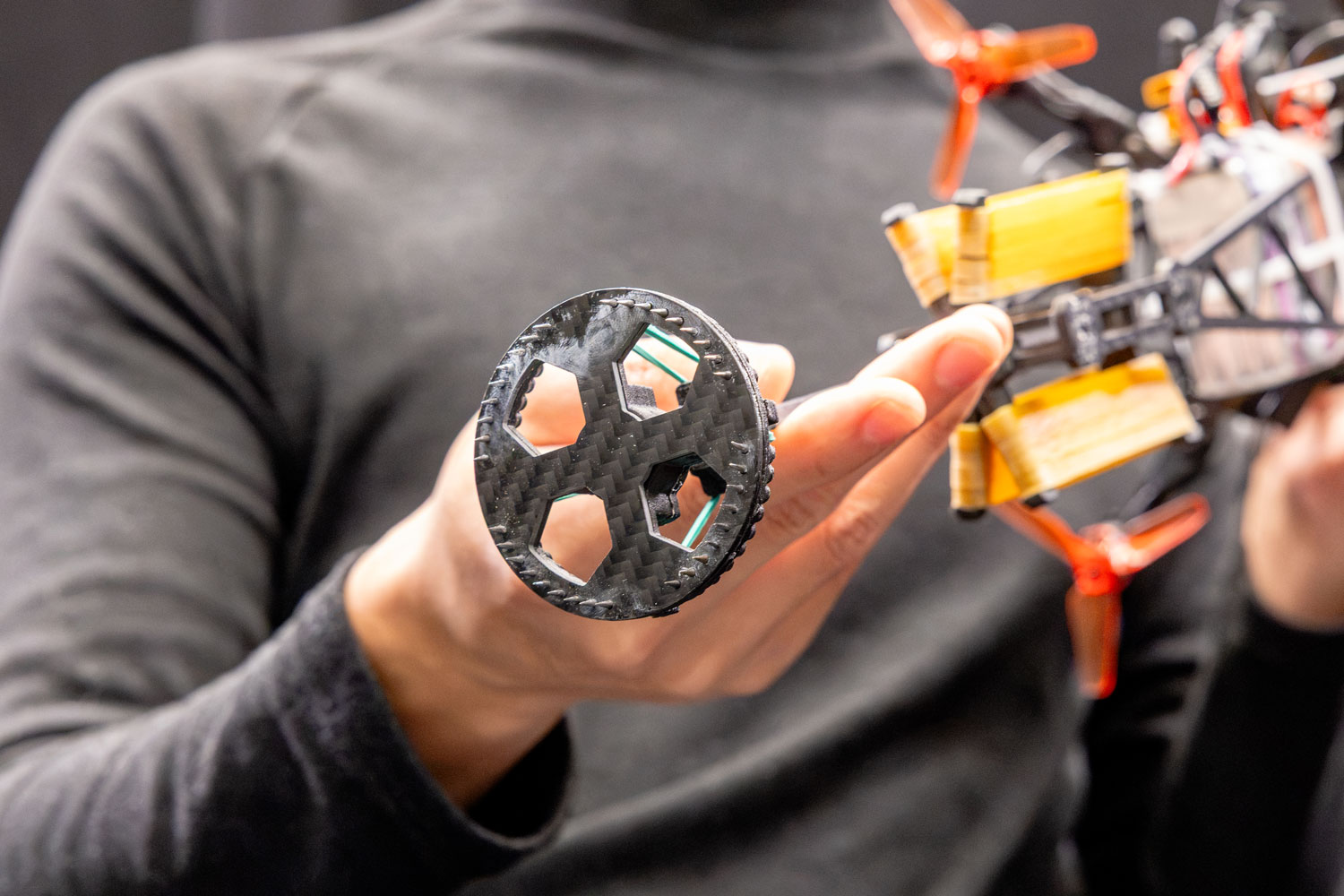
The redesigned system combines a wider sole, a compliant spherical ankle that self-aligns on landing, elastic restoring elements and optional steel spines for grip. A broad sole spreads contact forces across soft terrain, while spines resist sliding on slick surfaces. Passive mechanics matter because each ground-contact phase is too brief for a complicated actuator response.
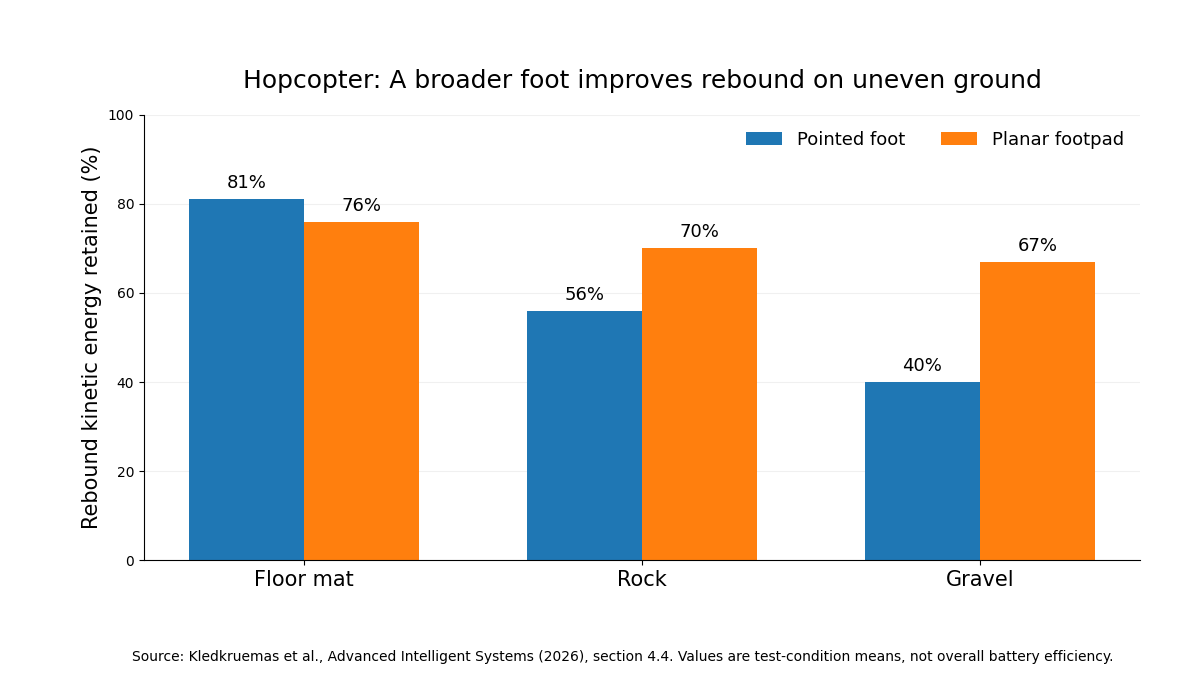
Measured rebound-energy retention on gravel rose from 40% with the pointed foot to 67% with the planar footpad, a 27-percentage-point gain. On rock, it rose from 56% to 70%. On a flat test mat, however, retention slipped from 81% to 76%, indicating a trade-off from the heavier foot. These figures represent takeoff kinetic energy divided by landing kinetic energy, not total battery efficiency.
The study also tested repeated travel along a 1.7-metre mixed-terrain route. The pointed foot failed all three trials; the planar foot completed three of five; and the spined design completed all three of its trials. Those unequal sample counts and controlled conditions do not establish a universal success rate.
What the Robot Can—and Cannot—Do
Hopcopter demonstration video embedded in the University of Toronto’s research announcement. It documents prototype behavior, not commercial deployment.
For context, wirelessly powered drones pursue longer operation through energy supply, while robot dogs use multiple legs to negotiate obstacles. Hopcopter instead combines flight control with a single elastic leg. The distinction matters for remote pipelines, mining sites and disaster zones where terrain can defeat wheels.
The research remains experimental. Outdoor demonstrations were pilot-controlled, not autonomous search-and-rescue deployments, and the team plans to develop autonomous navigation. As robotics software platforms and motion safety systems mature, the useful next test is whether the redesigned foot survives repeated unsupervised hopping on wet, shifting or unpredictable ground.
BitcoinVersus.Tech
BitcoinVersus.Tech Editor’s Note: We volunteer daily to ensure the credibility of the information on this platform is Verifiably True. If you would like to support our work and help further secure the integrity of our research initiatives, please scan the QR code below to donate 5,000 sats. For best results, scan the QR code from a laptop or larger screen.

Bitcoin address: 3C9o19EH5HSiwEPyCTmEKzxhNCbo2X6TTb. On a phone, open the QR image on another screen or copy and verify the address in your wallet before sending.
BitcoinVersus.tech is not a financial advisor. This media platform reports on financial subjects purely for informational purposes.


Leave a Reply