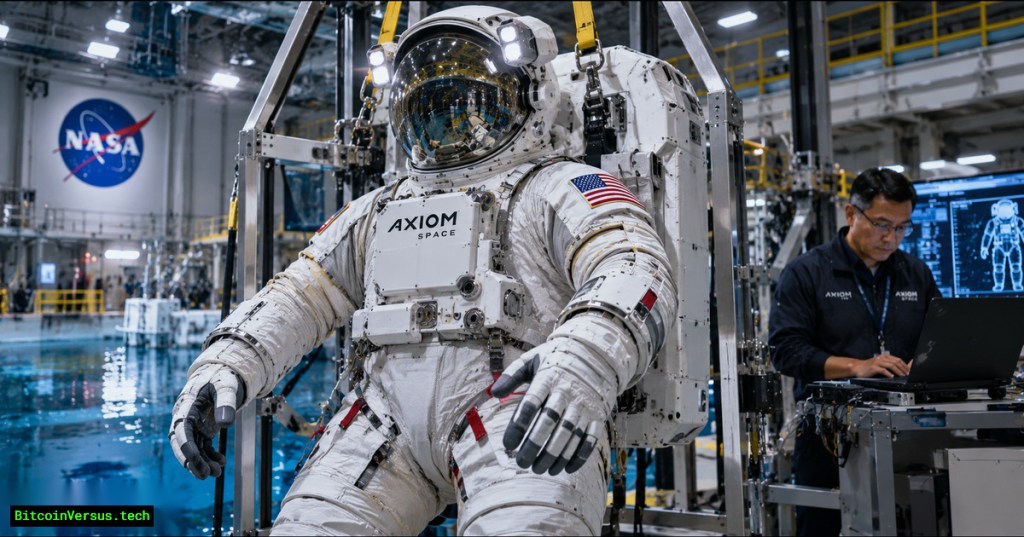
Axiom Space announced on November 13, 2026, that it had completed the Critical Design Review for its Axiom Extravehicular Mobility Unit (AxEMU), advancing NASA’s next-generation spacesuit toward fabrication and qualification testing. The milestone verifies that the engineering evidence is mature enough to proceed, but it is not flight certification or proof that the suit has completed a mission in space.
AxEMU is being developed to replace aging approaches to astronaut spacewalks and to support eventual lunar surface work. During the review, Axiom’s component teams submitted engineering drawings, structural calculations and data from tested prototypes. Integrated analyses also examined whole-suit mass properties and pressure drops through its supporting systems, according to the company.
NASA Johnson’s official March 24, 2026 AxEMU testing footage shows astronauts practicing underwater and simulated lunar-gravity tasks. Archival testing, not the November 13 design-review meeting. Credit: NASA Johnson / YouTube.
Engineering review is not flight certification
The work now shifts toward assembling the pressure garment and portable life-support system, with Axiom targeting early 2027 for those activities. Qualification testing must still cover thermal-vacuum conditions, vibration, performance and repeated operation before NASA can accept the suit for flight.
The program carries two related configurations. The base AxEMU is being prepared for an International Space Station demonstration. A separate AxEMU-S1 “Sortie” variation is intended for shorter lunar excursions during early Artemis missions. Axiom says the designs share components, suppliers and testing infrastructure rather than requiring entirely independent development programs.

Mobility, communication and remaining technical challenges
Spacesuit mobility matters because lunar astronauts cannot rely on the relatively simple movements of Apollo-era equipment. Kneeling, climbing and handling geology tools demand flexible joints while maintaining suit pressure. NASA and Axiom already conducted underwater and reduced-gravity simulations with astronauts. The agency’s recent ISS spacewalk coverage illustrates the continuing operational importance of dependable extravehicular equipment.
Communications are also critical. Improved sensors and suit-to-ground connections could support live imagery and telemetry while crews collect samples. Axiom’s collaboration on lunar 4G/LTE communications demonstrates the ambition, though a terrestrial-style network has not been proven to operate reliably across a deployed lunar surface crew system.
Axiom Space’s January 22, 2026 mobility demonstration introduces AxEMU suit features and intended Artemis use. Original manufacturer video, recorded before the November design-review closure. Credit: Axiom Space / YouTube.
NASA’s schedule risk remains
The schedule remains the principal risk. NASA’s Office of Inspector General reported in April 2026 that spacesuit demonstrations were already at least 18 months behind original plans, with Axiom the only active provider under the agency’s next-generation spacesuit services arrangement. The November design-review closure represents progress, not elimination of the remaining integration and certification risks.
The inspector general also highlighted limited schedule margin and the potential effects of failed qualifications. Engineers must validate material durability, human fit, thermal protection, pressure systems and compatibility with spacecraft airlocks. A design review cannot substitute for hardware surviving those conditions repeatedly.
Axiom’s future station business adds an industrial context. The company is pursuing commercial orbital infrastructure alongside spacesuits, while companies such as Redwire provide roll-out solar arrays for planned Axiom Station modules. NASA is also seeking commercial successors to the ISS. None of those projects establishes that an AxEMU demonstration flight is already scheduled and guaranteed.
Next milestones
The lunar timetable should be treated separately from laboratory milestones. NASA’s latest planning targets human exploration of the Moon in 2028, while planned lunar power and communications infrastructure reflects the longer-term goal of sustained surface operations. Suit hardware, landing vehicles and launch readiness all remain independent dependencies.
The key next checkpoints are completion of flight-like assemblies, full qualification tests and the agency’s certification decision. Axiom has cleared an important engineering gate. Astronauts have not yet worn the final certified suit for an operational spacewalk, and completion of the review alone does not settle the Artemis launch calendar.
Sources and methodology: Axiom Space release, November 13, 2026; NASA technical review update; NASA Office of Inspector General report summary, April 2026; NASA Johnson AxEMU training milestone; NASA AxEMU image archive. Program dates distinguish completed reviews from future tests and aspirational schedules.
Editor’s Note: The critical design review represents a design-maturity milestone, not final NASA certification or a guaranteed flight date. April 2026 inspector-general concerns are historical findings; Axiom’s November 13 progress is reported separately. The 1200 × 630 featured image is original conceptual photorealistic artwork of a fictional engineer and a suit, not an authentic photograph of NASA facilities. Its small neon-green Bitcoinversus.tech watermark appears on a solid black tag matching the supplied reference. The in-story archival NASA photograph and two official recordings are labeled with their original dates. Rendering a YouTube iframe does not establish successful playback on all devices.

BitcoinVersus.Tech is volunteer-run and publishes independent technical journalism. An optional 5,000-satoshi donation supports ongoing research. Scan the original QR from a second screen using a compatible Bitcoin wallet; on the same phone, use a wallet that can import a saved QR image when supported. Independently verify recipient 3C9o19EH5HSiwEPyCTmEKzxhNCbo2X6TTb and the 5,000-satoshi amount before sending. Bitcoin transfers are generally irreversible.
We volunteer daily to ensure the information on BitcoinVersus.Tech is Verifiably True. Technical and financial coverage is educational and informational, not personalized engineering, securities, tax or investment advice.


Leave a Reply