NASA is highlighting 302 small-business research projects with combined potential funding of up to $171 million, including lunar batteries, rollable solar arrays, robotic arms and reusable landing-pad technology. The agency’s November 20, 2026 announcement brings together selections made earlier in the year under its Small Business Innovation Research and Small Business Technology Transfer programs, known as SBIR/STTR. The announcement does not mean 302 finished products are headed to the Moon.
The awards target a problem often overshadowed by rockets: long-duration lunar missions require electricity, reliable machinery and surfaces that withstand repeated landings. NASA wants small companies and research institutions to prove practical solutions before large-scale mission integration.
NASA’s official May 26, 2026 Moon Base trailer establishes the broader exploration plan. Archival mission footage, not evidence that all 302 funded projects have flown.
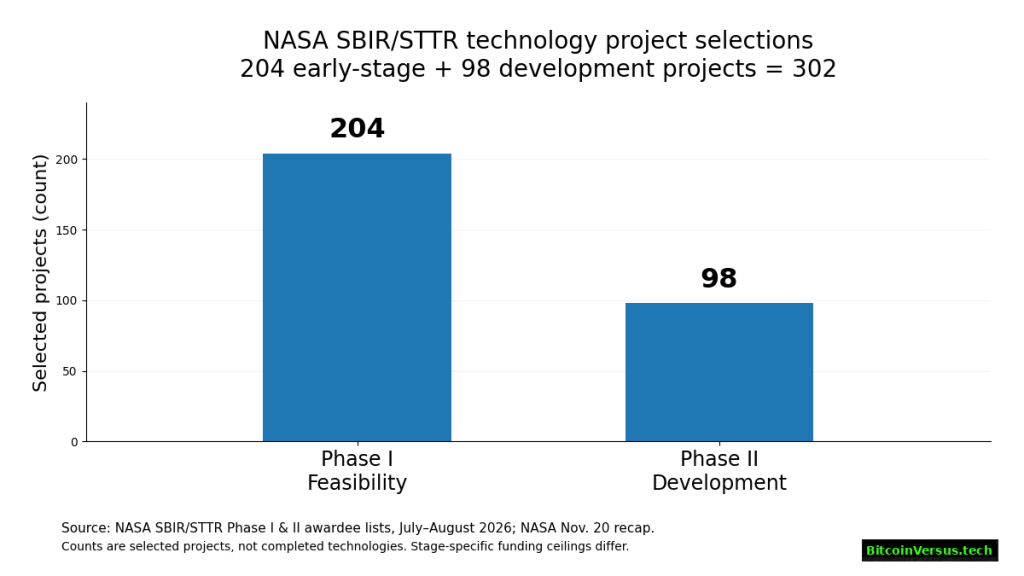
A portfolio of 204 feasibility projects and 98 development awards
NASA’s three August 7 Phase I lists include 51 SBIR Appendix A, 121 SBIR Appendix B and 32 STTR Appendix B selections. Combined, they make 204 Phase I projects. A separate July 21 announcement selected 98 Phase II projects from a previous Phase I cohort. Phase I contracts carry funding up to $225,000 to test feasibility; Phase II contracts can reach approximately $1.3 million for further development and demonstrations. NASA’s $171 million figure is a portfolio ceiling, not documented expenditure.
Four ideas NASA wants to develop
Rollable solar power: Opterus Research and Development received Phase II support to develop modular solar arrays that robots can handle in dusty lunar conditions. NASA describes a design potentially scalable to 50 kilowatts. The figure is a proposed system capacity, not a measured output from a deployed lunar installation. The idea complements the 20-meter lunar solar tower concept previously examined by BitcoinVersus.Tech.
A robotic arm that sees and feels: Intelligent Fiber Optic Systems Corporation received Phase I support for a 10-foot extendable arm combining cameras with tactile, force and temperature sensing. Potential tasks include cleaning solar panels, manipulating equipment and gathering samples. Rugged sensors, autonomous control and dependable positioning remain research challenges.
A colder battery: Elementium Materials is pursuing a battery module designed to operate down to minus 76 degrees Fahrenheit (minus 60 degrees Celsius) without active heating. Lower heater demand could conserve electricity and launch mass, but NASA has not published mission-proven performance or full-cycle efficiency for the selected design. The site previously covered separate solid-state Moon battery research.
NASA’s September 8, 2026 Moon Base progress update describes the mission architecture and technology demonstrations. It predates NASA’s November 20 award recap.
Landing pads built from lunar soil: Slate Geotechnical Consultants and the Colorado School of Mines received STTR Phase I support to evaluate two approaches to preparing regolith for repeat rocket landings. The problem is physical: exhaust plumes can eject abrasive dust and debris, dig craters and threaten nearby spacecraft. Researchers will also study robotic maintenance rather than assume any construction method is already flight-certified.
Why awards do not guarantee lunar deployment
Feasibility research is only the first test. Every concept must clear relevant engineering hurdles, including dust, thermal cycling, radiation exposure, service life and useful power output. A 50-kW target cannot be treated as a working solar farm; likewise, a cold-tolerant battery rating is not proof of a system capable of supplying power throughout a lunar night.
NASA’s selections fit into a wider infrastructure program that includes its commercial Moon delivery framework, prospective 5G and Wi-Fi 6 lunar networking and robotic systems designed for surface hazards and ice surveys. The key next proof points are completed prototypes, repeatable environmental tests and contracts to integrate selected devices into real missions.
Sources and verification
- NASA, November 20, 2026: 302-project portfolio and four technology examples
- NASA Phase I award selections, August 7, 2026
- NASA Phase II selection of 98 projects, July 21, 2026
- NASA lunar surface technology overview
- NASA official Moon Base trailer and NASA six-month progress update
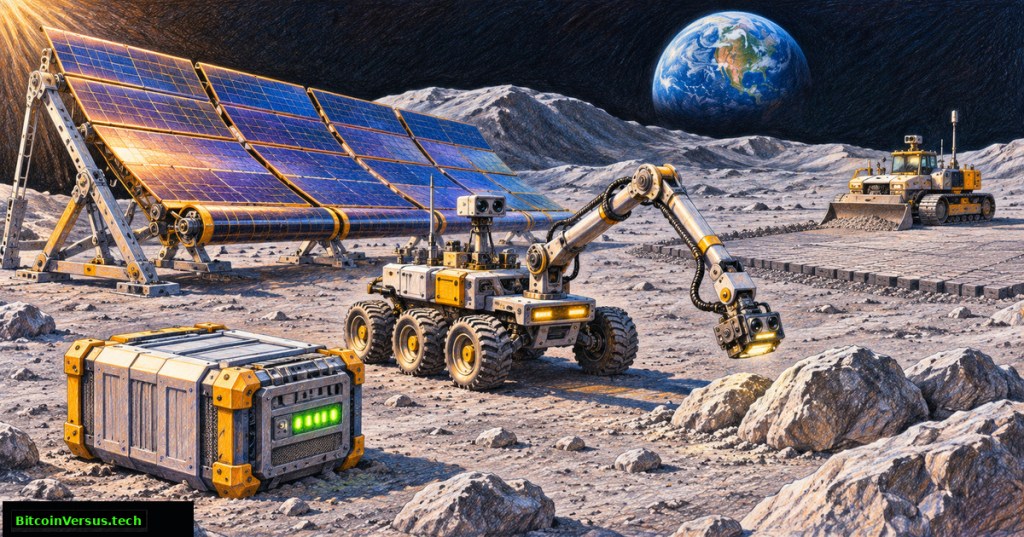
Editorial verification: Selections, award ceilings and project descriptions are sourced to NASA. Research designs are not characterized as deployed hardware. The featured cover is a colored-pencil editorial concept, not a photograph of operating Moon infrastructure. The two embedded NASA videos offer broader mission context and predate the November recap.
Editor’s Note: We volunteer daily to ensure the credibility of the information on this platform is Verifiably True. If you would like to support to help further secure the integrity of our research initiatives, please scan the QR code below

For mobile scanning, open the article on another display and scan the QR code with a Bitcoin wallet. The voluntary donation amount is 5,000 sats. Verify the receiving address 3C9o19EH5HSiwEPyCTmEKzxhNCbo2X6TTb before sending.
BitcoinVersus.Tech publishes technology and financial journalism for informational purposes and does not provide financial, investment, or legal advice.


Leave a Reply