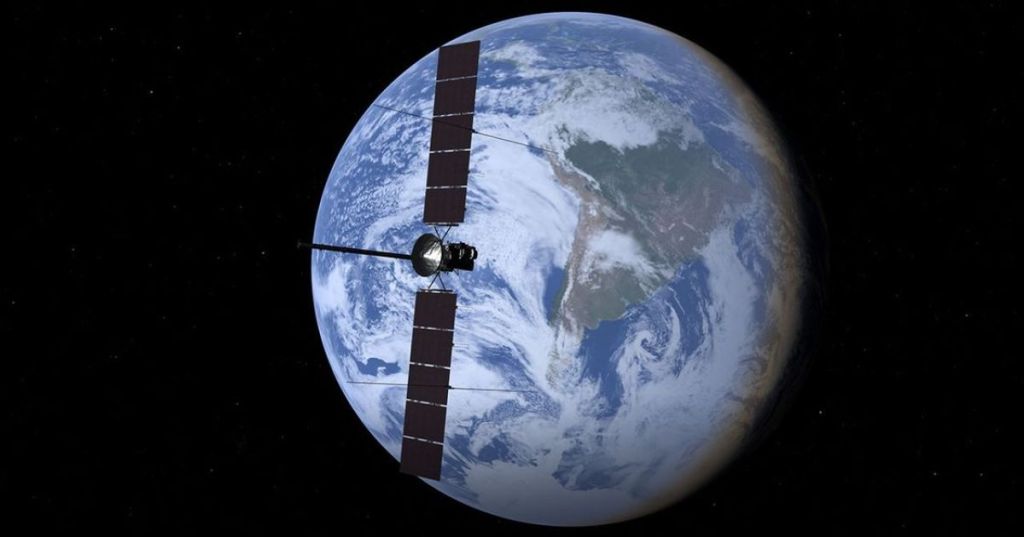
NASA’s Europa Clipper spacecraft is scheduled to return briefly to Earth’s vicinity on December 3, 2026, before continuing toward Jupiter. The agency’s November 25 mission update places its predicted closest approach at 3:14 p.m. Eastern Standard Time, west of Africa, with an altitude range of approximately 3,140–3,450 kilometers. The encounter will change the spacecraft’s trajectory while giving engineers a chance to calibrate all nine scientific instruments. The maneuver has not yet occurred.
How planetary motion redirects a spacecraft
A gravity assist exploits the motion of a planet around the Sun. In an idealized unpowered encounter, an approaching spacecraft accelerates toward a planet and decelerates as it departs. Its incoming and outgoing speeds can be approximately equal relative to that planet, but the directions differ. Because the planet itself travels around the Sun, changing the direction of the spacecraft’s planet-relative velocity can change its heliocentric speed and orbital energy. The planetary orbit undergoes a corresponding, practically imperceptible change. Mission designers use numerical trajectory models to account for the gravitational influence of other bodies and the spacecraft’s actual navigation state.
The mission already used Mars in March 2025 to reshape its solar orbit. The December encounter is designed to provide the final planetary gravity assist during the cruise to Jupiter. Navigation teams must establish the appropriate approach geometry to obtain the desired outgoing trajectory. Related techniques appear in our coverage of ESCAPADE’s powered Earth flybys and BepiColombo’s Mercury arrival.
Turning Earth into a calibration target
The spacecraft’s magnetometer will observe Earth’s magnetic environment, where existing measurements provide reference information for calibration. At Europa, the instrument will investigate magnetic responses associated with the suspected conducting ocean. Its thermal imaging system will also observe Earth during approach. Measuring infrared radiation can reveal temperature differences, a principle related to Hera’s thermal imaging of asteroids. An ultraviolet spectrograph will participate in coordinated observations with NASA’s Lunar Reconnaissance Orbiter to investigate hydrogen surrounding Earth.
The mission overview describes an orbiter spanning roughly 30 meters with its solar arrays extended. A sequence of 49 planned encounters with Europa will allow investigators to examine the ice, surface chemistry and interior while the spacecraft follows an orbit around Jupiter rather than remaining continuously beside the moon. Communications and spacecraft operations must accommodate long distances, as illustrated by ESA’s deep-space antenna infrastructure.
A mission decades in the making
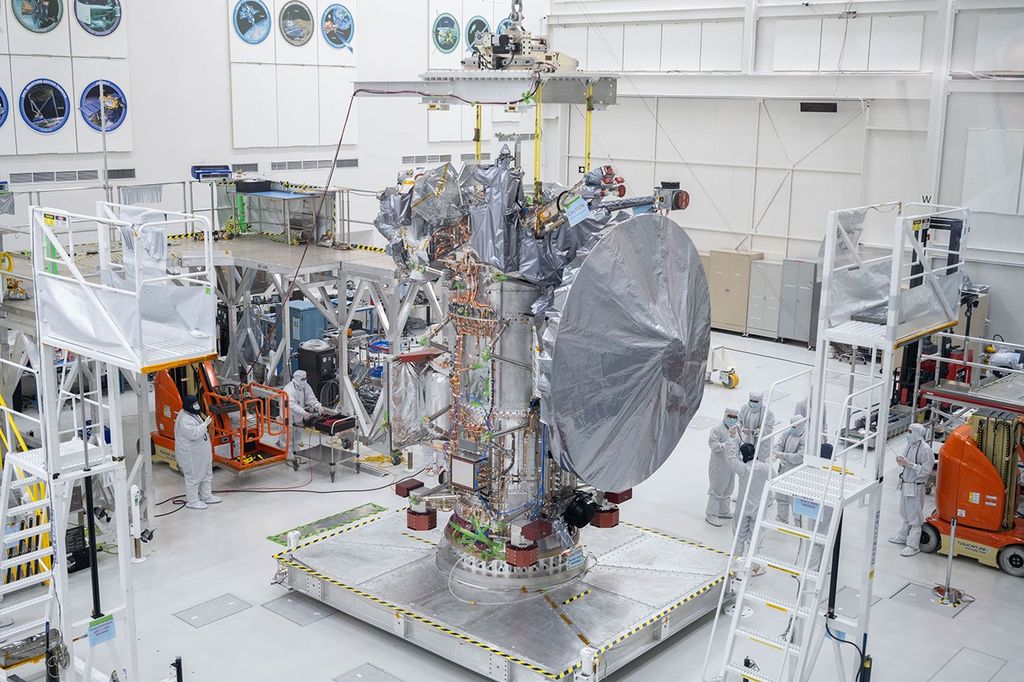
NASA also released The Europa Concept on November 23, documenting the engineering work preceding the October 2024 launch. The documentary provides context for the radiation tolerance, instrument integration and mission planning required for the expedition. Jupiter arrival is targeted for April 2030. Europa Clipper seeks evidence about environments that could support life; it is not designed to establish directly whether organisms inhabit the moon.
We volunteer daily to ensure the credibility of the information on this platform is Verifiably True. If you would like to support to help further secure the integrity of our research initiative, please scan the QR code below.

BitcoinVersus.tech is not a financial advisor. This media platform reports on financial subjects purely for informational purposes.


Leave a Reply