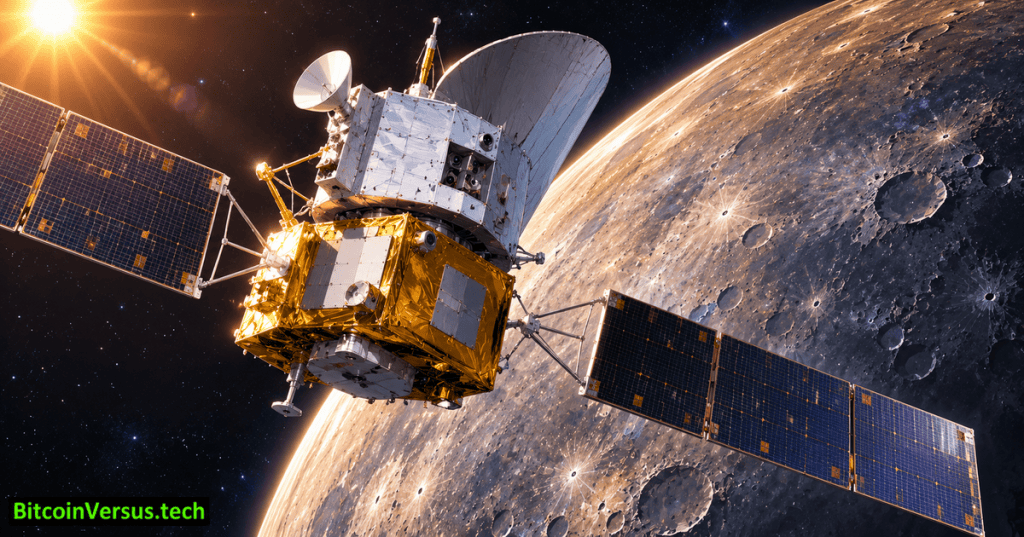
A spacecraft traveling for eight years reached Mercury despite an onboard software failure during its critical braking maneuver. The European Space Agency confirmed on November 23, 2026 that BepiColombo entered a stable orbit on November 21, achieving approximately 77% of the intended velocity change. Mission controllers have revised the remaining maneuvers without requiring additional engine burns.
ESA’s compilation of onboard monitoring-camera footage from BepiColombo’s eight-year journey, released before orbital arrival. Watch directly on YouTube.
A software failure during autonomous braking
The spacecraft needed to rotate into its braking orientation, temporarily interrupting radio contact with Earth. Its four axial chemical thrusters began firing roughly 635 kilometers above Mercury, with a planned burn lasting 37 minutes. When communications resumed, engineers discovered that the spacecraft had entered a protective operating mode and stopped the maneuver early.
ESA traced the anomaly to software involving orientation guidance and thruster control. Safe mode suspends nonessential operations to protect spacecraft hardware when flight conditions become unexpected. It does not, by itself, confirm that the intended orbital trajectory has been achieved. Flight dynamics specialists therefore reconstructed the trajectory using tracking measurements.
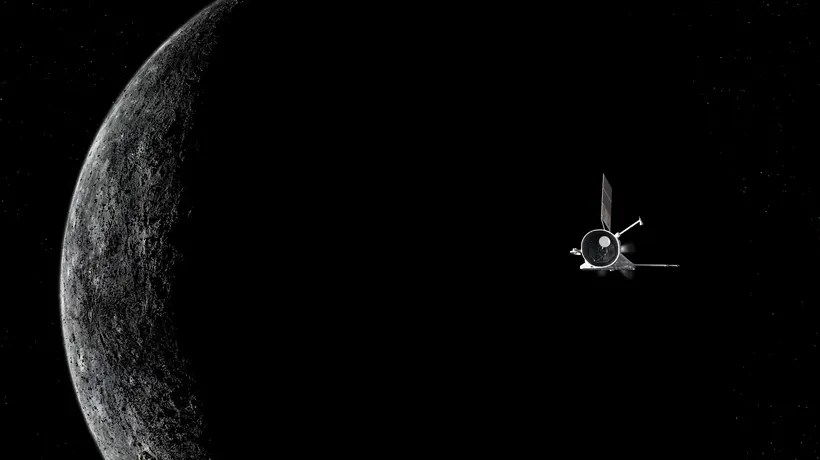
Why a 75-hour orbit was recoverable
The achieved orbital period was 75 hours rather than the targeted 58 hours, approximately 29% longer. A longer orbital period generally corresponds to a larger semimajor axis around the same planet. In a simplified two-body model, Kepler’s third law gives a semimajor-axis ratio of (75/58) raised to the two-thirds power, or about 1.19. That comparison does not specify the actual shape or altitude of the new orbit.
BepiColombo approached Mercury slowly after repeated gravity assists and solar electric propulsion. Its trajectory exploited weak gravitational capture, initially making it easier for the spacecraft to remain near Mercury. Chemical braking was still necessary to establish a durable orbit. Our earlier arrival preview covered the planned sequence before the anomaly occurred.
ESA Director General Josef Aschbacher’s November 24 recovery update, linked by Live Science. Original X post.
A series of shorter burns near the point of closest approach allows trajectory corrections to be recalculated after each maneuver. The resulting flexibility helped engineers preserve the original mission objectives even when the initial braking operation delivered less velocity change than expected. The approach complements research into electric spacecraft propulsion and dependable deep-space communications.
ESA’s September 2026 explanation of the arrival sequence, recorded before the actual braking anomaly. Watch directly on YouTube.
Two spacecraft, two scientific perspectives
The European Mercury Planetary Orbiter and Japanese Mercury Magnetospheric Orbiter, called Mio, remain attached for now. ESA’s arrival timeline retains their December 9–10 separation, with the European orbiter targeting its science trajectory in March 2027 and science operations the following month.
The European spacecraft will investigate Mercury’s surface and interior, while Mio examines the magnetic environment. Instruments include the Mercury Imaging X-ray Spectrometer, which recently demonstrated astronomical calibration capability. The orbital recovery demonstrates the value of designing a mission around measured outcomes rather than assuming every command executes perfectly. The future separation and science operations remain milestones to be achieved.
We volunteer daily to ensure the credibility of the information on this platform is Verifiably True. If you would like to support to help further secure the integrity of our research initiative, please scan the QR code below.



Leave a Reply