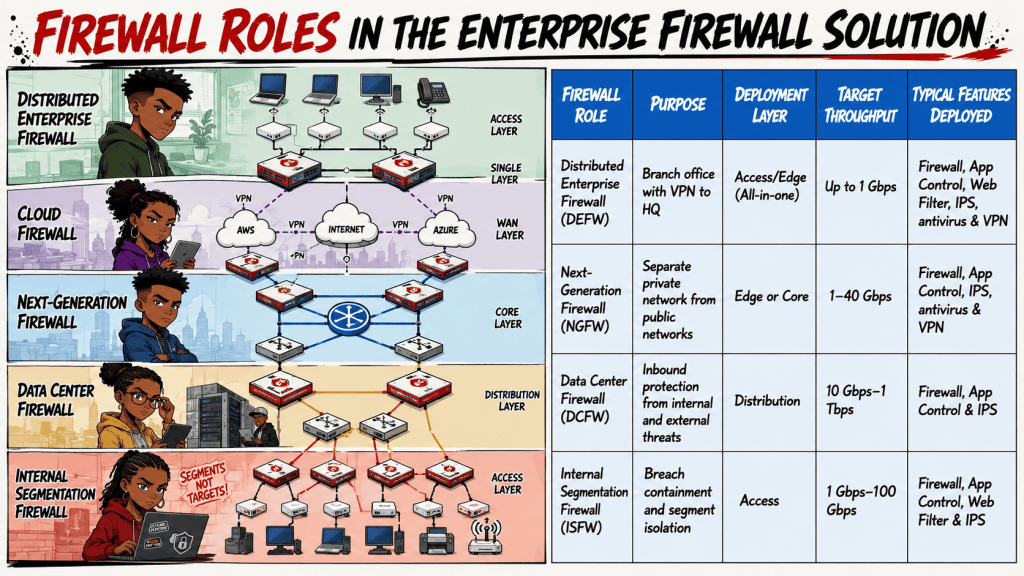
Enterprise firewall architecture uses multiple firewall roles to protect traffic at different points across a network rather than relying on a single security appliance at the perimeter.
Distributed enterprise firewalls, next-generation firewalls, data center firewalls, cloud firewalls, and internal segmentation firewalls can each serve a different purpose depending on where traffic originates, where it is headed, and how sensitive the connected systems are.
Together, these security layers help network architects control access between branch offices, cloud infrastructure, internal users, data centers, VPN connections, and public networks.
A next-generation firewall (NGFW) is commonly positioned at the network edge or core, where it can inspect traffic moving between private infrastructure and external networks.
Data center firewalls focus on protecting high-value servers, applications, and workloads, while internal segmentation firewalls (ISFWs) create additional security boundaries inside the organization.
Segmentation is especially important because a device that gains access to one part of the network should not automatically receive unrestricted access to every other subnet, department, application, or server environment. Firewall rules, application control, intrusion prevention, web filtering, authentication, and VPN policies can all contribute to controlling these traffic flows.
Modern firewall deployment is therefore an important part of overall enterprise network architecture. Firewalls can operate across access, edge, WAN, core, distribution, cloud, and data center layers, allowing security policy to follow the structure of the network itself.
This layered approach improves visibility into north-south and east-west traffic while helping contain compromised systems and enforce least-privilege access. As enterprise environments become increasingly distributed across offices, remote users, cloud services, wireless networks, and data centers, choosing the correct firewall role for each architectural layer becomes a fundamental network engineering and cybersecurity decision.
BitcoinVersus.Tech Editor’s Note:
We volunteer daily to ensure the credibility of the information on this platform is Verifiably True. If you would like to support to help further secure the integrity of our research initiatives, please donate here: 3C9o19EH5HSiwEPyCTmEKzxhNCbo2X6TTb
BitcoinVersus.tech is not a financial advisor. This media platform reports on financial subjects purely for informational purposes.


Leave a Reply