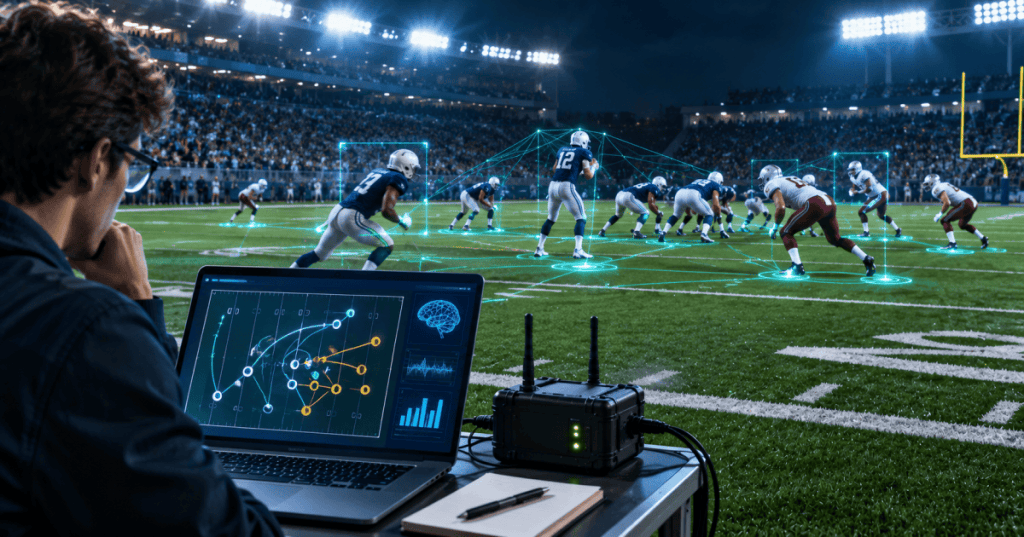
Carnegie Mellon University announced November 5, 2026 that its researchers are using NFL game film and player-tracking data to train artificial-intelligence systems capable of interpreting American football. The project, backed by the league’s NFL Forward Initiative, is exploring whether foundation models can recognize plays, automate video annotation and eventually predict tactical decisions. Predictive coaching performance has not yet been demonstrated.
The work brings together Chenyan Xiong, an associate professor at CMU’s Language Technologies Institute, and Ron Yurko, director of the Carnegie Mellon Sports Analytics Center. The NFL supplied official game footage and several terabytes of tracking information. Rather than announcing a completed play-calling system, the university describes two early pretrained models: one trained on video and another on location data. Combining the two remains a subsequent research step.
Amazon Web Services, “Going Deep: AWS + NFL Next Gen Stats — How AWS Captures Every Play” (February 2026). The official technical explainer predates CMU’s November research announcement.
How football becomes machine-readable data
The NFL’s Next Gen Stats system uses RFID sensors in shoulder pads, equipment and footballs to generate location information. Combining positions with broadcast or coaching video could help an AI model associate a route, defensive alignment or coverage change with what actually happened on the field. The sensor streams supply structured movement data; film supplies visual context.
Earlier BitcoinVersus.Tech reporting explained how NFL games function as real-time data pipelines and existing AI recognition of run schemes and blocking assignments. The newly announced CMU project differs by targeting broader football understanding across two data modalities, potentially helping an analyst search for formations or retrieve comparable historical plays without manually tagging every frame.
What the two research models can—and cannot—do
The initial systems separately learn from film and on-field player tracking. Xiong described more ambitious questions for future work, including whether a model could anticipate a blitz, recognize a safety rotation or simulate the likely outcome of a proposed play call. CMU has not supplied public benchmark accuracy, a validated win-probability improvement, a released model, or evidence that an NFL coach is using the research during games.
Those limits matter because predicting the next defensive call is not equivalent to identifying an already completed play. A retrospective model may have access to movement that a coach could not know before the snap. Proper evaluation would require time-separated training and test data, a clear pre-snap cutoff, and comparisons against meaningful baselines. Errors or gaps in player identification, video synchronization and RFID coverage could also change predictions.
AWS Events, “Deep Dive: AWS + NFL Next Gen Stats” (January 2026). The presentation discusses cloud processing and machine-learning pipelines underlying tracking analytics; it is background, not footage of a finished CMU play predictor.
The potential payoff for coaches and fans
The immediate target is the labor-intensive process of reviewing hours of footage, grouping similar plays and attaching meaningful football labels. Successful automation could help scouts and analysts spend less time on repetitive tagging. Future consumer applications might allow fans to ask which teams used comparable concepts, but CMU has not announced a public application or release date.
Yurko previously contributed research to the NFL IQ chatbot used around the 2026 draft. More broadly, AI-assisted race-control analysis and volumetric basketball streaming show other ways sports organizations work with complex streams of sensor and video data. Neither project validates Carnegie Mellon’s proposed football predictions.
League data access is another distinction. CMU says its team received authorized NFL footage and tracking records; that does not mean the entire dataset or trained models are available for unrestricted public use. Independent assessments of accuracy, privacy controls, access rights and deployment costs would be needed before claiming a reliable production tool.
The next measurable milestone is a model combining both input sources, followed by published evaluation results. Until then, the research represents a potentially useful foundation for sports analytics, not an AI system that has already learned to outcoach NFL staff.
Editor’s Note: Carnegie Mellon University’s November 5 announcement is the primary source. The NFL data partnership, research team and two pretrained components are attributed to CMU. Predictive accuracy, live coaching deployment and any release schedule remain unverified. The featured cover is original conceptual artwork, not a photograph of the actual research team. Both AWS videos predate the new announcement.

For mobile scanning, open the article on another display and scan the original QR code with a compatible Bitcoin wallet. Verify the destination before donating 5,000 sats: 3C9o19EH5HSiwEPyCTmEKzxhNCbo2X6TTb.
We volunteer daily to ensure the credibility of the information on this platform is Verifiably True. If you would like to support our work and help further secure the integrity of our research initiatives, please scan the QR code below to donate 5,000 sats.
BitcoinVersus.tech is not a financial advisor. This media platform reports on financial subjects purely for informational purposes.


Leave a Reply