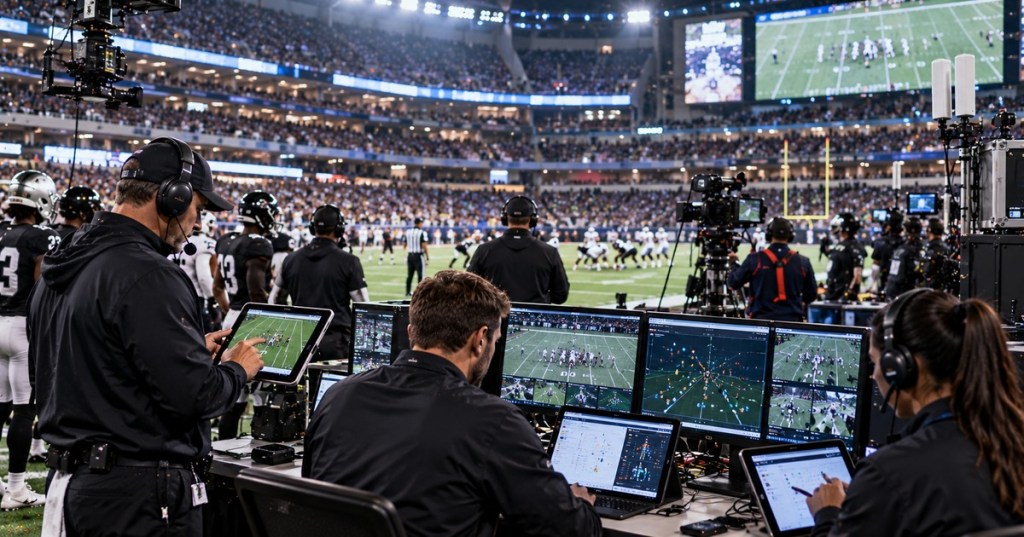
Every NFL game now runs on a technology stack that looks less like traditional football operations and more like a distributed real-time data center. Players carry tracking tags. Stadiums contain dedicated wireless receivers. AWS machine-learning models process movement data in near real time. Sony Hawk-Eye supports replay and line-to-gain measurement. Verizon runs private coach-to-coach communications. Microsoft provides hardened sideline computers and analytics tools.
The result is a sport where a single snap can generate hundreds of new data points before the next play begins.
Every player is a moving data source
NFL Football Operations says every venue uses a tracking system containing roughly 20 to 30 ultra-wideband receivers and 2 to 3 RFID tags inside each player’s shoulder pads.
Tags are also placed on officials, pylons, sticks, chains, and inside the football. The NFL estimates that about 250 tracking devices can be active in one venue during a game.
The system captures player location, speed, distance traveled, acceleration, direction, and other movement information 10 times per second, with location measured within inches.
That is the raw material behind Next Gen Stats.
The stadium is the edge-computing layer
The first step is local collection. Tracking receivers around the field capture the RFID/UWB signals coming from players, officials, equipment, and the ball.
This is effectively edge computing: collect the time-sensitive data close to where the event happens, clean and organize it, then feed it into larger analytics systems.
That same design appears in factories, SCADA networks, autonomous vehicles, telecom systems, and the Formula 1 infrastructure we recently covered in Formula 1 Shrinks Its Traveling Data Center to One Rack.
AWS turns movement into football intelligence
The NFL says Next Gen Stats runs on Amazon Web Services infrastructure. AWS says the league now transforms more than 500 million data points per season into insights for teams, broadcasters, players, and fans.
AWS says 75 machine-learning models process NFL data in under a second across the wider Next Gen Stats environment.
Those models help create metrics such as completion probability, expected rushing yards, coverage recognition, tackle probability, pass-rush pressure, and route classification.
The 2026 NFL season goes deeper into AI
For 2026, the NFL and AWS expanded their run-game analysis. The Next Gen Stats team says it worked with AWS Professional Services on transformer-based models that identify run concepts and individual blocking matchups.
That is a significant jump from simply measuring a running back’s speed. The system is increasingly trying to infer football structure: who was responsible for which block, what concept the offense ran, and which matchup created the lane.
In other words, the league is moving from tracking where players went toward modeling why the play worked.
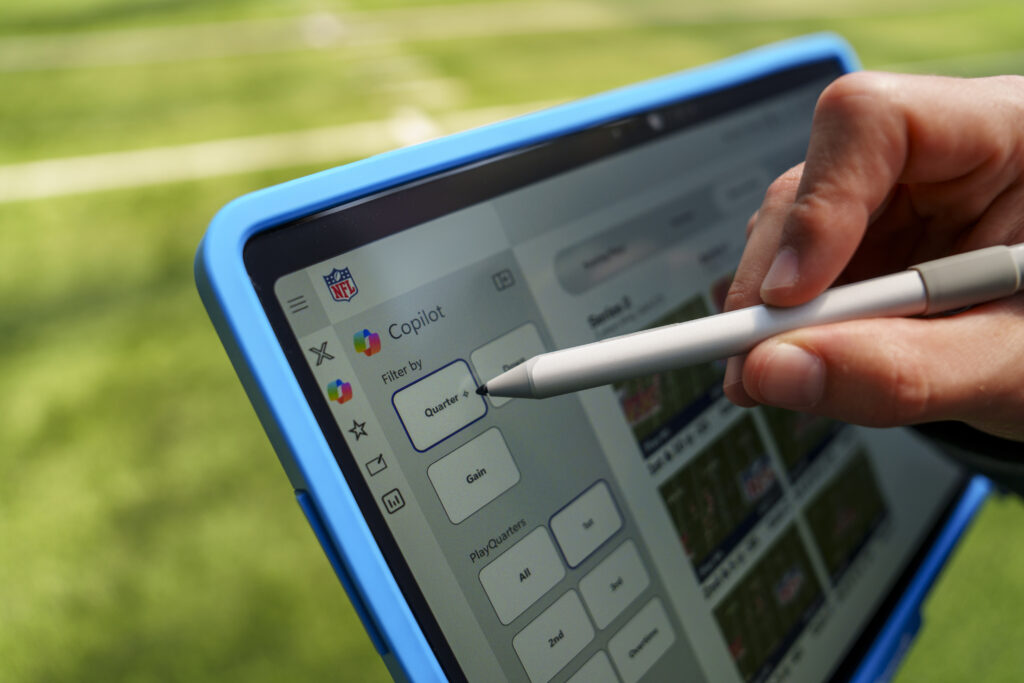
The sideline now runs on 2,500+ AI PCs
Microsoft’s sideline system has also changed dramatically.
Starting in 2025, the league upgraded sidelines and coaches’ booths to more than 2,500 Surface Copilot+ PCs across all 32 clubs. Microsoft says the deployment supports roughly 1,800 players and more than 1,000 coaches and football staff.
The Sideline Viewing System lets teams receive high-resolution game images, zoom, annotate, tag plays, and quickly revisit earlier sequences. New AI-powered filtering can narrow plays by criteria such as penalties, scoring plays, turnovers, down, and distance.
The devices are not ordinary open laptops. NFL Football Operations says they are identically configured, locked down, unable to access the public internet, and cannot install software that might give one club a competitive advantage.
The sideline network has hardwired fallback
Microsoft and the NFL designed the sideline environment around failure tolerance.
Charging carts provide power and hardwired Ethernet connectivity so the Sideline Viewing System can continue operating if Wi-Fi fails. The devices are also built to survive rain, cold, heat, glare, drops, and a full game on battery.
This is where sports technology starts to look familiar to data-center and network technicians: redundancy, wired fallback, device hardening, access control, patching, standardized configurations, and strict change management.
Our older 2024 network-topology guide and 2025 network-port overview cover the same underlying networking principles at a more general level.
Coaches talk over a private wireless network
The NFL also uses a dedicated coach-to-coach communications network rather than relying on normal stadium Wi-Fi or consumer cellular service.
Verizon says it deployed Managed Private Wireless for coach communications across all 30 NFL stadiums. The private system is designed to reduce interference, improve security, and maintain low-latency headset communications even in RF-heavy stadium environments.
Sony’s new NFL coach headsets connect into that Verizon system through a belt pack. The headsets were engineered for stadium noise exceeding 100 decibels and tested for rain, sleet, snow, heat, cold, and physical drops.
Frequency coordination is a hidden engineering job
One NFL game can contain television wireless systems, stadium Wi-Fi, coach communications, officiating radios, microphones, cameras, team equipment, security radios, and other RF devices operating in the same physical space.
NFL Event Frequency Coordinators manage those systems so one device does not accidentally interfere with another. The league maintains information on frequencies, power levels, venue systems, broadcast requirements, and game operations before kickoff.
That is RF engineering—not just sports operations.
Sony Hawk-Eye is becoming part of officiating infrastructure
Sony’s Hawk-Eye SMART system has supported NFL replay since the 2021 season, giving stadium replay officials and the league’s Art McNally GameDay Central operation synchronized access to multiple camera angles.
The NFL has also expanded Hawk-Eye optical tracking into virtual line-to-gain measurement. Rather than depending only on the traditional sideline chain crew to measure close first-down situations, the system uses optical tracking and synchronized camera data to calculate the distance digitally.
Replay is centralized in New York
Stadium replay is not isolated to the stadium.
The NFL’s Art McNally GameDay Central facility in New York can monitor multiple games simultaneously. Each replay station can access network camera angles and use Hawk-Eye synchronized replay tools to review the same play from several viewpoints.
This creates a distributed architecture: cameras and officials at the venue, local replay systems, centralized league review, and network connectivity tying the pieces together in real time.
The football itself is instrumented
The ball is no longer just leather, bladder, laces, and air.
Wilson, Zebra Technologies, and the NFL developed football tracking that places RFID technology inside game balls while maintaining league specifications for weight, balance, and flight.
The NFL says quarterbacks, Wilson, and the Competition Committee tested tracking devices specifically to make sure the technology did not alter how the ball flies.
More than 200 new data points can come from one play
NFL Football Operations says Next Gen Stats can create more than 200 new data points on every play.
Those points can describe speed, acceleration, distance, formation, route type, coverage, pressure, rushing expectations, tackle probability, separation, and other aspects of the play.
The practical effect is that a modern NFL play exists in several forms simultaneously:
- the physical play on the field;
- RFID/UWB position data;
- broadcast and replay video;
- coaching still images;
- machine-learning outputs;
- officiating camera data;
- radio communications;
- historical databases and dashboards.
This is why NFL stadiums feel like temporary data centers
The comparison is not perfect, but the engineering overlap is real.
- Compute: local servers, cloud processing, AI models, and analytics.
- Networking: wired Ethernet, stadium Wi-Fi, private wireless, internet backhaul, and centralized league connectivity.
- Storage: tracking data, replay footage, images, statistics, and historical datasets.
- Edge devices: player tags, football tags, tablets, cameras, headsets, pylons, and other connected equipment.
- Redundancy: hardwired fallback, spare devices, centralized replay, and standardized league configurations.
- Security: locked-down devices, controlled applications, private communications, identity controls, and RF coordination.
The easiest way to understand NFL technology
The stadium senses the game. Edge systems collect it. Networks move it. Cloud systems analyze it. Coaches consume it. Broadcast systems visualize it. Officiating systems verify it.
Football is still decided by blocking, tackling, throwing, catching, and coaching. But underneath those human decisions is now a computing infrastructure measuring almost every movement on the field.
Bottom line
The modern NFL is one of the clearest examples of sports becoming an engineering system.
RFID tags and ultra-wideband receivers track the players. AWS turns that stream into machine-learning metrics. Surface Copilot+ PCs deliver game information to coaches. Verizon private wireless carries coach communications. Sony Hawk-Eye supports replay and measurement. Central league systems tie the stadiums back to New York.
Every NFL game is now simultaneously a football game, a wireless network, an edge-computing deployment, a machine-learning pipeline, and a live broadcast data center.
BitcoinVersus.Tech Editor’s Note: Technology availability and implementation can evolve between seasons and venues. NFL tracking, communications, replay, and sideline systems are league-managed environments designed to preserve competitive fairness as well as performance and reliability.
Follow BitcoinVersus.Tech for sports technology, data centers, networking, AI, robotics, semiconductors, and infrastructure engineering.
Support independent technology reporting: Bitcoin donations help fund BitcoinVersus.Tech research and publishing.
Disclaimer: BitcoinVersus.Tech provides technology news and education for informational purposes only.


Leave a Reply