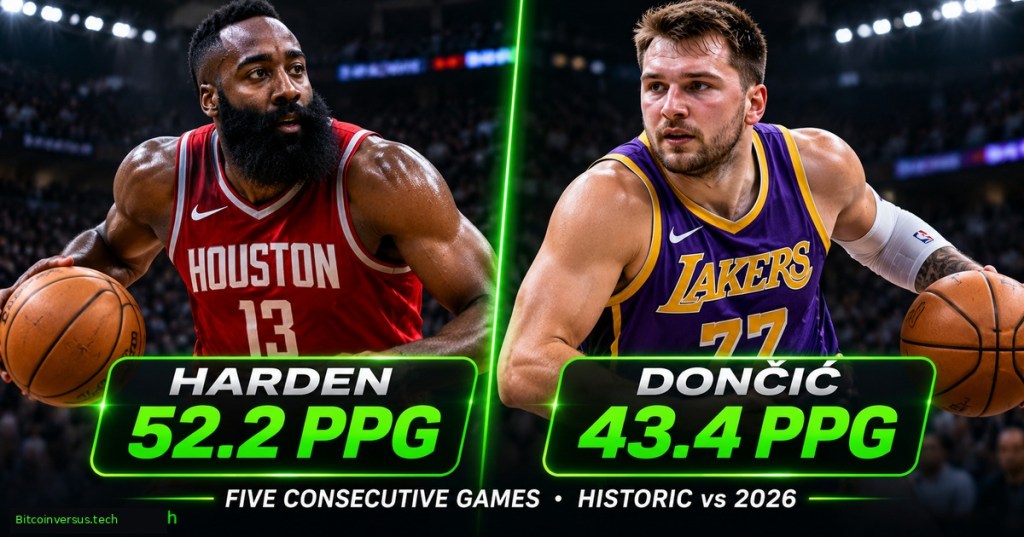
An extraordinary scoring burst can be measured through points, shot attempts and efficiency, but a proper comparison requires the same number of games. A reader-provided X post prompted an independent statistical comparison of James Harden’s Houston peak in January 2019 with Luka Dončić’s recent 2026 Lakers surge. The social post itself could not be accessed for verification; published NBA game logs supply every number below.
Across five consecutive appearances each, Harden averaged 52.2 points from January 14–23, 2019, versus 43.4 points for Dončić from October 30–November 6, 2026. The advantage is 8.8 points per game, or approximately 20.3% relative to Dončić’s average. Those windows do not establish any all-time best-five-game record; they compare two clearly dated scoring peaks.
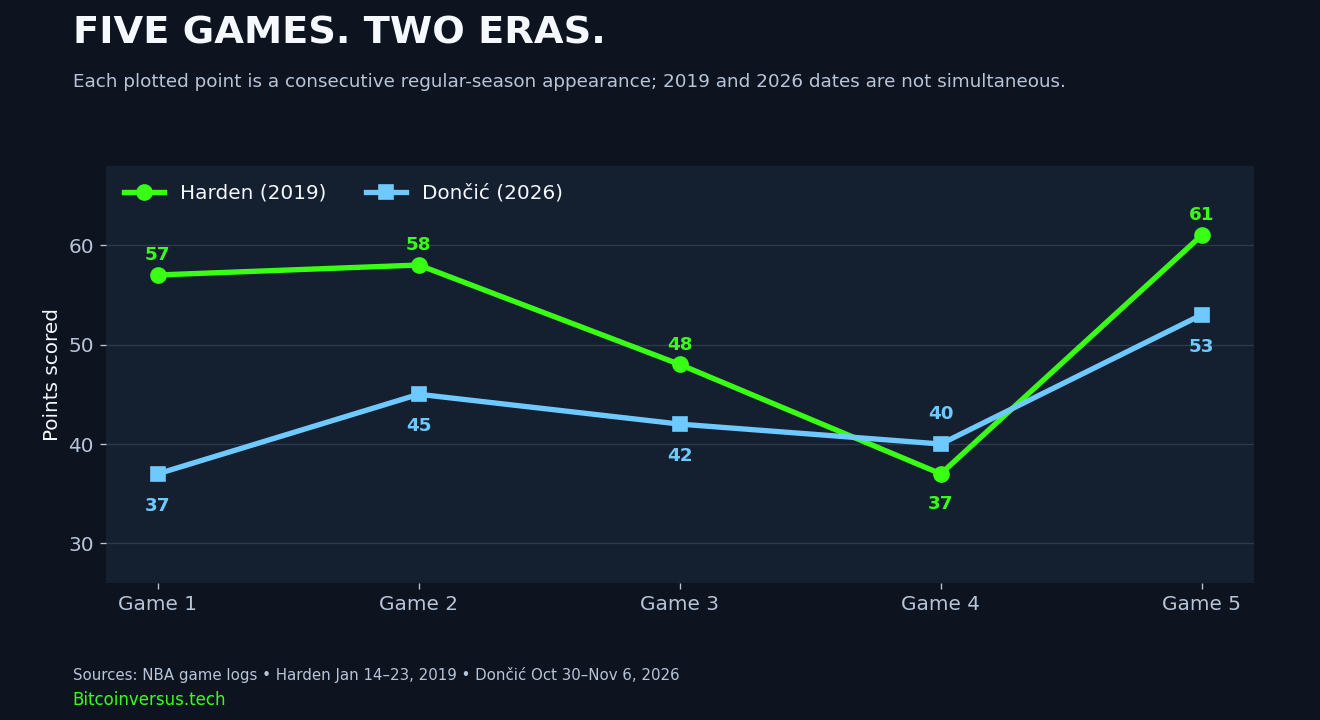
Harden’s 261 points versus Dončić’s 217
Harden scored 57 against Memphis, 58 against Brooklyn, 48 against the Lakers, 37 against Philadelphia and 61 against the Knicks. The five-game sum was 261 points on 76-of-161 field-goal shooting, with 89 free-throw attempts and a 3–2 Houston record. His remarkable January performance occurred inside a much longer 32-game streak with at least 30 points; the NBA reported a 41.1-point average for the full streak. The single-window total and longer streak are different statistics.
James Harden scores 61 against the Knicks on January 23, 2019 — the final game of the historic sample. Official NBA video, January 23, 2019.
Dončić’s latest five performances were 37 at Golden State, 45 against Toronto, 42 against Miami, 40 at Sacramento and 53 against Portland. Those games produced 217 points, 66-of-130 field-goal shooting and a 4–1 Los Angeles record. The NBA’s official November 6 highlights document his 53-point finish. His 2026–27 season average reached 40.1 points through nine appearances, not through a completed season.
Dončić shoots more efficiently
Across the matched samples, Harden shot 47.2% from the field and 34.9% from three. Dončić posted 50.8% and 43.7%, respectively. Estimated true shooting gives Harden 65.2% and Dončić 69.0%, a 3.8-percentage-point Dončić edge. The calculation divides points by twice the sum of field-goal attempts and 0.44 times free-throw attempts; the free-throw factor is a conventional approximation.
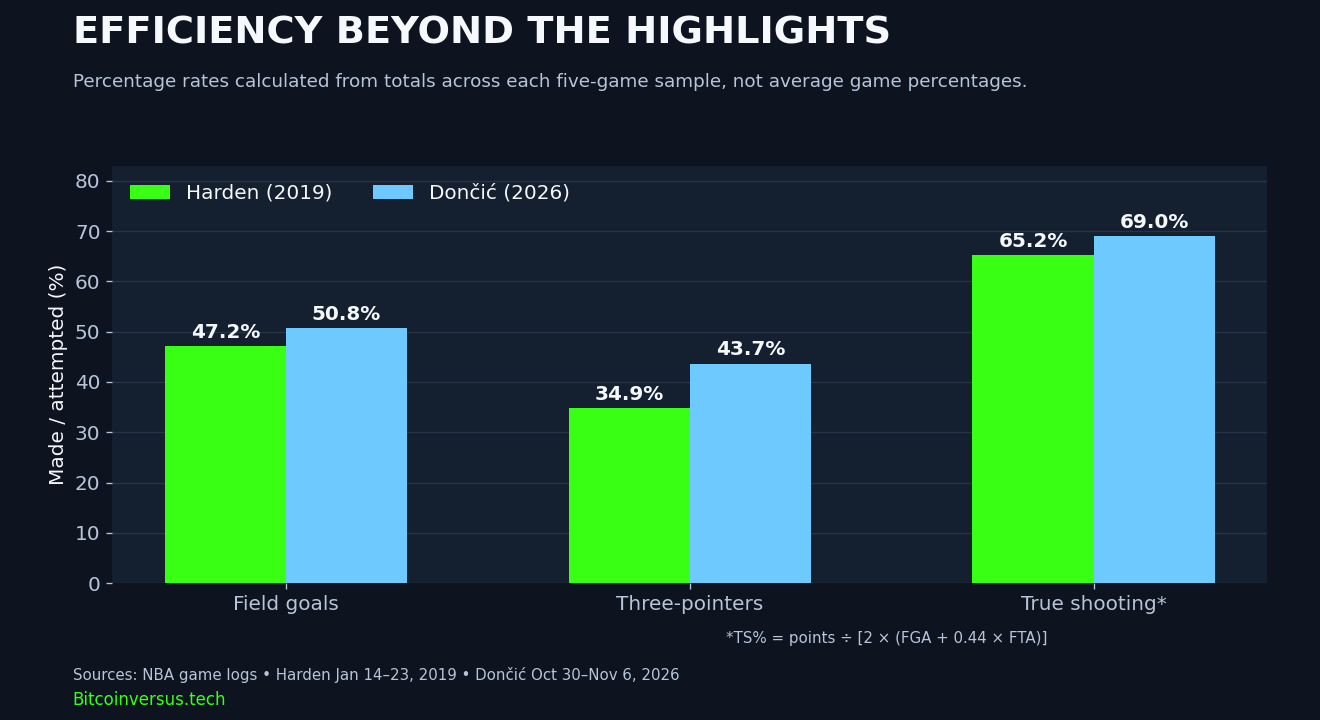
Scoring workload explains the difference. Harden averaged 32.2 field-goal attempts and 17.8 free-throw attempts, versus Dončić’s 26.0 and 12.4. Harden generated far more attempts while making 6.0 threes per game, close to Dončić’s 6.2. The stronger Dončić percentage is meaningful, but it cannot automatically establish superiority against different defenders, schemes and era-wide scoring conditions.
Passing and rebounding separate the styles
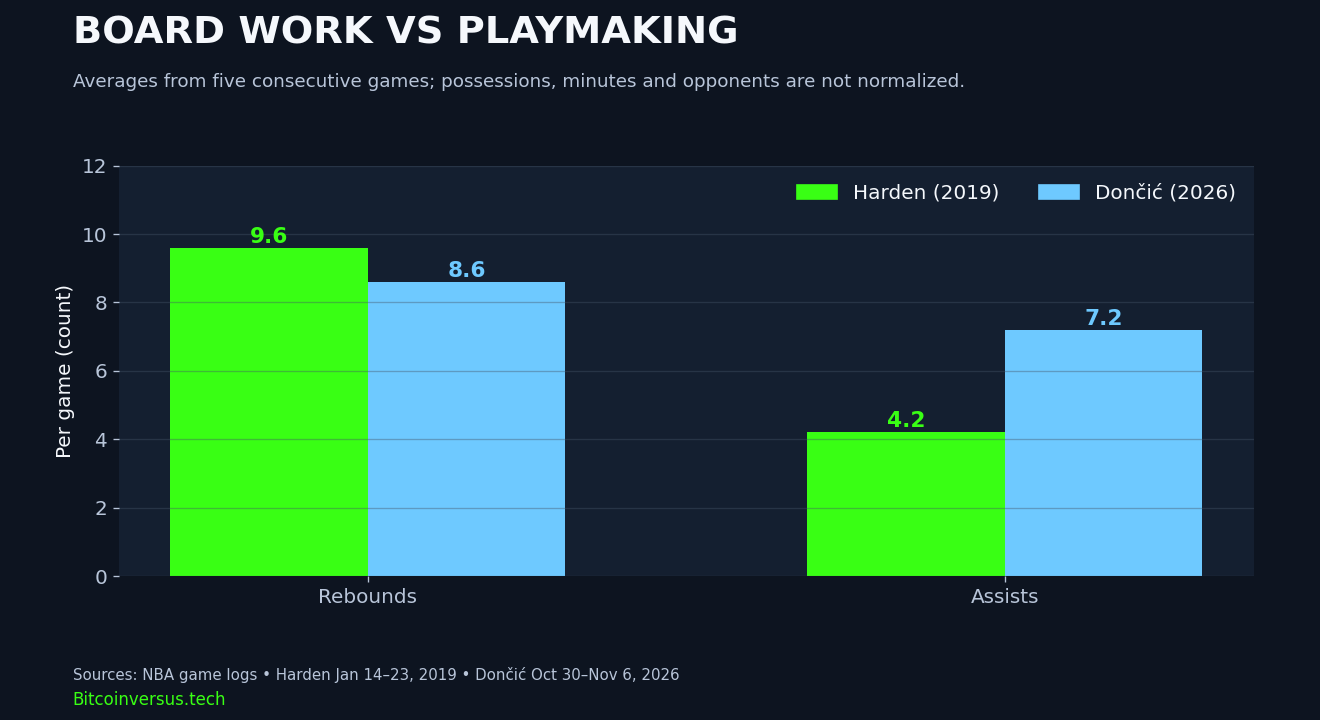
Harden averaged 9.6 rebounds and 4.2 assists; Dončić delivered 8.6 rebounds and 7.2 assists. Harden wins the sampled rebound battle, but Dončić produced three additional assists per game. Assists depend on teammate conversion, and neither figure measures every shot created through gravity, screens or defensive rotations.
Prior Dončić and Wembanyama statistical comparisons assess different strengths, and a separate MVP scouting report considers defensive impact. The historical context also connects with BitcoinVersus.Tech’s 2026 player rankings. Comparing players across years requires more than box-score production: pace, possessions, teammates and opposition all affect outcomes.
Sports-data systems can capture dimensions absent from traditional box scores; earlier reporting on live player-tracking infrastructure illustrates the difference between recorded events and inferred performance value. For the two measured five-game windows, the conclusion is narrower and stronger: Harden carried the bigger scoring burden, while Dončić combined exceptional scoring with better shooting efficiency and more assists.
Statistics and source records: NBA official Dončić game log; NBA November 7 scoring recap; Harden historical game-by-game log; NBA Harden 2018–19 review; NBA official Harden highlights; NBA official Dončić highlights. The X post was not accessible for independent inspection and supplies no reported figures.
Editor’s Note: Harden’s five consecutive appearances were January 14, 16, 19, 21 and 23, 2019. Dončić’s were October 30, November 1, 2, 4 and 6, 2026. Percentages use aggregate makes and attempts, not unweighted nightly means. True shooting uses a 0.44 free-throw estimate. No era adjustment or universal career-best five-game claim is made. Cover artwork is an AI-generated editorial composite, not a photograph of a shared matchup. Charts are original and independently calculated from sourced box scores. The supplied X post was inaccessible; its content was not independently verified. The official Harden video is historical NBA footage.
Support BitcoinVersus.Tech
To support independent technology reporting, scan the original donation QR below for an optional 5,000-satoshi contribution. On a phone, display the code on another screen and scan with a compatible Bitcoin wallet, or import the saved QR image if supported. Verify the destination and amount before confirming payment.

We volunteer daily to ensure the information on this platform is Verifiably True. If you would like to support the research, please scan QR code.


Leave a Reply