Three-point percentage measures how frequently an NBA player makes a shot attempted beyond the arc. The formula divides successful three-point field goals by attempts and multiplies by 100. Unlike total three-pointers made, the measure ranks accuracy rather than shooting volume, so eligibility thresholds are essential.
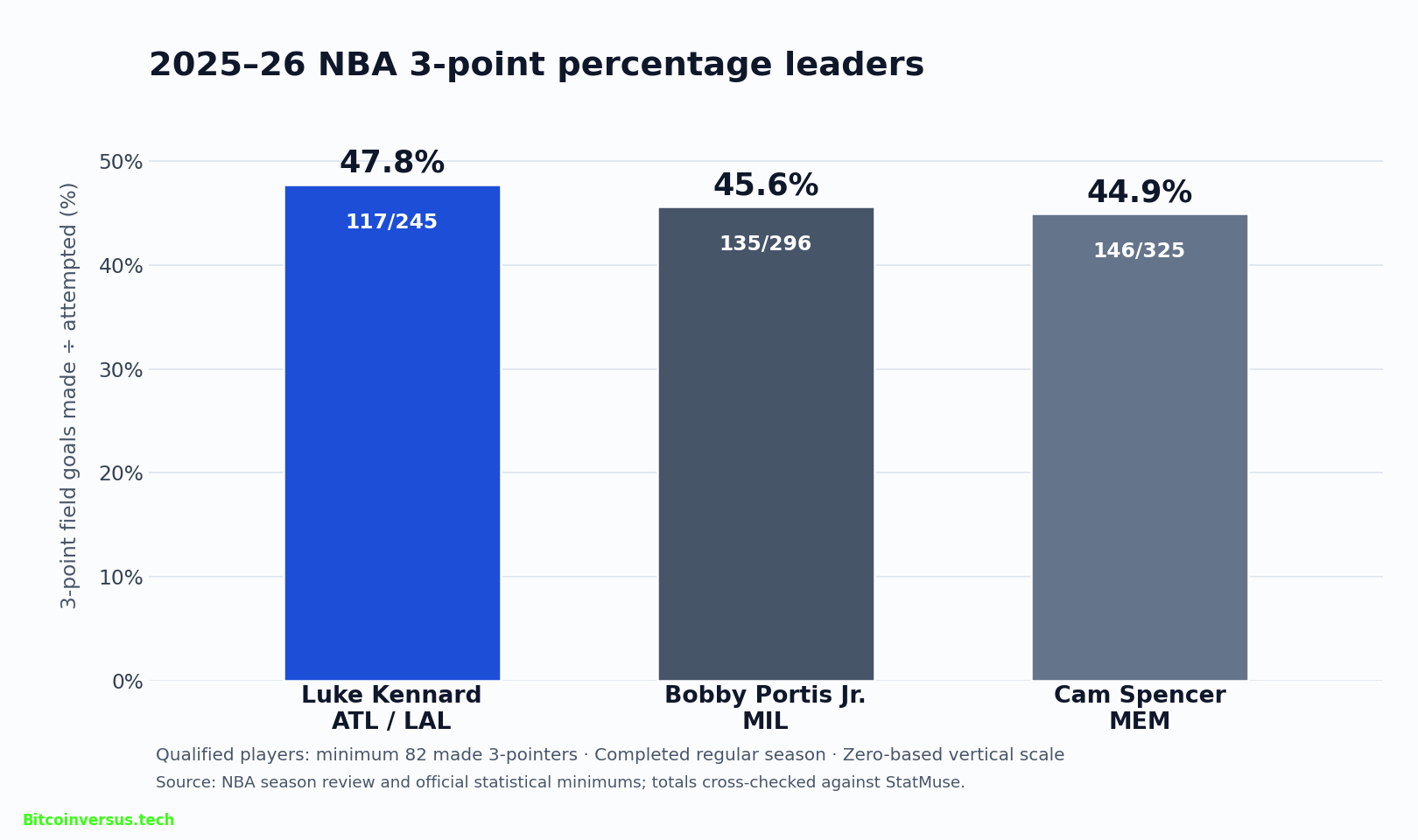
The NBA’s completed 2025–26 season review names Luke Kennard the league’s three-point percentage leader at 47.8%. Using final season totals and the NBA’s official qualifying rule, Bobby Portis Jr. ranked second at 45.6% and Cam Spencer third at 44.9%. All three cleared the required 82 made three-pointers.
Luke Kennard led with 117 makes in 245 attempts
Kennard converted 117 of 245 long-range attempts across 78 appearances, producing 47.755%, rounded to 47.8%. His season total combines time with Atlanta and the Los Angeles Lakers. The NBA credited Kennard with the 2025–26 percentage title; his rate was 2.2 percentage points above Portis.
Official NBA highlights: “Luke Kennard Makes His Official Lakers Debut,” February 7, 2026. Credit: NBA/YouTube. The footage illustrates his season with Los Angeles; the final 47.8% figure includes both teams.
Bobby Portis Jr. followed at 45.6%
Portis made 135 of 296 attempts for Milwaukee, equal to 45.608%. His perimeter shooting widened opponents’ defensive assignments despite playing primarily as a frontcourt scorer. In a March 15 victory over Indiana, he made six three-pointers in 11 attempts and scored 29 points.
Official NBA full-game highlights: Indiana Pacers at Milwaukee Bucks, March 15, 2026. The NBA video description identifies Portis’ 29 points, 10 rebounds and six made threes. Credit: NBA/YouTube.
Cam Spencer ranked third but made the most threes
Spencer converted 146 of 325 attempts for Memphis, a 44.923% rate. He attempted 80 more three-pointers than Kennard and made 29 more, yet placed behind him in percentage. The comparison shows why an accuracy ranking should never be described as the list of most productive long-distance scorers.
Official Memphis Grizzlies player highlights against Sacramento, published November 30, 2025. Credit: Memphis Grizzlies/YouTube. The clip represents one game, not a statistical summary of the full season.
Three-point percentage requires a fair denominator
The NBA’s statistical minimums require 82 made threes over an 82-game season to qualify for the percentage leaderboard. Without the rule, a player who makes one attempt in one appearance would lead at 100%, despite providing almost no meaningful season-long sample. All three featured players exceeded the threshold.
The rankings do not describe the first weeks of 2026–27, which remain a separate, incomplete season. They also do not control for defender distance, shot location, time on the shot clock or teammate-created opportunities. A 2.2-point gap in accuracy is a descriptive season result, not proof that one shooter would outperform another in identical situations.
BitcoinVersus.Tech’s Maxey–Curry comparison and Harden–Dončić scoring analysis illustrate other basketball measurements, but neither should be mixed into a three-point percentage leaderboard. Similarly, Wembanyama–Dončić MVP metrics and the quintuple-double investigation evaluate different basketball skills.
For the accuracy category, Kennard was the unambiguous qualified 2025–26 leader. Portis and Spencer completed the top three, while higher three-point volume remained a distinct statistic for future comparisons.
Statistical sources
NBA 2025–26 season review (complete league leaders); NBA official qualifying minimums; season three-point makes and attempts, cross-checked against Basketball-Reference. Percentages equal 100 × 3PM ÷ 3PA, rounded to one decimal. Team abbreviations describe the 2025–26 season, not November 2026 rosters.
Editor’s Note: The article covers only qualified 2025–26 regular-season three-point percentage, not 2026–27 standings or three-point volume. The original 1200 × 630 featured illustration depicts stylized basketball players rather than actual game photography and is not duplicated in the body. Official team and NBA highlight videos are historical context and do not independently establish season-long rankings. Video rendering, playback and mobile layout require separate verification.
Support BitcoinVersus.Tech
For an optional 5,000-satoshi contribution, scan the original BitcoinVersus.Tech QR code below with a compatible wallet. On a phone, display the article on another device or use the wallet’s supported saved-image scanning feature. Confirm the payment destination and amount before submitting.

We volunteer daily to ensure the information on this platform is Verifiably True. If you would like to support the research, please scan QR code.


Leave a Reply