
BATON ROUGE, La. — November 8, 2026. Deuce Geralds has moved rapidly from celebrated Georgia high-school prospect to LSU’s starting defensive tackle. At 6-foot-1 and 285 pounds, the true freshman plays inside, where a defender must penetrate between blockers without surrendering run gaps. His early value is clear: quick interior disruption, active pass-rush technique and backfield production. The remaining question is how consistently he can survive the physical demands of Southeastern Conference offensive lines.
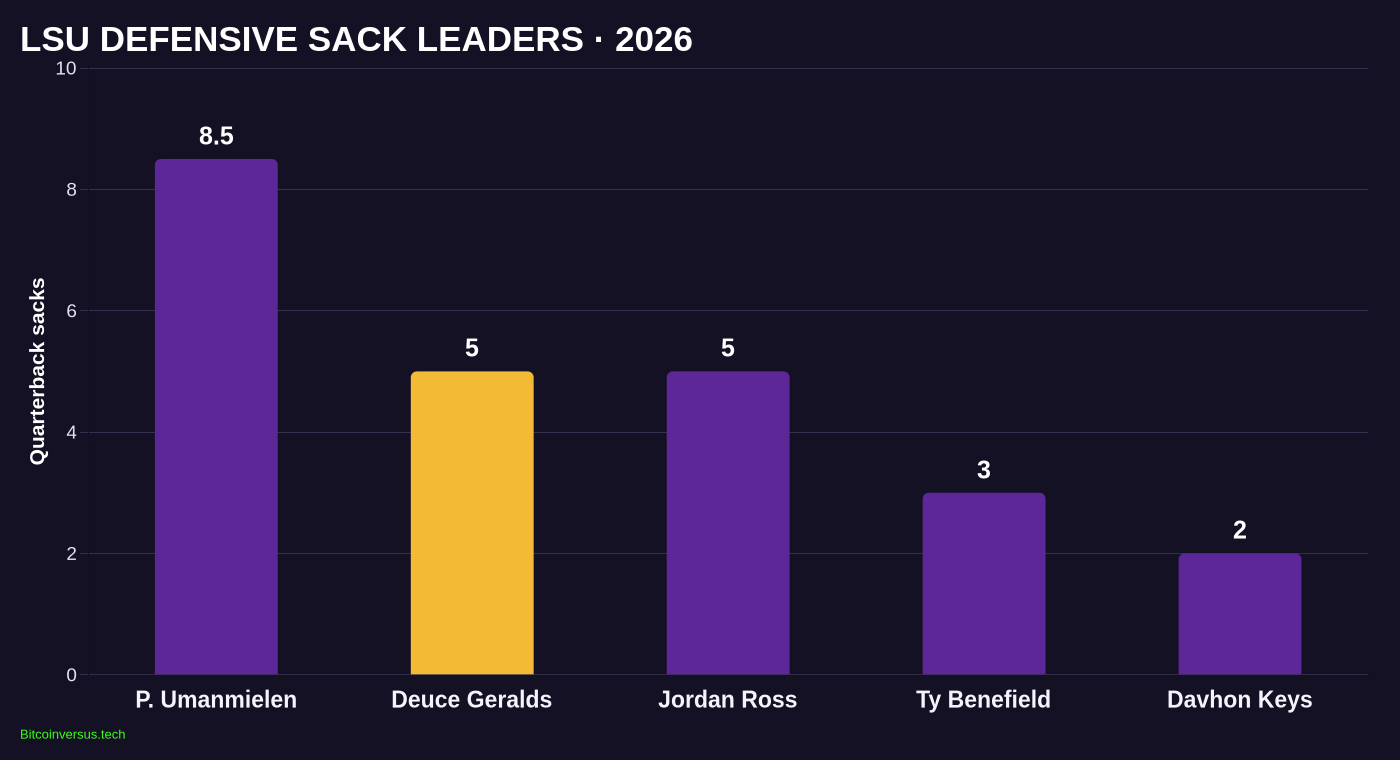
LSU’s official roster lists Geralds as No. 99. The university’s November 8 cumulative statistics credit him with 26 total tackles, five sacks, five tackles for loss, four official quarterback hurries, one forced fumble and a pass breakup through nine games. He has started all nine. His five sacks tie Jordan Ross for second on the Tigers behind Princewill Umanmielen’s 8.5.
LSU at The Voice of College Football discusses Geralds’ prospect profile in a July 26, 2026 preseason feature. The video predates his college game production. Source: LSU at The Voice of College Football/YouTube.
Pass rush: low leverage, sudden acceleration
Geralds’ strongest early projection is as an attacking interior lineman aligned over or outside a guard. His compact build helps him play with a low center of gravity, while first-step quickness allows him to attack a blocker’s edge. One September analysis of LSU’s Ole Miss game recorded 47 snaps for Geralds, nearly all in the B-gap, with a 71.7 PFF run-defense grade in the matchup.
The explosive get-off is not his only tool. LSU center Braelin Moore praised Geralds’ range of pass-rush moves during August camp. A complete film evaluation should isolate his hand timing, inside-counter success, ability to reset after contact and pressures against true one-on-one pass sets. Against Texas A&M, On3 credited him with a two-sack performance in its midseason freshman assessment.
Run defense: promise and a clear test
An attacking B-gap defender must keep shoulder leverage, recognize blocking combinations and avoid opening an escape lane while chasing the backfield. Geralds has enough contact strength to compete, but sustaining his base against double-teams remains a meaningful developmental checkpoint. His freshman pressure production does not independently prove every-down run-stopping dominance.
A PFF snapshot dated October 29 assigned Geralds an 80.5 overall defensive grade, 72.5 pass-rush grade and 73.0 run-defense grade, with 18 pressures on 179 pass-rush snaps. The pressure figure is a graded-provider statistic from an earlier reporting date—not LSU’s official four quarterback hurries and not the final season count. The datasets should not be summed or treated as interchangeable.
Alabama supplied a difficult measuring point
LSU lost 31–13 to Alabama on November 7. Geralds was credited with one assisted tackle and no sacks or tackles for loss in the official game book. Alabama managed 79 net rushing yards on 29 attempts, but a team-level run-defense outcome cannot be credited solely to a single lineman. The game also reinforces why a scouting projection needs repeated evaluation against elite competition.
After Further Review: LSU examines the Tigers’ defensive-tackle depth and Geralds’ early practice role in an August 14, 2026 preseason segment. Analysis, not fresh Alabama footage. Source: After Further Review: LSU/YouTube.
Scouting projection
At Collins Hill High, LSU credits Geralds with 91 tackles, 37 tackles for loss and 16 sacks in 2025, plus 45 quarterback hurries and seven forced fumbles. Such output explains the recruiting reputation, but high-school production and college grades must be evaluated separately. His quickness and hand activity suggest an immediate passing-down fit; broader three-down value depends on read-and-react discipline, anchoring and week-to-week consistency.
Geralds’ trajectory warrants continued attention, without assigning him a premature NFL draft grade. Evaluating scouts, separating athletic traits from production and reviewing game film all reinforce the same standard: combine repeatable technique with verified, opponent-adjusted evidence. Related defensive scouting analysis shows why role, responsibility and usage cannot be reduced to a single headline statistic.
Primary sources and scouting limits
LSU Athletics roster and biography; LSU cumulative 2026 statistics (as of November 8); LSU–Alabama November 7 game book; PFF grading snapshot (dated October 29); On3 midseason freshman assessment. Technique descriptions are sourced scouting interpretations; no claim of independently charting every college snap is made.
BitcoinVersus.Tech Editor’s Note: Official LSU statistics take precedence for season totals. PFF grades and pressures cover a separate, older sample and use different definitions. The cover is conceptual artwork rather than an authenticated photograph of Geralds. YouTube sources were checked for identifiable title, publisher and publication date; iframe rendering does not establish successful viewer playback.
Support BitcoinVersus.Tech
For an optional 5,000-satoshi contribution, scan the original BitcoinVersus.Tech donation QR with a compatible Bitcoin wallet. If using a phone, open the code on another display or use your wallet’s supported saved-image scanning function. Verify the payment destination and amount before confirming.

We volunteer daily to ensure the information on this platform is Verifiably True. If you would like to support the research, please scan QR code.


Leave a Reply