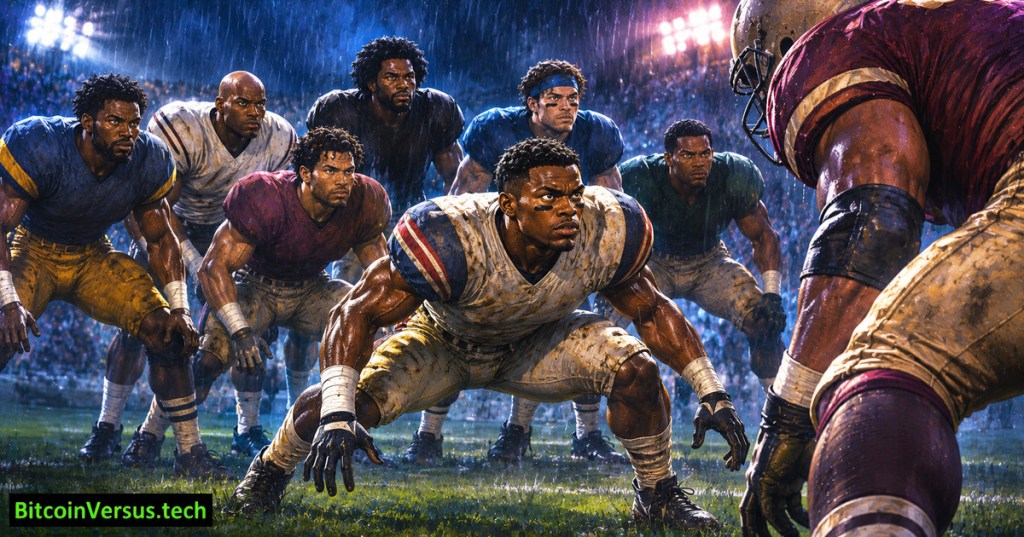
The great middle linebackers of professional football are often imagined as towering run-stoppers. Yet several of the NFL’s most productive defenders were dismissed or discounted because of their measurements. Mighty Mites ranks seven linebackers who were conspicuously shorter or lighter than their era’s preferred prototype and then made the league reconsider what an effective defender looks like.
For the countdown, “undersized” is a historical scouting description, not a medical or universal cutoff. The list concentrates on men roughly six feet tall or shorter. Their accomplishments determine most of the order, while the mismatch between their measurements and prevailing expectations is the deciding factor. Pro Bowls, All-Pro honors, sustained impact, championships and innovation matter more than modern tackle totals, which are not measured consistently across every era.
Why linebacker size became a scouting argument
Linebackers traditionally needed enough mass and reach to defeat blocks from linemen and fullbacks. Modern spread formations added a second demand: move laterally, recognize routes, cover receivers and tackle in open space. Tampa Bay’s 2026 analysis of the position’s evolution explains why a 220–230-pound linebacker now fits roles that once favored 240–250 pounds. Size still matters; it simply interacts with leverage, footwork, reaction speed, pursuit angles and scheme.
| Rank | Linebacker | Listed height | Listed weight | Notable honor |
|---|---|---|---|---|
| 7 | Dat Nguyen | 5 ft 11 in | 238 lb | 2003 second-team All-Pro |
| 6 | Jessie Tuggle | 5 ft 11 in | 230 lb | 5 Pro Bowls |
| 5 | London Fletcher | 5 ft 10 in | 242 lb | 4 Pro Bowls; 256 straight games |
| 4 | Zach Thomas | 5 ft 11 in | 235 lb | 5 first-team All-Pros; Hall of Fame |
| 3 | Derrick Brooks | 6 ft 0 in | 235 lb | 11 Pro Bowls; Hall of Fame |
| 2 | Mike Singletary | 5 ft 11 in* | about 230 lb | 2 Defensive Player of Year awards |
| 1 | Sam Mills | 5 ft 9 in | 229 lb | 5 Pro Bowls; Hall of Fame |
No. 7 — Dat Nguyen: The Cowboys’ overlooked tackling technician
5 ft 11 in, 238 pounds. Dat Nguyen turned a relatively compact frame into a successful seven-season career with the Dallas Cowboys from 1999 through 2005. A third-round choice from Texas A&M, he excelled at reading plays early and arriving at the ball before blockers could establish leverage. Nguyen led Dallas in tackles in three seasons and made the 2003 second-team All-Pro roster. His induction biography at the National Football Foundation records his college honors and professional milestones. The Texas Sports Hall of Fame lists 517 college tackles across his career. Nguyen’s story demonstrates that efficient reads and tackling position can offset limited reach, though an undersized player still has to withstand repeated interior contact.
Dat Nguyen discusses his Cowboys career. Video by The Vietnamese with Kenneth Nguyen (independent interview; not an NFL or team-run YouTube channel). Watch on the independent uploader’s YouTube page if embedding is unavailable. Independent uploads may still contain third-party football footage subject to separate rights restrictions.
No. 6 — Jessie Tuggle: Atlanta’s relentless Hammer
5 ft 11 in, 230 pounds. Jessie Tuggle spent 14 NFL seasons with the Atlanta Falcons after joining the club as an undrafted player out of Valdosta State in 1987. Coaches eventually discovered that his tackling technique, acceleration through traffic and stamina compensated for the size he lacked. The Falcons credit him with 1,640 tackles under their team accounting system, along with five Pro Bowl selections. His number 58 was retired by Atlanta, which documents the career in its official Hammer Time retrospective. Tuggle developed into a defensive leader on the franchise’s first Super Bowl team, which reached the title game after the 1998 season. His inclusion captures a lesson often lost in draft projections: consistent positioning, instincts and the ability to finish a tackle can produce more long-term value than a preferred silhouette.
Tuggle of War (The Hammer) — Jessie Tuggle Career Highlights. Video by StrangeVoodooTV (independent compilation; not an NFL or team-run YouTube channel). Watch on the independent uploader’s YouTube page if embedding is unavailable. Independent uploads may still contain third-party football footage subject to separate rights restrictions.
No. 5 — London Fletcher: Durability without the conventional frame
5 ft 10 in, 242 pounds. London Fletcher was considered short for an inside linebacker but almost never left the field. He entered the NFL undrafted in 1998, became a Super Bowl champion with the St. Louis Rams, then served as a defensive leader in Buffalo and Washington. Across 16 seasons, he appeared in 256 consecutive regular-season games and earned four Pro Bowl selections; Pro-Football-Reference provides the game history and roster measurements. Fletcher was built powerfully despite his height, so calling him simply a tiny defender would be misleading. His value came from rapid diagnosis of run fits, communication, sound pursuit and availability year after year. Durability matters in football economics: a proven player able to execute the scheme every Sunday reduces the risk that coaches must absorb elsewhere on the roster.
London Fletcher makes his Hall of Fame case. Video by The Rich Eisen Show (independent interview; not an NFL or team-run YouTube channel). Watch on the independent uploader’s YouTube page if embedding is unavailable. Independent uploads may still contain third-party football footage subject to separate rights restrictions.
No. 4 — Zach Thomas: The prepared fifth-round Hall of Famer
5 ft 11 in, 235 pounds. Miami selected Zach Thomas in the fifth round of the 1996 draft, long after many more physically imposing prospects. He immediately became the Dolphins’ defensive leader, earning AFC Defensive Rookie of the Year recognition. Thomas made seven Pro Bowls and five first-team All-Pro teams before his 2023 induction into the Pro Football Hall of Fame. The Hall’s official biography credits his preparation and anticipation, noting how routinely he was in the right gap before the play fully developed. He studied formations and tendencies, used disciplined footwork and avoided wasted motion. In a role that demands quick decisions, the fraction of a second gained by recognizing an offense can negate inches of height. Our SEC scouting breakdown explores similar issues of technique, projection and assignment.
Zach Thomas Highlights. Video by Duke Wilson 14 (independent compilation; not an NFL or team-run YouTube channel). Watch on the independent uploader’s YouTube page if embedding is unavailable. Independent uploads may still contain third-party football footage subject to separate rights restrictions.
No. 3 — Derrick Brooks: The prototype for a faster linebacker
6 ft 0 in, 235 pounds in statistical rosters; Tampa Bay lists 229 pounds at the 1995 draft. Some scouts viewed Derrick Brooks as too small, but the Buccaneers traded up to select the Florida State standout at No. 28 overall. He went on to 11 Pro Bowls, the 2002 NFL Defensive Player of the Year award and a Super Bowl XXXVII championship. Brooks recorded 25 career interceptions and did not miss a regular-season game during 14 years in Tampa Bay, according to the Pro Football Hall of Fame. Defensive coordinator Monte Kiffin’s Tampa 2 system valued his ability to run, cover space and diagnose routes as much as physical collisions. Brooks was not merely succeeding despite a smaller frame: he helped expand what teams considered valuable at weakside linebacker. The Bucs’ own 2026 historical review explicitly recognizes his undersized draft profile.
Derrick Brooks — 2002 full-season highlights. Video by DeanLegend (independent compilation; not an NFL or team-run YouTube channel). Watch on the independent uploader’s YouTube page if embedding is unavailable. Independent uploads may still contain third-party football footage subject to separate rights restrictions.
No. 2 — Mike Singletary: The 5-foot-11 commander of the 46 defense
5 ft 11 in according to the Chicago Bears. Mike Singletary was regarded by some clubs as too short to command the middle of an NFL defense. Chicago nevertheless selected the Baylor star in the second round in 1981, and he became the voice and central tackler of the Bears’ legendary 46 defense. He earned 10 Pro Bowls, eight All-Pro selections, Defensive Player of the Year awards in 1985 and 1988, and a Super Bowl XX title. His accomplishments are documented by the Pro Football Hall of Fame, while the Chicago Bears describe the scouting skepticism about his height. Singletary attacked the running game through fast diagnosis, aggressive leverage and communication that synchronized defenders around him. Ranking him second rather than first reflects the list’s additional emphasis on how profoundly a player’s modest size affected access to professional football.
Mike Singletary Highlights. Video by Ironworker Jeff (independent compilation; not an NFL or team-run YouTube channel). Watch on the independent uploader’s YouTube page if embedding is unavailable. Independent uploads may still contain third-party football footage subject to separate rights restrictions.
No. 1 — Sam Mills: The Field Mouse who kept pounding
5 ft 9 in, 229 pounds. No player represents the Mighty Mites premise more clearly than Sam Mills. Dismissed because of his height, the former Montclair State star was cut by the Cleveland Browns and Toronto Argonauts before establishing himself with the Philadelphia Stars of the USFL. He won two USFL championships, then followed coach Jim Mora to the New Orleans Saints. Mills became a foundational member of the Saints’ Dome Patrol linebackers, earned five NFL Pro Bowls and later helped lead the expansion Carolina Panthers to the 1996 NFC Championship Game. He entered the Pro Football Hall of Fame in 2022. His signature ‘Keep Pounding’ philosophy grew into a central part of Carolina’s culture after he stayed with the team as a coach. The full record combines an extreme size disadvantage, repeated rejection, elite production and an enduring institutional legacy. Under the ranking’s stated criteria, those factors place Mills at No. 1.
The Incredible Life & Legacy of Sam Mills with Paul Domowitch. Video by The Heart of Sports (independent long-form discussion; not an NFL or team-run YouTube channel). Watch on the independent uploader’s YouTube page if embedding is unavailable. Independent uploads may still contain third-party football footage subject to separate rights restrictions.
What smaller linebackers teach about football evaluation
The seven careers reveal several transferable principles: anticipation shortens the distance to the ball; leverage compensates for a reach disadvantage; coverage intelligence creates value outside the tackle box; durability and scheme fit shape careers. None eliminates the importance of body mass or length, especially against oversized blockers. NFL standards also evolve. Modern offenses frequently spread defenders horizontally, and a mobile 230-pound linebacker may be more useful on passing downs than an old-fashioned heavyweight who struggles in space.
Talent evaluation can still misfire. Our earlier NFL Politics countdown explores stars who never logged an NFL regular-season game; our draft-evaluator ranking examines the limits of projection; and our defensive-back statistics analysis underscores how assignments complicate statistical comparisons. The lesson from Mills, Singletary and their peers is not that size never matters, but that measurement without film, role and performance is incomplete evidence.
Methodology: An editorial historical ranking as of November 21, 2026. We prioritized verified NFL performance, honors, defensive impact and the documented scouting penalty associated with size. Heights and weights are historical roster listings and can differ among official team programs. Tackle counts, particularly from earlier eras, reflect different tracking practices; comparisons across decades should use honors, game film, and team context rather than treating all tackle totals as identical. Pro Football Hall of Fame, Pro-Football-Reference, National Football Foundation and official team histories provide the underlying records.


Leave a Reply