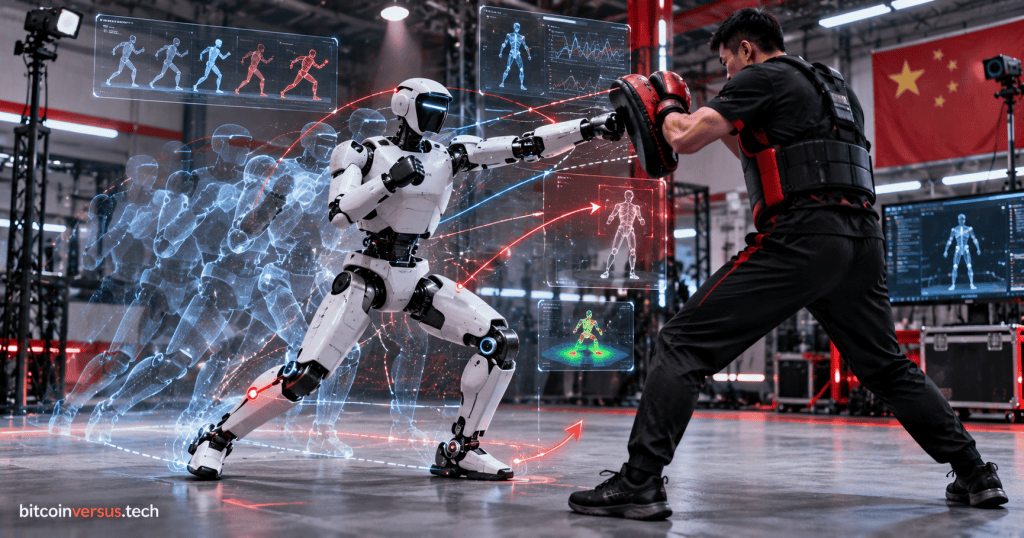
Unitree Robotics says its G1 humanoid can now spar against a moving human opponent without teleoperation or a scripted fight sequence, using a world-action model called UnifoLM-X2-1.0 to predict, plan and react in real time.
In Unitree’s September 7 demonstration, the G1 adjusts its stance, moves around a padded trainer, throws punches and kicks, and appears to react to changing contact while overlays visualize predicted future motion. Unitree describes the system as fully autonomous humanoid combat driven by a world model.
The autonomy claim is important but should be read precisely: Unitree has shown a company demonstration, not an independently reproduced benchmark. The public material does not yet disclose control-loop latency, trial failure rates, model architecture details or whether some inference runs offboard.
World-action models try to predict before they move
A conventional robot controller can execute a trained policy from sensor input to motor commands. A world-action model goes a step further by modeling what may happen next, then using those predicted physical states to choose an action.
That matters in sparring because the environment changes continuously. The opponent moves, contact pushes the robot off balance, and every counteraction changes the next state. A useful controller has to perceive, predict, plan and stabilize fast enough that the plan is not obsolete by the time the joints move.
Unitree summarized that claim in its official Twitter announcement, saying UnifoLM-X2-1.0 targets instant planning, decision-making and dynamic interactive execution.
The approach fits the broader physical-AI shift BitcoinVersus.tech recently covered in Skild S1 learning new robot tasks from a single video. In both cases, the goal is to reduce dependence on narrowly scripted behaviors and make the robot adapt to situations it has not seen exactly before.
The demo removes the obvious remote pilot
Humanoid fighting videos are not new, but many previous demonstrations used controllers, motion capture, VR teleoperation or rehearsed sequences. Unitree’s new claim is that UnifoLM-X2-1.0 closes the perception-to-action loop autonomously during the bout.
Independent coverage of the demonstration notes the same distinction while also flagging what is still missing: no public technical paper, no repeatability data, no latency measurements and no clear disclosure of whether all compute is onboard the G1.
Those omissions matter because a polished demonstration can establish feasibility without establishing reliability. A factory or field robot has to recover from unusual contact repeatedly, not only perform well in a selected clip.
Combat is really a stress test for dynamic control
The useful engineering lesson is broader than fighting. Sparring forces a humanoid to combine balance, perception, whole-body control and rapid reaction under unpredictable physical contact. Those same capabilities can transfer to material handling, construction, inspection and other jobs where the environment pushes back.
BitcoinVersus.tech has also covered NVIDIA Isaac ROS 5.0 bringing AI agents deeper into robot development. Unitree’s world-action approach attacks the problem from another layer: instead of only giving a robot better tools and perception, it attempts to predict how the physical scene will evolve before committing to motion.
Three days later, Unitree opened a different foundation model
Unitree followed the combat demo with a separate September 10 release of UnifoLM-WLA-1.0, an open-source embodied foundation model designed to coordinate desktop manipulation and whole-body mobile manipulation through one model.
The two releases should not be conflated. UnifoLM-X2-1.0 is the model Unitree names in the autonomous combat demo, while WLA-1.0 is the open-source release shown days later. Together, however, they show how aggressively the company is moving toward foundation models that can control many behaviors instead of one preprogrammed routine.
Autonomy makes safety a harder systems problem
As physical AI becomes more adaptive, the safety boundary has to become more independent from the model making the decisions. A controller that can improvise also creates more possible states for engineers to evaluate.
That is why BitcoinVersus.tech recently examined Agility and FORT extending Digit 5 safety beyond the robot itself. Autonomous world models and independent safety systems solve different problems, but increasingly capable humanoids will need both.
What Unitree still has to prove
The demo is technically interesting because it places a humanoid in a fast, contact-rich loop where prediction and recovery matter. But the strongest version of Unitree’s claim will require evidence beyond one published clip: repeated trials, latency data, failure modes, compute disclosure and independent reproduction.
If those results eventually hold up, the important breakthrough will not be that a humanoid can throw a punch. It will be that a world model can stay closed-loop with a moving physical environment quickly enough to keep a general-purpose robot balanced, predictive and useful.
BitcoinVersus.Tech
Advertisement
BitcoinVersus.Tech Editor’s Note:
We volunteer daily to ensure the credibility of the information on this platform is Verifiably True. If you would like to support to help further secure the integrity of our research initiatives, please donate here: 3C9o19EH5HSiwEPyCTmEKzxhNCbo2X6TTb
BitcoinVersus.tech is not a financial advisor. This media platform reports on financial subjects purely for informational purposes.


Leave a Reply