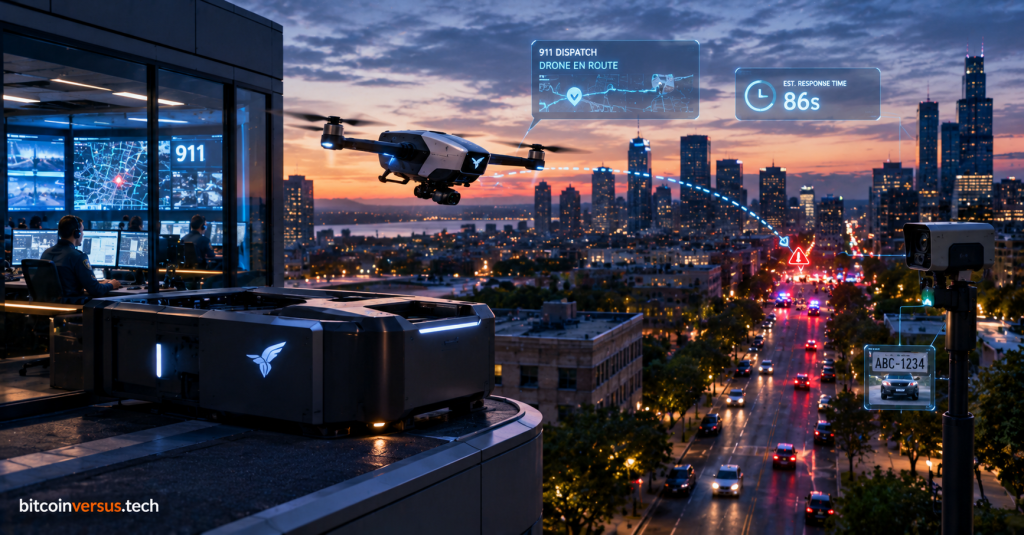
Flock Safety’s Drone as First Responder system is spreading across U.S. police departments with a simple promise: launch a camera-equipped drone when an emergency call arrives and get live eyes on the scene before officers reach it.
According to the company’s current DFR product data, its drone programs reach calls for service in an average of 86 seconds, can launch from rooftop docks in response to 911 calls or other configured alerts, and stream live video back to dispatchers and officers in the field.
The operational appeal is obvious: a drone can provide situational awareness before a patrol car arrives. The policy challenge is just as obvious: the same system combines automated dispatch, high-resolution cameras, license-plate infrastructure and a growing network of police technology.
The drone is becoming part of the dispatch stack
Flock’s system is designed to connect with computer-aided dispatch, 911 data, license-plate-reader alerts, gunshot detection and other public-safety tools. Instead of waiting for an officer to arrive and manually launch a drone, the aircraft can be sent toward coordinates while the call is still developing.
Flock says its DFR customers report an average 86-second arrival time, a 20% share of calls resolved without dispatching patrol, and an 89% increase in subjects located. Those are company-reported operational figures rather than independently standardized benchmarks.
The architecture resembles a larger trend BitcoinVersus.tech has tracked in RuView’s camera-free Wi-Fi sensing experiment: once sensors become networked and machine-readable, the value increasingly comes from how quickly software can turn raw signals into an actionable picture.
Flock aviation executive Rahul Sidhu showed the camera side of that strategy in a public Twitter demonstration, saying the Alpha payload was designed for long-range visual and thermal observation during emergency response.
Cities are connecting drones to broader surveillance systems
Recent independent reporting describes multiple U.S. communities deploying or evaluating Flock’s DFR model as part of wider emergency-response systems. The drone can receive a location from a call or alert, fly toward the scene and provide a live feed while human responders are still traveling.
That is technically different from a traditional patrol drone. The important unit is no longer just the aircraft. It is the whole chain: call intake, automated location data, flight software, live video, camera analytics, dispatch screens and the policies governing who can use the resulting information.
BitcoinVersus.tech’s AI privacy rankings focused on a similar systems question from the consumer side: privacy depends less on a single model or sensor than on where information travels, how long it is retained and who can access it.
Speed and surveillance arrive together
A drone arriving before officers can reduce uncertainty. A dispatcher may be able to distinguish a real threat from a false alarm, identify the direction a vehicle traveled, locate a missing person or tell responding officers what they are walking into.
The same capabilities also create a more mobile form of surveillance. A camera mounted on an aircraft can see over fences, follow movement across a larger area and feed imagery into the same software ecosystem used by fixed cameras and license-plate readers.
Flock says its drones are activated for specific calls and missions rather than general patrol, and that flights are logged and auditable. Critics of networked policing technology argue that oversight has to be evaluated at the system level because data-sharing and access policies can matter as much as the sensor itself.
That tension is also visible in the broader debate over AI systems that gain value from increasingly personal data. More context can make software more useful, but it also increases the consequences of weak access controls.
The real technology is the response loop
The most important engineering development is not simply that police departments can buy faster drones. Consumer and enterprise drones have been capable aircraft for years. What is changing is the response loop around them.
A 911 call can now become coordinates, coordinates can become an automated flight, the flight can become a live video stream, and that video can reach decision-makers before the first ground unit arrives. Every second removed from that chain increases the value of the system during a real emergency.
Flock’s 86-second figure therefore describes more than aircraft speed. It describes a future in which emergency response begins with a networked sensor arriving first—and where the debate over public safety increasingly becomes a debate over who controls the data generated during those first minutes.
BitcoinVersus.Tech
Advertisement
BitcoinVersus.Tech Editor’s Note:
We volunteer daily to ensure the credibility of the information on this platform is Verifiably True. If you would like to support to help further secure the integrity of our research initiatives, please donate here: 3C9o19EH5HSiwEPyCTmEKzxhNCbo2X6TTb
BitcoinVersus.tech is not a financial advisor. This media platform reports on financial subjects purely for informational purposes.


Leave a Reply