Europe just doubled the production capacity of the factory that builds some of its most powerful supercomputers.
Bull opened a new production building at its historic Angers, France, site on October 2, expanding the facility that assembles high-performance computers, AI infrastructure and enterprise servers. The company says the €80 million redevelopment turns Angers into a flexible production center for supercomputers today and future quantum systems later.
The factory can now build twice as much
Bull’s official factory announcement says the new site spans 20,000 square meters, including 10,700 square meters dedicated to production. The expansion doubles manufacturing capacity while targeting a 30% productivity increase and a 30% reduction in building-maintenance costs.
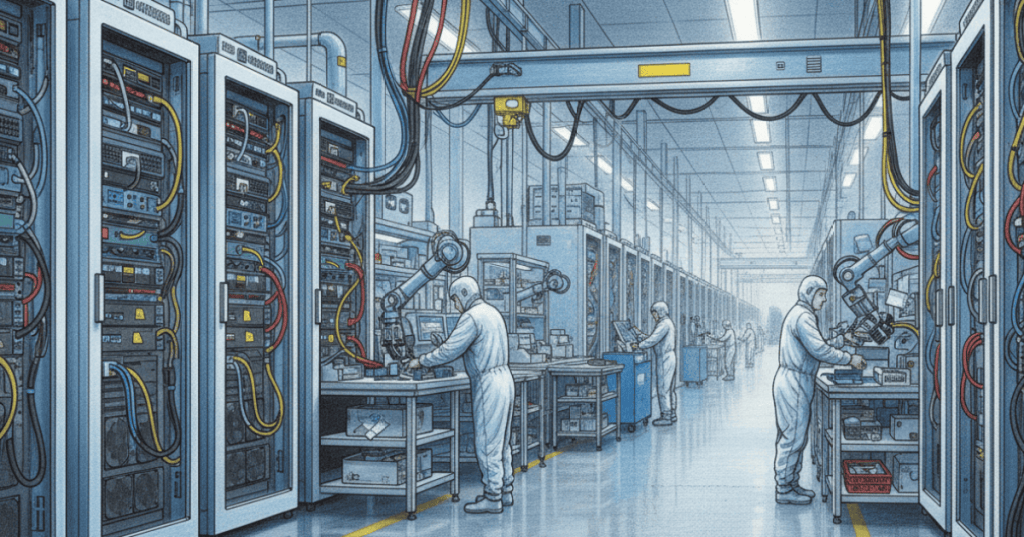
The site is designed around reconfigurable Industry 5.0 production areas, greater automation and collaborative robots. That matters because a supercomputer factory is not a normal server assembly line. Each installation can require custom power, cooling, networking, validation and integration before racks ever arrive at their final data center.
Reuters reported that Angers has increased output from roughly six racks per month to 12, with the site potentially capable of reaching 24 racks per month in 2027. That is a major jump at a time when AI infrastructure demand is forcing manufacturers to think at rack scale rather than only chip scale.
This is where Europe’s exascale ambitions become physical hardware
Angers has already contributed to JUPITER, Europe’s first exascale-class supercomputer. BitcoinVersus.Tech recently covered how SiPearl’s Rhea1 CPUs are entering the JUPITER platform, putting a European-designed processor into a European-built supercomputer architecture.
The same factory is scheduled to deliver Alice Recoque, France’s next exascale system, and LUMI-AI in Finland during 2027. Bull is also working with Foxconn on European assembly of NVIDIA Vera Rubin NVL72 systems, giving the Angers site a role not only in traditional HPC but also in the new generation of AI factories.
AI infrastructure is becoming a full-rack manufacturing problem
The shift is visible across the industry. BitcoinVersus.Tech reported that Vultr ordered $1.2 billion of HPE-built AMD Helios AI racks, systems that combine GPUs, CPUs, networking and direct liquid cooling as a single deployment unit.
Networking is being pulled into that same rack-scale model. Cisco’s AI Factory architecture now includes Supermicro rack-scale systems, another sign that AI data centers increasingly arrive as tightly integrated compute, switching, power and cooling packages.
Bull’s expansion is the European version of that trend: the factory itself becomes part of the AI stack. The competitive advantage is no longer only designing a processor or a server. It is being able to integrate thousands of components into validated systems quickly enough to meet deployment schedules.
The building is designed to recover energy too
The new building uses more than 3,500 photovoltaic panels with 1.5 MWp of peak capacity. Bull also plans to recover waste heat from equipment and inject about 5 GWh per year into the local district-heating network—enough energy, the company says, to supply the equivalent of roughly 600 households.
That is especially relevant for supercomputing because cooling and power density are now central design constraints. The same engineering expertise used to cool exascale machines increasingly overlaps with the requirements of large AI training clusters.
Europe is trying to own more of the AI stack
The Angers expansion is ultimately about technological sovereignty as much as manufacturing volume. Europe can buy processors and accelerators from global vendors, but it also wants the ability to design, integrate, test and operate strategic computing infrastructure inside Europe.
Bull says the new Open Factory program will let other AI, advanced-computing and quantum companies use Angers to move from laboratory prototypes toward industrial-scale production. If that model works, the factory could become a shared manufacturing layer for a wider European computing ecosystem.
The bigger story is simple: the AI race is no longer only about who has the fastest chip. It is also about who can physically manufacture, cool, network, test and deploy entire compute systems at scale. Europe just doubled one of the few places where it can do all of that itself.
BitcoinVersus.Tech
Advertisement
Editor’s Note
We volunteer daily to ensure the credibility of the information on this platform is Verifiably True. If you would like to support to help further secure the integrity of our research initiatives, please donate here: 3C9o19EH5HSiwEPyCTmEKzxhNCbo2X6TTb
BitcoinVersus.tech is not a financial advisor. This media platform reports on financial subjects purely for informational purposes.


Leave a Reply