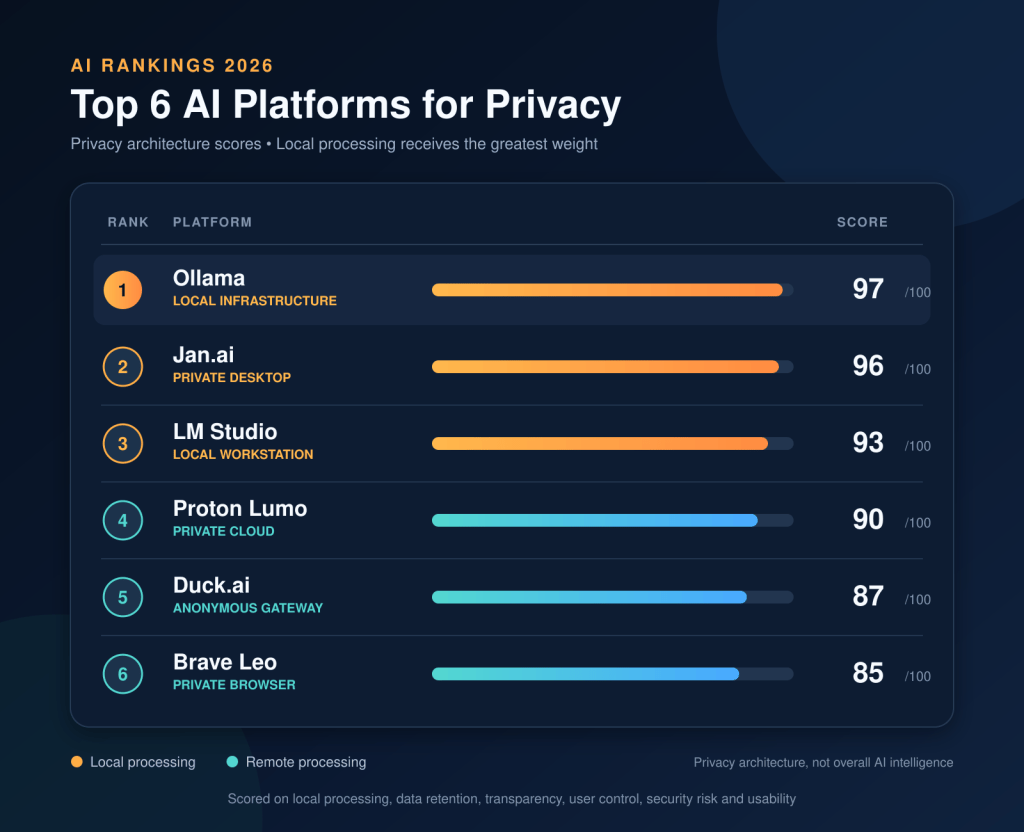
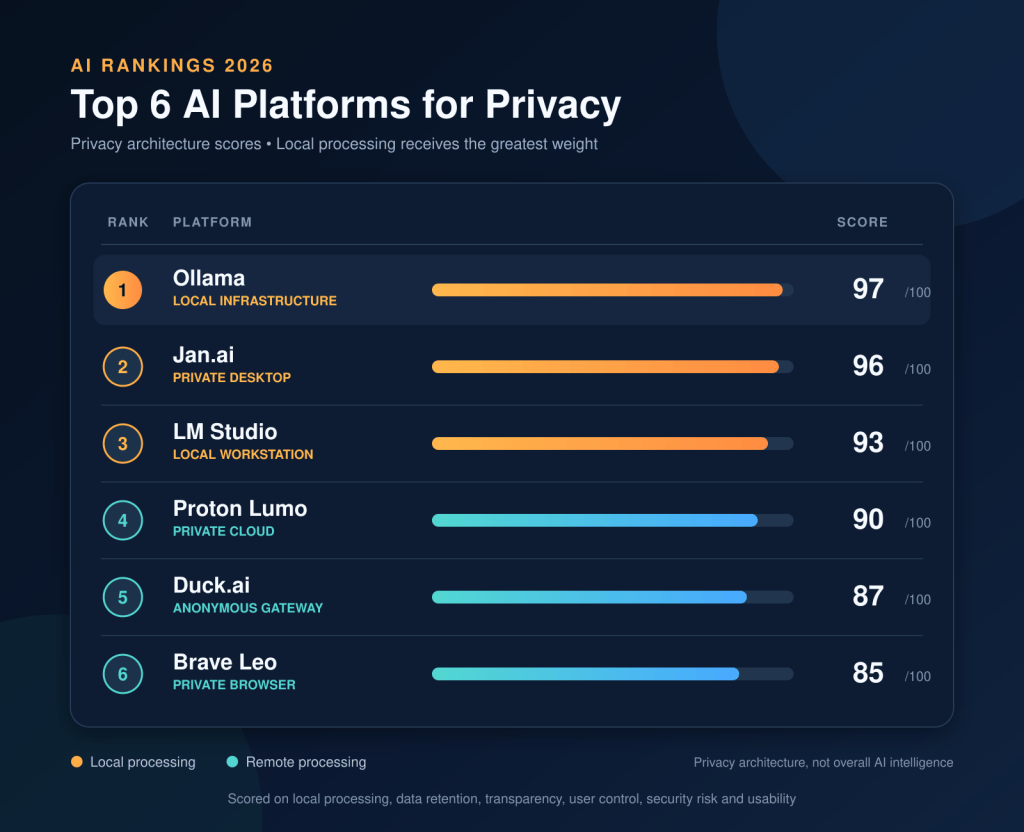
This ranking measures privacy, not raw model intelligence. Local processing receives the greatest weight because sensitive prompts and files never need to reach an outside server.
How We Ranked the Best AI Platforms for Privacy
These rankings evaluate local and offline processing at 40 percent, data collection and retention at 25 percent, user control and transparency at 15 percent, security and configuration risks at 10 percent, and usability at 10 percent.
Local AI platforms rank higher because prompts and files can remain on the user’s device, while cloud services are judged by encryption, logging, model training, and third party data policies. The scores measure privacy architecture, not overall AI intelligence.
1. Ollama
Scouting report: The strongest overall privacy prospect for developers, engineers, and technical users.
Ollama can run downloaded models completely on the user’s computer. The company says it cannot see locally processed prompts or responses, and cloud functions can be disabled through a configuration setting or the OLLAMA_NO_CLOUD=1 environment variable.
Its local API also makes it suitable for private coding tools, internal applications, and self hosted AI systems. The primary concern is operator configuration because optional cloud models, web search, or an improperly exposed local API can change the privacy profile. Ollama privacy documentation
Best trait: Maximum local control
Weakness: Requires responsible configuration
NFL style comparison: Franchise infrastructure prospect with the highest technical ceiling
2. Jan.ai
Scouting report: The best privacy focused desktop assistant for users who want local AI without living in the command line.
Jan is open source, runs offline, and stores conversations and usage information locally. It does not require a cloud account for local models and supports Windows, macOS, and Linux.
Jan loses a single point to Ollama because Ollama is slightly stronger as a local infrastructure layer, but Jan may be the better everyday choice for nondevelopers. Connecting Jan to a remote AI provider changes the privacy rules to those of that provider.
Best trait: Private by default desktop experience
Weakness: Remote API connections reduce its privacy advantage
Scout comparison: Polished five star prospect with an immediate starting role
3. LM Studio
Scouting report: The best graphical local AI workstation.
LM Studio can process chats, documents, and models entirely on the device. Its privacy policy states that locally processed messages, chat histories, and documents are not transmitted from the computer.
It also offers strong model management and local server features. Optional cloud and Bionic services require users to pay attention to whether a task is running locally or remotely, although LM Studio promises zero data retention for its cloud services.
Best trait: Strong local AI interface and model management
Weakness: Local and cloud options can be confused
Scout comparison: High floor workstation prospect that is ready for immediate deployment
4. Proton Lumo
Scouting report: The number one cloud based privacy assistant.
Lumo operates on Proton controlled European servers, does not send prompts to outside model providers, and says it does not log conversations or use them for training. Saved history receives zero access encryption.
However, the Lumo GPU server must still decrypt a prompt temporarily to perform inference, so it cannot match a model operating entirely on the user’s hardware. Proton Lumo security model
Best trait: Strongest combination of cloud convenience and privacy
Weakness: Prompts still leave the device for processing
Scout comparison: Elite cloud prospect that falls just below the local starters
5. DuckDuckGo Duck.ai
Scouting report: The strongest anonymous gateway to multiple commercial AI models.
Duck.ai removes identifying metadata such as the user’s IP address before forwarding requests to model providers. DuckDuckGo also has agreements prohibiting providers from using conversations for training. Its disclosure table identifies which models use zero data retention and which have limited exceptions.
For example, some OpenAI requests can remain in temporary prompt caching for up to one hour. Duck.ai privacy documentation
Best trait: Private access to several major AI models
Weakness: Prompts still pass through outside providers
Scout comparison: Versatile specialist with excellent coverage but additional dependencies
6. Brave Leo by Brave Software
Scouting report: The best privacy focused AI assistant built directly into a browser.
Leo requires no account, keeps optional chat history locally, and says conversations are not retained by Brave or used for training. Its browser integration makes it useful for privately summarizing webpages and documents. Leo also supports local models through its Bring Your Own Model feature, but standard Leo still relies on remote processing.
When connected to Ollama locally, much of the privacy advantage comes from Ollama itself. Brave Leo privacy documentation, Brave local model support
Best trait: Private browser integration
Weakness: Standard operation still uses remote infrastructure
Scout comparison: Excellent role player whose value increases with a local model backend
Final Verdict
Ollama is the privacy champion for technical users who want maximum control. Jan.ai is the best private desktop assistant, while LM Studio is the strongest graphical local AI workstation. Proton Lumo leads the cloud division. Duck.ai provides the best anonymous model selection, and Brave Leo is the most convenient privacy focused browser assistant.
No platform receives a perfect score. Local AI protects data from cloud collection, but it cannot protect an already compromised computer, exposed API port, malicious model file, browser extension, or poorly


Leave a comment