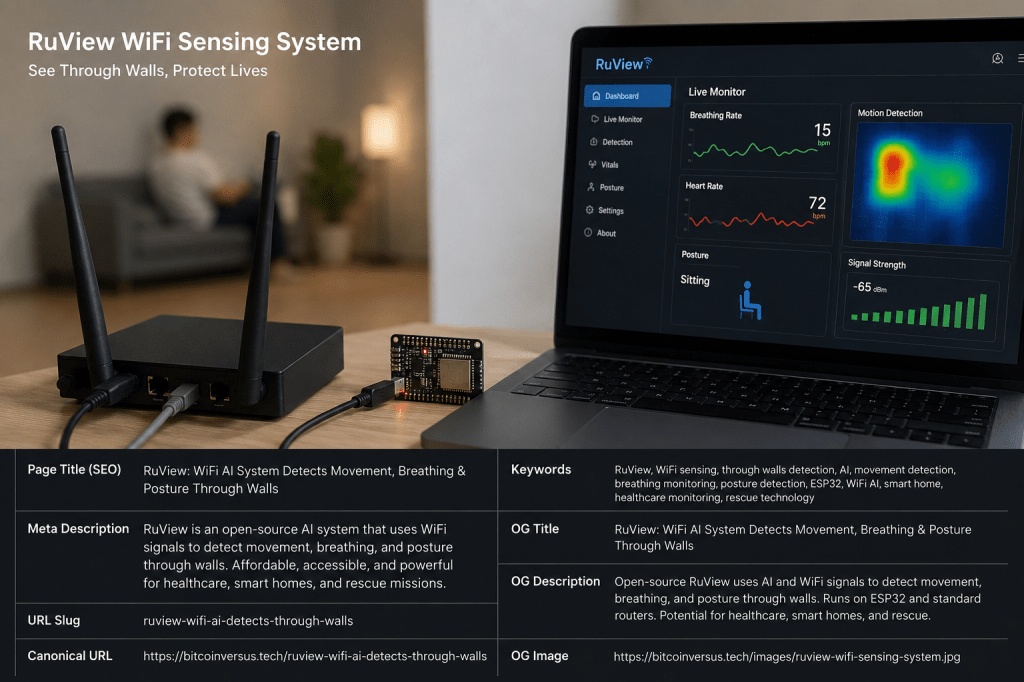
RuView is an open source GitHub project that explores how ordinary WiFi signals can become a camera free sensing layer for rooms, homes, and emergency environments.
The repository describes a system that can detect people, track movement, estimate posture, and monitor breathing or heart rate by analyzing changes in wireless signal behavior rather than using cameras, wearables, or cloud based video feeds.
The core technical idea centers on Channel State Information, often called CSI, which measures how WiFi signals move through a space and change when they bounce, bend, or weaken around people.
When a person walks, sits, breathes, or changes posture, the wireless environment shifts in subtle ways.
RuView attempts to translate those signal changes into structured sensing data through AI models and edge computing workflows.
The project has drawn attention because it may run on low cost hardware, including ESP32 based nodes, rather than specialized military grade radar systems.
CNX Software reported that RuView uses multiple ESP32 nodes for WiFi based presence detection, pose estimation, and breathing or heart rate monitoring, while the project materials describe a broader stack involving firmware, a Rust sensing server, model packaging, tests, and a user interface layer.
RuView’s strongest potential use cases include elder care monitoring, smart home occupancy detection, sleep observation, intrusion detection, and emergency rescue scenarios where cameras may be intrusive, unavailable, or blocked by smoke, darkness, or walls.
Research around passive WiFi sensing has already explored healthcare related motion detection, respiration monitoring, tremor detection, falls, and through wall movement, giving RuView a credible research lane even while its public implementation remains experimental.
A major caveat is that viral descriptions can make RuView sound easier and more mature than the repository currently proves.
Independent technical coverage notes that advanced sensing features require CSI capable hardware, while ordinary laptops usually provide only coarse RSSI style signal data.
Cybernews also reported developer skepticism around broad “see through walls” claims, meaning RuView should be framed as an open source experimental sensing platform rather than a finished commercial security or medical product.
BitcoinVersus.Tech Editor’s Note:
We volunteer daily to ensure the credibility of the information on this platform is Verifiably True. If you would like to support to help further secure the integrity of our research initiatives, please donate here: 3C9o19EH5HSiwEPyCTmEKzxhNCbo2X6TTb
BitcoinVersus.tech is not a financial advisor. This media platform reports on financial subjects purely for informational purposes.


Leave a Reply