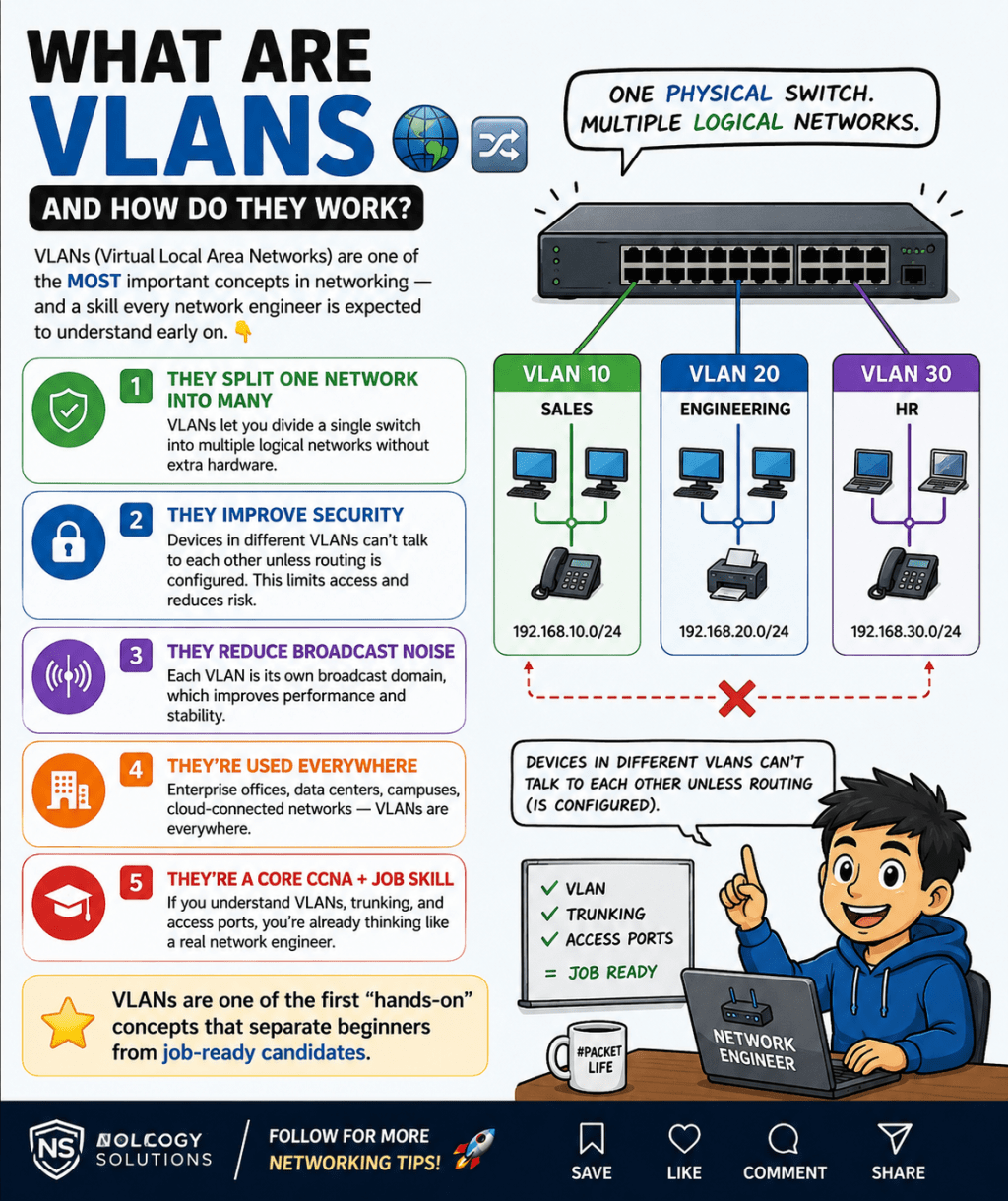
VLANs, or Virtual Local Area Networks, are one of the most important building blocks in modern networking.
A VLAN allows one physical network to be divided into multiple logical networks, giving administrators more control over how devices communicate. Instead of placing every computer, server, camera, printer, phone, and wireless device into one large flat network, VLANs separate traffic into organized groups.
A VLAN works by assigning devices to a specific network segment. For example, an office may use one VLAN for employees, another VLAN for guests, another VLAN for security cameras, and another VLAN for servers. Each group can use the same physical switches while remaining logically separated from the others. That structure helps companies avoid unnecessary hardware while still maintaining cleaner network design.
The biggest benefit of VLANs is segmentation. Segmentation keeps different types of traffic separated, making the network easier to manage and troubleshoot. A guest WiFi user does not need access to internal servers. A printer does not need access to every device in the building.
A security camera system does not need to communicate freely with office laptops. VLANs help define those boundaries.
VLANs also improve security. Devices in separate VLANs usually cannot communicate with each other unless routing rules, firewall policies, or access control settings allow it. That separation can reduce risk if one device becomes compromised.
A flat network gives attackers more room to move. A segmented network makes unauthorized movement harder.
Performance is another major reason VLANs are used. Each VLAN creates its own broadcast domain, which means broadcast traffic stays inside that specific VLAN.
In a large network, too much broadcast traffic can create unnecessary noise and reduce efficiency. VLANs help keep traffic cleaner, more predictable, and easier to analyze.
Access ports and trunk ports are two important VLAN concepts. An access port usually connects one device to one VLAN, such as a desktop computer, printer, camera, or mining machine.
A trunk port carries traffic from multiple VLANs between switches, routers, firewalls, or wireless access points. Understanding the difference between access ports and trunk ports is essential for real network configuration.
VLANs are common in enterprise offices, schools, hospitals, warehouses, campuses, data centers, and Bitcoin mining facilities. Any environment with multiple device types can benefit from logical separation.
In a mining facility, VLANs may separate ASIC management traffic, technician laptops, monitoring servers, cameras, wireless access points, and guest access. That makes the network easier to control and diagnose.
However, VLANs are not a complete security solution by themselves.
They should be paired with strong firewall rules, proper routing, secure switch settings, port security, monitoring, documentation, and least privilege access. VLANs create structure, but policy determines what traffic is allowed.
For students, technicians, and network engineers, VLANs are a core job skill. A person who understands VLANs, subnetting, trunking, access ports, routing, and firewall rules is starting to think like a real infrastructure professional.
VLAN knowledge connects directly to CCNA study, help desk escalation, data center operations, cybersecurity, wireless networking, and systems administration.
VLANs matter because modern networks are too complex to remain flat. As more devices connect to business networks, logical separation becomes more important. VLANs help networks stay organized, secure, scalable, and easier to manage.
BitcoinVersus.Tech Editor’s Note:
We volunteer daily to ensure the credibility of the information on this platform is Verifiably True. If you would like to support to help further secure the integrity of our research initiatives, please donate here: 3C9o19EH5HSiwEPyCTmEKzxhNCbo2X6TTb
BitcoinVersus.tech is not a financial advisor. This media platform reports on financial subjects purely for informational purposes.


Leave a comment