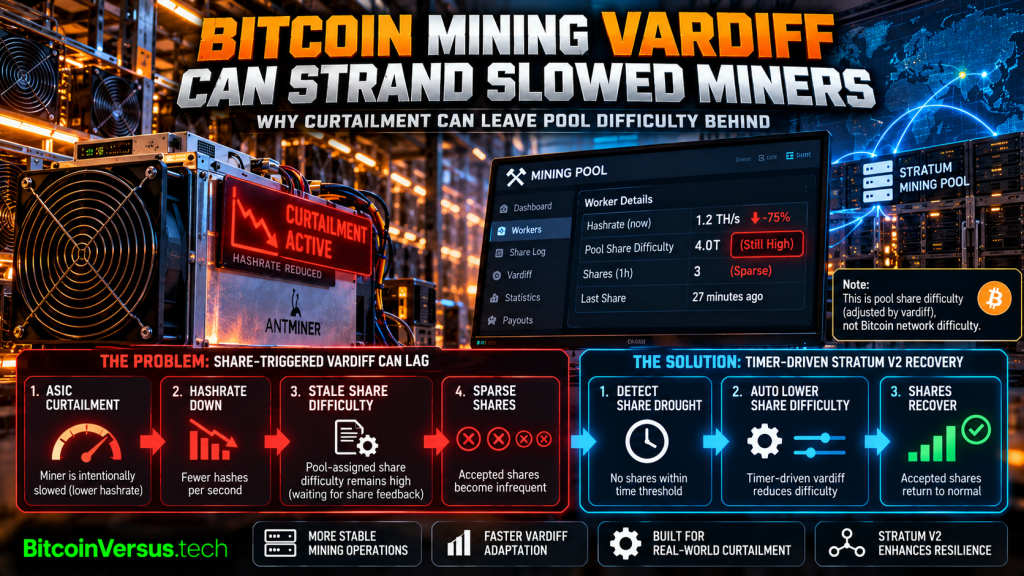
A Bitcoin miner that deliberately cuts hashrate can expose a subtle weakness in some mining-pool variable-difficulty controllers: the machine slows down, but its assigned share difficulty may remain calibrated for the faster miner it used to be.
Bitcoin Optech highlighted the issue on September 18 after mining engineer Eric Price published a detailed controller analysis. The finding concerns pool-assigned share difficulty, not Bitcoin’s network mining difficulty, and available evidence does not establish widespread real-world losses.
The operational risk appears during a hashrate decline: a miner can remain connected and hashing while the pool receives too few shares to quickly recognize how much the machine has slowed.
Why a slower miner can become difficult for the pool to see
Mining pools assign workers a share target that is easier than Bitcoin’s network target. Those shares provide evidence of contributed work and give the pool a stream of observations from which it can estimate the miner’s hashrate.
Variable difficulty, commonly called vardiff, adjusts that share target so submissions arrive at a useful cadence. Price’s research describes a failure mode when a controller recalculates only after a share arrives.
If an operator throttles an ASIC sharply, the miner performs fewer hashes per second. Its previous share difficulty can then be too high for the new operating rate. Shares become less frequent, but if a fresh share is itself what triggers recalculation, the controller receives less information exactly when it most needs to lower the target.
In control-system terms, the share stream is the sensor. When the stream becomes sparse, a share-triggered controller can lose visibility into the decline it is supposed to track.
Curtailment makes the issue operationally relevant
Industrial miners routinely change electrical load for grid conditions, power prices, thermal limits and site economics. BitcoinVersus.tech recently covered Braiins Price Adapt automating ASIC power targets and BitFuFuOS connecting ASIC firmware to power-market control.
Those systems are not implicated in the vardiff finding. They illustrate why rapid hashrate changes are normal operating events rather than laboratory-only scenarios.
The Sept. 21 mining report explains the finite-window consequence: a slowed miner can continue consuming electricity while accepted shares become unusually sparse. Depending on pool accounting and the observation window, the operator may receive little or no pool-side credit during that interval.
This should not be interpreted as proof that curtailment generally wastes power. BitcoinVersus.tech has also documented 235 EH/s of mining ASIC capacity sitting idle for multiple economic and operational reasons. The vardiff research isolates a controller behavior that operators can test.
The finding is about how pool software responds after a miner slows, not an argument against demand response or ASIC power management.
Stratum V2 has a timer-driven escape path
The current Stratum V2 reference implementation does not depend exclusively on a new share to wake the difficulty controller. It periodically reevaluates vardiff on a timer. During a share drought, that timer can continue lowering assigned difficulty until the miner begins producing shares at a more useful cadence.
That avoids the permanent freeze described for a purely share-triggered controller. Price’s analysis adds an important qualification: recovery can still be slow on long-lived channels, so timer-driven recovery is safer but not necessarily immediate.
BitcoinVersus.tech recently covered encrypted Stratum V2 mining through AxeOS, while Braiins OS 26.09 illustrates the broader push toward better ASIC operating visibility.
The distinction matters: Stratum V2’s reference implementation has a timer-based recovery behavior, but that does not mean every mining-pool deployment uses identical vardiff logic.
Operators can test a pool without physically throttling the ASIC
The research describes a shaping proxy that acknowledges miner shares locally while forwarding only a controlled portion upstream. That makes the pool observe an apparent hashrate decline even though the physical ASIC can continue operating normally.
An operator can establish a stable baseline, step the apparent share rate downward, and watch the difficulty assigned by the pool. A controller with an effective decline-recovery path should eventually lower difficulty. A target that remains pinned can indicate slow or absent recovery under the tested conditions.
The test still needs careful interpretation. Random share arrival, channel age, controller timing and an accidentally quiet miner can all distort the result. The research specifically warns that a TCP connection remaining alive is not proof that shares are still flowing.
For a mining technician, the useful diagnostic is simple: after simulated hashrate falls, watch whether pool-assigned difficulty follows it down or remains stranded near the old operating point.
Open-source mining software makes the behavior testable
MARA Foundation has emphasized open-source Bitcoin infrastructure and tooling as part of its 2026 work. The following MARA-hosted video provides context for that effort and the wider push to make mining software inspectable rather than opaque.
The practical value of open implementations is especially clear here. Pool difficulty behavior can be inspected in source, reproduced with controlled tests and compared against alternatives instead of being treated as an unexplained payout anomaly.
Vardiff is a small component in the mining stack, but a small feedback-loop decision can become operationally important when thousands of ASICs are changing power states at once.
BitcoinVersus.Tech Editor’s Note:
We volunteer daily to ensure the credibility of the information on this platform is Verifiably True. If you would like to support to help further secure the integrity of our research initiatives, please donate here: 3C9o19EH5HSiwEPyCTmEKzxhNCbo2X6TTb
BitcoinVersus.tech is not a financial advisor. This media platform reports on financial subjects purely for informational purposes.


Leave a Reply