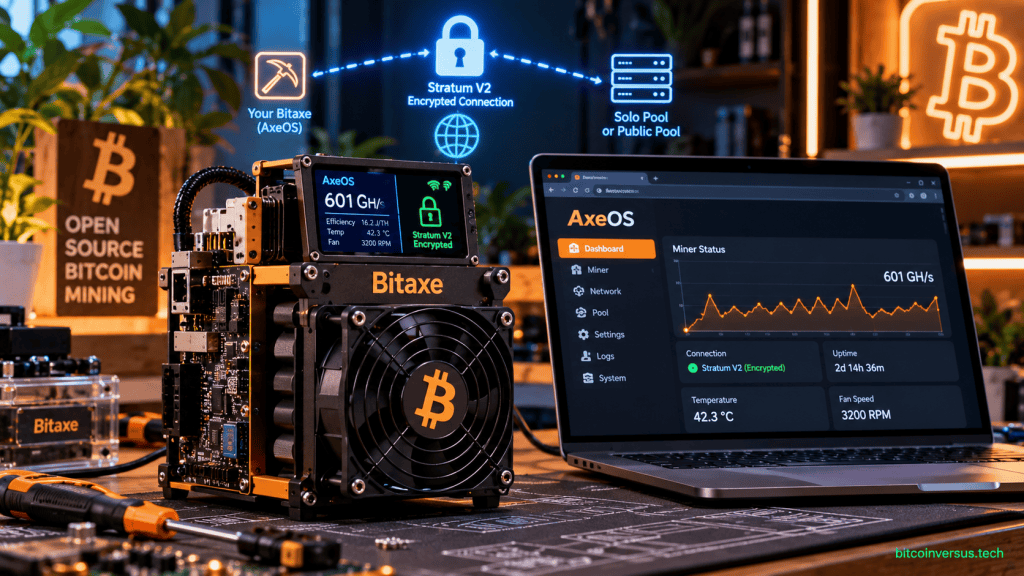
Open-source Bitaxe miners can now connect directly to a Stratum V2 endpoint operated by Bitaxe Pool, giving AxeOS users an encrypted and authenticated path from a desktop Bitcoin ASIC to a solo-mining pool.
The pool added Stratum V2 service on September 8, and a September 13 technical guide documents the configuration for AxeOS 2.14.0 and newer. The change is important because the miner-to-pool connection is part of the mining stack that remains largely invisible after an ASIC begins hashing.
AxeOS now speaks the newer mining protocol
Stratum V1 has been the dominant mining-pool protocol for years. Stratum V2 replaces its plaintext JSON transport with a binary protocol and supports encrypted connections. On a Bitaxe, the operator selects Stratum V2 inside AxeOS and supplies the pool host, port, channel type and authority public key.
The authority key matters because it lets the miner authenticate the pool during the encrypted handshake rather than simply connecting to whatever server answers at the configured address. Bitaxe Pool says its V2 endpoint uses port 3336 for Bitaxe-class miners.
For readers new to the hardware, this Solo Satoshi walkthrough shows a real Bitaxe Touch being configured, including Wi-Fi, pool information and the AxeOS dashboard. The video is embedded here so the miner and its software interface can be viewed directly inside the article.
Open-source mining is becoming a full stack
Bitaxe is unusual because the hardware design and firmware are both public. The project publishes PCB and design files for multiple miner generations, while ESP-Miner provides the ESP32-based firmware and AxeOS browser interface. That makes the pool protocol another inspectable layer rather than a hidden appliance feature.
BitcoinVersus.Tech recently covered AxeOS improving device-specific frequency warnings, while our mining-hardware coverage has also examined a 600 TH/s industrial air-cooled miner and Bitdeer’s latest production figures. Bitaxe sits at the opposite end of the scale: low-power hardware intended to let individuals operate and modify a Bitcoin ASIC themselves.
Encryption does not change mining odds
Stratum V2 does not make a Bitaxe hash faster or improve the probability attached to a given amount of hashrate. Its value is in the communication layer. The protocol can encrypt miner-to-pool traffic and authenticate the pool, reducing the exposure inherent in a plaintext V1 connection.
The open-source firmware project added Stratum V2 support in ESP-Miner 2.14.0 in June. The newer September pool endpoint means Bitaxe operators now have another live destination where those AxeOS controls can be used directly.
That combination is the larger story: open PCB designs, open firmware, a local web interface and a modern mining protocol are increasingly available in one small home-mining stack.
BitcoinVersus.Tech
Advertisement: Follow BitcoinVersus.Tech for independent coverage of Bitcoin, ASIC hardware, open-source mining, semiconductors, artificial intelligence, data centers and energy.
Disclaimer: BitcoinVersus.Tech provides news, analysis and educational information for general informational purposes. Nothing in this article is financial, investment, legal or professional advice. Readers should independently verify information and make their own decisions.


Leave a Reply