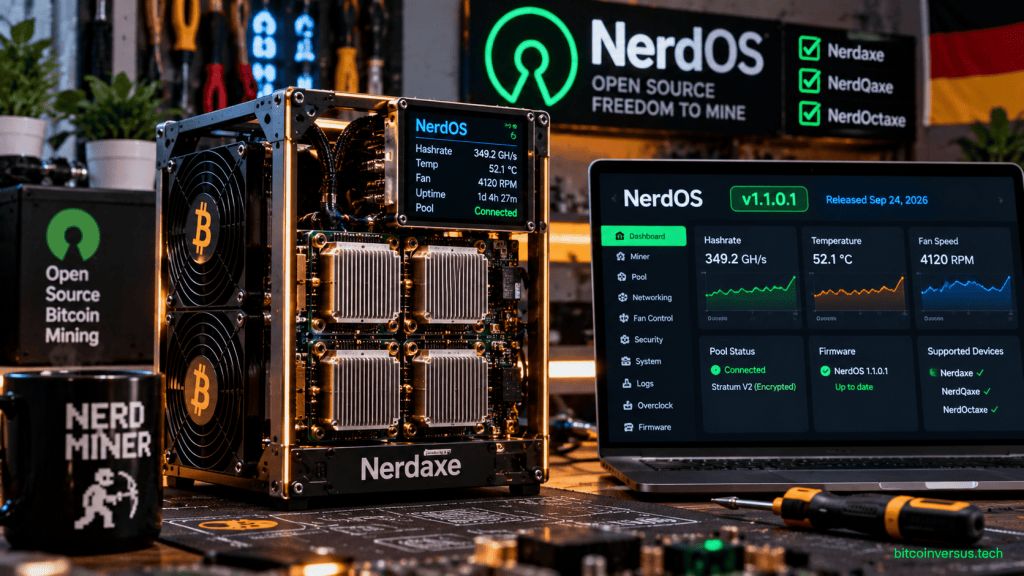
The open-source Bitcoin mining ecosystem has another current firmware branch to watch: NerdOS 1.1.0.1, released September 24 for Nerdaxe, NerdQaxe and related multi-chip home miners.
Unlike Bitaxe devices running AxeOS, the Nerd family uses NerdOS, a related open-source firmware maintained for boards ranging from single-chip Nerdaxe hardware to four-chip NerdQaxe and larger NerdOctaxe designs. A current open-mining guide lists version 1.1.0.1 as the September 24 release and describes NerdOS as a branch of the same broader ESP-Miner firmware family.
NerdOS gives open miners their own control stack
NerdOS provides the browser-based layer between an operator and the ASIC board. The interface exposes mining status, pool configuration, clock settings, fan control, security options, swarm management and system controls without requiring a separate PC to keep the miner running.
The distinction is important because open-source mining is no longer a single-board experiment. The Nerd mining ecosystem documents devices ranging from one BM1370 ASIC to four- and eight-chip designs, with supported hardware including Nerdaxe Gamma, NerdQaxe++, NerdQX and NerdOctaxe variants.
Four BM1370 chips put NerdQaxe++ near 5 TH/s
One of the better-known NerdOS targets is the NerdQaxe++. It combines four BM1370 ASICs on one open board rather than the single chip used by a Bitaxe Gamma. Published firmware-based configuration data places the board around 4.9 TH/s at roughly 76 watts under its standard settings, although actual performance depends on hardware revision, cooling and tuning.
That makes the project an interesting bridge between tiny desktop miners and conventional industrial ASICs. BitcoinVersus.Tech recently covered Bitaxe adding encrypted Stratum V2 pool connectivity through AxeOS, NMAxe’s latest open-miner firmware work, and three solo-mined Bitcoin blocks landing within 22 hours. NerdOS represents another independently developed branch of that home-mining movement.
The ASIC remains closed, but the machine around it is open
Open-source Bitcoin miners still rely on proprietary ASIC silicon. BM1370 and related Bitmain chips are not open designs. What projects such as Nerdaxe and Bitaxe expose are the board layouts, controllers, firmware, cooling choices and software surrounding those chips.
That difference gives builders room to repair boards, modify firmware, change cooling, inspect pool behavior and build new multi-chip configurations without waiting for a vertically integrated miner manufacturer. NerdOS also supports modern pool features including Stratum V2 on compatible builds, extending open development into the miner-to-pool communication layer.
For Bitcoin mining decentralization, the important trend is not whether a desktop miner can economically outperform a warehouse full of industrial ASICs. It is that the engineering stack around Bitcoin mining hardware is becoming accessible enough for independent developers to inspect, modify and manufacture.
BitcoinVersus.Tech
Advertisement: Follow BitcoinVersus.Tech for independent coverage of Bitcoin, ASIC hardware, open-source mining, semiconductors, artificial intelligence, data centers and energy.
Disclaimer: BitcoinVersus.Tech provides news, analysis and educational information for general informational purposes. Nothing in this article is financial, investment, legal or professional advice. Readers should independently verify information and make their own decisions.


Leave a Reply