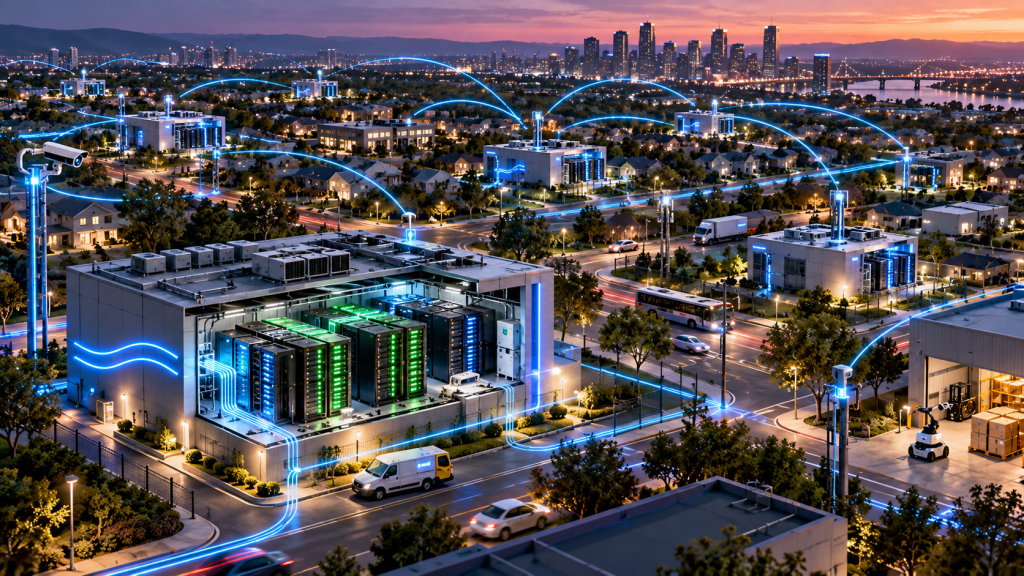
Spectrum is turning an existing cable-network footprint into distributed AI infrastructure, activating compute across a network that can reach more than 1,000 smaller edge data centers already embedded in its operations.
The company says the footprint can place accelerated computing within roughly 10 milliseconds of 500 million connected devices in homes and businesses across the United States. The Edge Compute Infrastructure platform uses NVIDIA accelerated computing and is adding commercial relationships with CAST AI, HP and Hydra Host.
AI Compute Is Moving Closer to the Device
Large centralized data centers remain essential for training and serving artificial intelligence, but some workloads cannot tolerate a long network trip. Robots, machine vision, interactive video, industrial sensors and private-data applications can benefit when compute sits much closer to where the data originates.
Spectrum’s approach is notable because it starts with facilities and fiber that already exist. Instead of building every AI site from the ground up, the company is adding accelerated compute to smaller network locations distributed across its service footprint.
The architecture connects directly with trends BitcoinVersus.tech has been tracking in low-power physical-AI acceleration, robot-learning infrastructure, NVIDIA’s Isaac ROS 5.0 robotics stack and hardware isolation for autonomous AI agents.
More Than 1,000 Existing Edge Facilities
The scale claim is the key part of the announcement. Spectrum says its network already includes more than 1,000 smaller owned and operated facilities that can host edge compute. Those sites are tied together by its fiber network and sit geographically closer to end users than a handful of hyperscale campuses.
At SCTE TechExpo 2026, Spectrum is demonstrating the platform with NVIDIA accelerated computing and commercial partners. CAST AI is working with the infrastructure for distributed AI workloads, HP is participating in the ecosystem, Hydra Host is using the platform for AI compute, and World Wide Technology is demonstrating a robotics use case.
Why 10 Milliseconds Matters
Ten milliseconds is not a guarantee that every application will see 10 ms end-to-end latency. Device connectivity, application software, routing and workload scheduling all add delay. Spectrum’s claim is about infrastructure proximity: its edge footprint can put compute physically and topologically closer to a very large number of devices.
That distinction matters for physical AI. A warehouse robot, traffic camera or industrial inspection system may need to react continuously rather than wait for a distant cloud region. Edge inference can also reduce how much raw sensor data has to cross a wide-area network.
Cable Infrastructure Becomes AI Infrastructure
The larger strategic shift is that telecom and cable assets are being repurposed for compute. Network operators already control fiber, powered buildings and locations near customers. Adding GPUs and accelerated servers can turn some of those assets into a distributed compute layer.
That does not eliminate hyperscale data centers. Training frontier models and running enormous batch workloads still favor massive centralized campuses. Spectrum is instead targeting the other end of the architecture: latency-sensitive inference and applications that benefit from geographic distribution.
If the commercial deployments scale, the result could make AI infrastructure look less like a small number of giant campuses and more like a hierarchy: hyperscale training centers at the core, regional facilities in the middle and hundreds or thousands of smaller accelerated-compute nodes near the devices actually using the models.
BitcoinVersus.Tech Editor’s Note
Support independent technology reporting: BTC donations may be sent to 3C9o19EH5HSiwEPyCTmEKzxhNCbo2X6TTb.
Follow BitcoinVersus.tech on X/Twitter for AI infrastructure, semiconductors, robotics, Bitcoin mining and data-center reporting.
Disclaimer: BitcoinVersus.tech is not a financial advisor. This media platform reports on financial subjects purely for informational purposes.


Leave a Reply