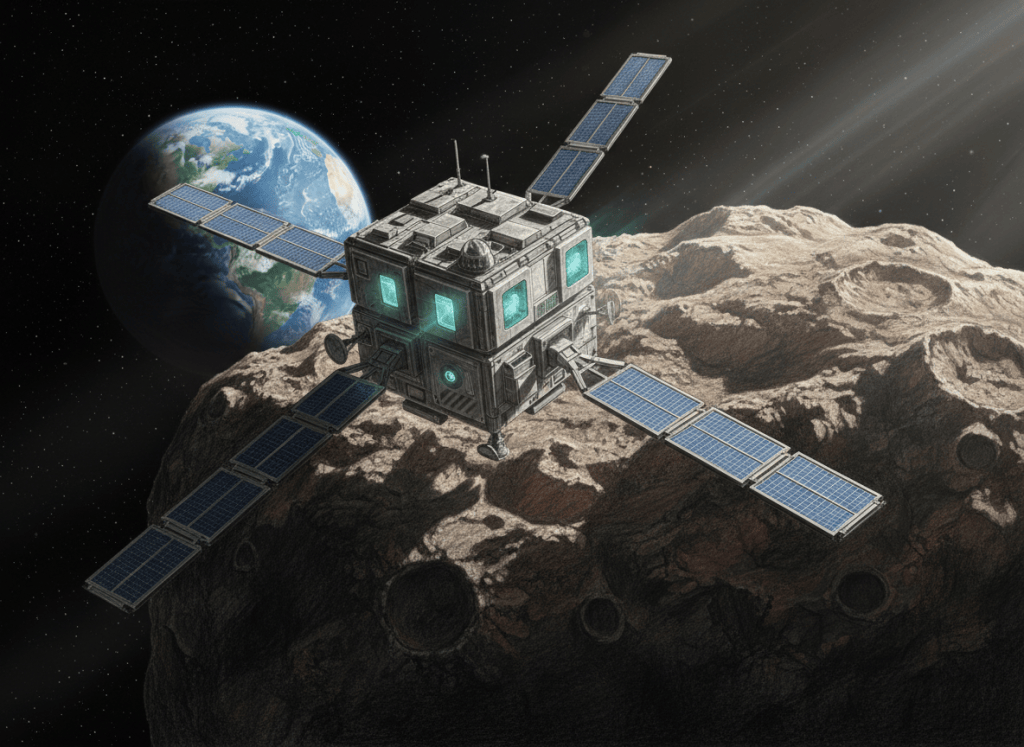
AstroForge wants to prove that a spacecraft can finish an entire mission after separation without receiving a single command from Earth.
The California asteroid-mining startup introduced Autonomy-1 on September 21 as the first full-scale flight demonstration of Solo, its onboard spacecraft intelligence model. The mission is planned to launch in 2027 aboard the first flight of Stoke Space’s Nova Pathfinder vehicle, with Solo responsible for coordinating spacecraft operations after separation.
Autonomy-1 removes mission control from the command loop
In its official Autonomy-1 announcement, AstroForge says the spacecraft will transmit telemetry and science data back to Earth but is not intended to receive commands after it separates from the launch vehicle. The mission will also carry COMPASS, a NASA Goddard heliophysics payload that Solo will operate alongside the spacecraft itself.
AstroForge summarized the plan in its Autonomy-1 launch thread on X: the spacecraft is intended to complete its mission objectives without a human operator in the loop.
Solo sits above conventional flight software instead of replacing it
The architecture matters. Solo is not supposed to replace the deterministic, physics-based software that already handles tightly defined spacecraft functions. Instead, AstroForge describes it as an intelligence layer that watches spacecraft state, identifies off-nominal behavior, decides what should happen next and coordinates the appropriate onboard systems.
TechCrunch reported that Solo is a transformer-based control stack developed in-house. The company is training specialized models on subsystem data and giving the higher-level system access to roughly 2,500 spacecraft sensor inputs, allowing it to correlate problems that a ground team might only see through a constrained telemetry stream.
DeepSpace-2 is the rehearsal before Solo takes control
AstroForge is not planning to hand a spacecraft to Solo without an intermediate test. DeepSpace-2 is expected to carry the model first in “shadow mode,” meaning Solo will process real spacecraft data and make hypothetical decisions while the vehicle continues operating under its conventional control architecture.
That gives engineers a way to compare Solo’s decisions against actual flight behavior before Autonomy-1 removes the ground-command loop. The progression resembles a staged validation program: observe first, compare the model against reality, then let the autonomous layer act on a dedicated demonstration mission.
Deep-space autonomy is becoming an infrastructure problem
The deeper a spacecraft travels, the harder it becomes to treat Earth as a real-time control room. Communications windows are limited, downlink bandwidth is constrained, and light-time delays grow with distance. AstroForge says ground operations already represent nearly one-third of its mission costs and argues that assigning a dedicated mission-control structure to every future spacecraft will not scale to a fleet.
That makes Autonomy-1 less about adding an AI label to a spacecraft and more about moving operational decision-making closer to the hardware. BitcoinVersus.Tech recently covered Varda’s shift toward operating multiple reentry vehicles as a fleet, another example of space companies confronting the operational complexity that arrives after one-off demonstrations become repeatable services.
The test is whether autonomy can survive real anomalies
Autonomous spacecraft already exist in narrower forms. Guidance systems can execute burns, navigation software can maintain attitude, and mission-specific logic can perform preplanned sequences. Solo’s more ambitious claim is cross-system reasoning: using a larger view of the spacecraft to connect symptoms, identify likely causes and choose a recovery action without waiting for a human team.
That idea also intersects with the broader push to make orbital infrastructure more self-sufficient. NASA-backed Otter is being developed to inspect uncooperative spacecraft in orbit, while Satlyt is exploring distributed AI-compute infrastructure across satellites. Autonomy-1 applies the same general pressure from another direction: reduce the amount of human intervention required to keep a spacecraft useful.
A successful demo would shift the economics of small deep-space fleets
The important result will not be whether Solo can follow a nominal checklist. It will be whether the system can recognize unexpected conditions, select safe responses and continue a mission with enough reliability that operators can trust a spacecraft they cannot command.
If Autonomy-1 works as planned, the demonstration would give AstroForge evidence that the traditional relationship between spacecraft and mission control can be redesigned. Instead of every vehicle depending on a large Earth-based decision loop, more of the intelligence required to survive and operate could travel with the spacecraft itself.
BitcoinVersus.Tech
Advertisement
Editor’s Note
We volunteer daily to ensure the credibility of the information on this platform is Verifiably True. If you would like to support to help further secure the integrity of our research initiatives, please donate here: 3C9o19EH5HSiwEPyCTmEKzxhNCbo2X6TTb
BitcoinVersus.tech is not a financial advisor. This media platform reports on financial subjects purely for informational purposes.


Leave a Reply