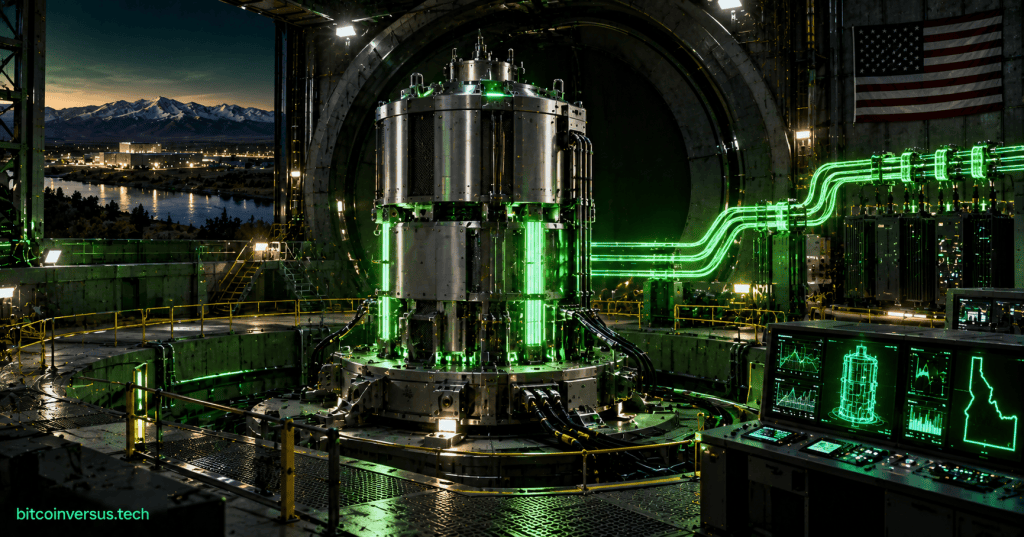
A one-megawatt transportable nuclear reactor is moving toward a full-power test in Idaho. Deployable Energy has been selected by the U.S. Department of Energy’s National Reactor Innovation Center to test its Unity Nuclear Battery inside Idaho National Laboratory’s DOME microreactor testbed in 2027.
According to Idaho National Laboratory’s September 30 announcement, Unity is a light-water-moderated, helium-cooled transportable microreactor designed to generate 1 MWe. The planned campaign will evaluate full-power performance, integration, controls, safety and operating procedures at a much higher scale than the company’s earlier zero-power criticality work.
Unity is moving from criticality to useful power
Criticality proves that a reactor can sustain a controlled chain reaction. It does not by itself prove that the complete power system can operate continuously at rated electrical output. That is why the DOME test is a major engineering step: Deployable Energy now has to demonstrate how the reactor, helium cooling, controls, protection systems and balance-of-plant behave together under power.
Deployable Energy’s announcement on X confirms the selection and frames DOME as the company’s next major validation step at INL.
DOME was built to shorten the path from reactor design to hardware
DOME opened in April 2026 as a purpose-built environment for fueled microreactor experiments producing up to 20 MW of thermal power. Instead of every developer creating an entirely new test site, the facility gives advanced-reactor teams access to an established national-laboratory testbed for gathering performance and safety data.
NRIC says Deployable Energy will be the second company to test in DOME after Radiant. The testing campaign is self-funded, and the company must continue meeting milestones involving technology readiness, fuel availability and regulatory plans to retain its scheduled test window.
The design targets places where a grid connection is difficult
Deployable Energy describes Unity as a compact, modular system intended for manufacturing and transport rather than a conventional custom-built nuclear station. The company’s technology overview lists industrial, defense, humanitarian and remote applications and says the reactor uses standard 5% enriched fuel.
That approach fits a broader energy trend BitcoinVersus.Tech has been following. Amazon and X-energy’s nuclear data-center partnership illustrates the demand for firm power at enormous scale. Microreactors attack a different end of the problem: smaller loads, remote sites and applications where transporting a compact power plant may be easier than extending major transmission infrastructure.
One megawatt is small for a reactor—but meaningful for distributed infrastructure
A 1 MWe unit is tiny compared with a utility nuclear station, yet it sits in an interesting range for isolated industrial operations, defense installations, remote communities and other mission-critical loads. Multiple standardized modules could also change how nuclear capacity is expanded if the manufacturing and licensing model ultimately works as intended.
BitcoinVersus.Tech has previously examined why small modular reactors could change nuclear deployment. Unity pushes that modular idea down another order of magnitude, toward a product the developer wants to manufacture, transport and redeploy rather than a megaproject assembled permanently on one site.
The real test is whether “nuclear battery” can become an operating product
The term “nuclear battery” can sound like a sealed consumer battery, but Unity is a fission microreactor with reactor physics, cooling, controls, fuel and safety systems. The 2027 DOME campaign therefore matters because it moves the idea toward the conditions that determine whether a reactor can become an operational power product rather than simply a successful experiment.
The energy market has a strong reason to watch. BitcoinVersus.Tech recently reported that U.S. data centers could face a 33 GW power shortfall by 2028. Microreactors will not solve that scale of demand by themselves, but a manufacturable one-megawatt reactor could create another option for loads that need firm power without waiting years for large grid upgrades.
Deployable Energy has already crossed the criticality milestone. The next question is harder: can the complete Unity system safely produce useful electrical power at full output and generate the operational data needed for commercialization? DOME is where that question is scheduled to get a much more concrete answer.
BitcoinVersus.Tech
Advertisement
Editor’s Note
We volunteer daily to ensure the credibility of the information on this platform is Verifiably True. If you would like to support to help further secure the integrity of our research initiatives, please donate here: 3C9o19EH5HSiwEPyCTmEKzxhNCbo2X6TTb
BitcoinVersus.tech is not a financial advisor. This media platform reports on financial subjects purely for informational purposes.


Leave a Reply