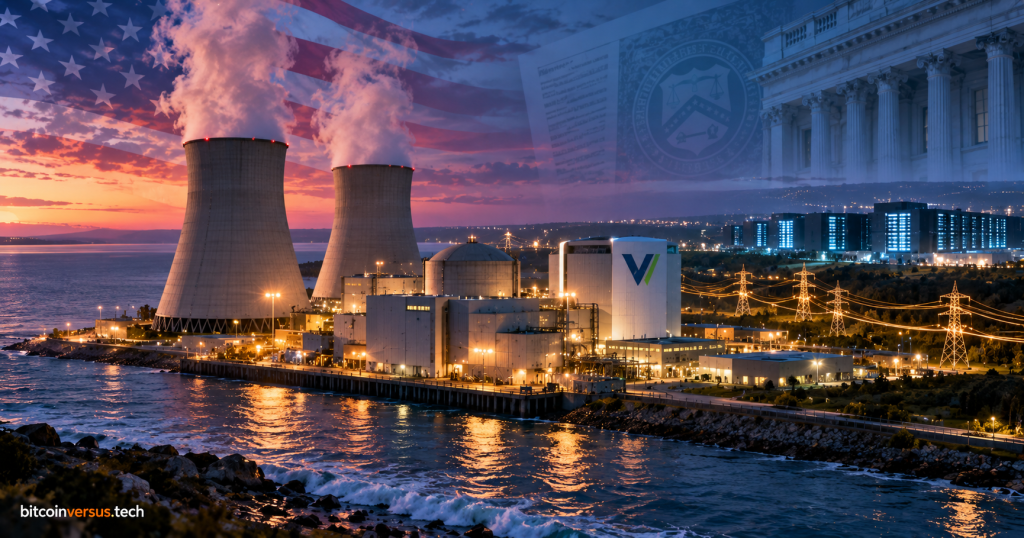
The U.S. government plans to lend Vistra about $4.2 billion to increase output from existing nuclear power plants, according to a person familiar with the matter cited by Reuters, as electricity demand from AI data centers, electrification and crypto mining keeps climbing.
According to the current report, Energy Secretary Chris Wright is expected to announce the financing Monday at a Vistra nuclear plant on Lake Erie in Ohio. Reuters says the loan would support power uprates at at least three of Vistra’s four nuclear stations.
The significance is speed: instead of waiting years for a new reactor, an uprate attempts to pull more megawatts from nuclear infrastructure that is already built, staffed, connected to the grid and licensed to operate.
The federal financing path was already visible
A September 15 Department of Energy filing shows the Office of Energy Dominance Financing evaluating a federal loan guarantee for Vistra’s Perry Nuclear Power Plant uprate project in Lake County, Ohio. The document describes modifications intended to increase generating capacity and improve long-term plant performance and reliability.
Reuters reports that Vistra operates six reactors across four U.S. nuclear plants with more than 6.5 GW of combined generation. The planned federal financing would target at least three stations through uprates rather than building entirely new plants.
The broader power problem is already visible in data-center planning. BitcoinVersus.tech recently reported that U.S. data centers could face a 33 GW power shortfall by 2028, putting more pressure on utilities and grid operators to add firm generation quickly.
Reuters also posted the report on X as the financing story moved through energy and infrastructure markets.
What an uprate actually changes
Nuclear uprates can involve higher-capacity equipment, turbine changes, fuel modifications and other plant improvements that allow an existing reactor to produce more electricity. They are not equivalent to constructing another reactor from scratch.
That matters when the grid needs additional firm capacity faster than a greenfield nuclear project can usually be licensed and built. An operating reactor already has the transmission connection, operating staff, security perimeter and much of the physical infrastructure required to deliver power.
AI is pulling nuclear deeper into data-center strategy
AI infrastructure changes the electricity problem because large compute campuses can require hundreds of megawatts while expecting extremely high uptime. Utilities therefore need generation that can run consistently through the day rather than only when weather conditions cooperate.
Nuclear power is not the only answer, but its capacity factor and existing grid footprint make current plants unusually valuable. BitcoinVersus.tech has also covered Deployable Energy’s 1 MW nuclear battery moving toward full-power testing, showing how the industry is simultaneously exploring much smaller reactor formats for distributed loads.
Existing reactors may be the fastest nuclear megawatts available
The policy logic behind uprates is straightforward. New nuclear plants can require long development cycles, while uprating an operating site can add capacity using an existing licensed facility and existing grid infrastructure.
BitcoinVersus.tech previously examined Amazon and X-energy’s nuclear data-center strategy. The Vistra financing report points to a complementary route: rather than waiting only for new reactors, squeeze more output from plants that are already operating.
That approach also connects directly to the data-center buildout. More AI compute means more transformers, transmission, substations and generation behind every rack. If the reported loan closes, federal financing would effectively be used to expand the power ceiling of existing nuclear assets instead of creating an entirely new site.
The announcement is still pending
The $4.2 billion figure is currently based on Reuters reporting from a person familiar with the matter. The Department of Energy and Vistra had not publicly confirmed the full financing package in that report, although DOE documentation already confirms federal loan-guarantee review for the Perry uprate project.
If announced as reported, the loan would make a simple point about America’s near-term power strategy: before the next generation of reactors arrives, some of the fastest nuclear capacity may come from getting more electricity out of the fleet that already exists.
BitcoinVersus.Tech
Advertisement
BitcoinVersus.Tech Editor’s Note:
We volunteer daily to ensure the credibility of the information on this platform is Verifiably True. If you would like to support to help further secure the integrity of our research initiatives, please donate here: 3C9o19EH5HSiwEPyCTmEKzxhNCbo2X6TTb
BitcoinVersus.tech is not a financial advisor. This media platform reports on financial subjects purely for informational purposes.


Leave a Reply