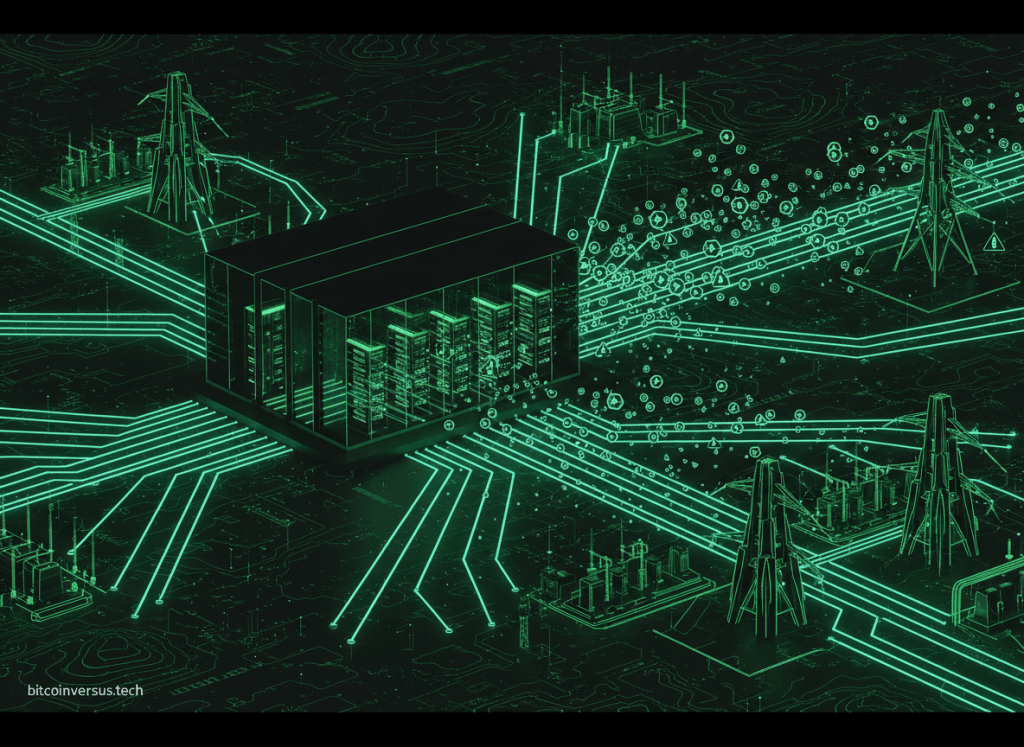
AI is getting cheaper to use, but that does not mean it will use less electricity. The opposite may happen: falling model and token costs can make artificial intelligence economical in far more workflows, pushing total compute—and therefore power demand—higher even as each individual task becomes more efficient.
That rebound effect is emerging as one of the most important infrastructure questions in the AI boom. McKinsey’s 2026 Global Energy Perspective identifies data centers as the fastest-growing electricity-load segment in OECD power markets and projects roughly 24% annual growth in global data-center electricity demand through 2030. Business Insider’s October 3 analysis connects that outlook directly to cheaper AI models and falling token prices.
Cheaper AI can create more AI
The basic economics are straightforward. When the cost of producing an AI response falls, companies can justify using AI for tasks that previously were too expensive. A support assistant can handle more conversations. A coding agent can run more tests. An industrial system can analyze more sensor data. An enterprise can deploy agents to thousands of employees instead of a small pilot group.
Efficiency therefore changes the denominator without necessarily shrinking the total. If the cost per AI task falls faster than demand grows, electricity consumption can decline. But if lower prices unlock enough new demand, aggregate compute consumption rises.
Data centers are becoming a new class of grid load
McKinsey’s projection matters because a 24% compound annual growth rate is not simply a server-industry statistic. Electricity systems must provide generation, transmission, substations, transformers, backup power and increasingly sophisticated load-management systems around that compute.
The physical infrastructure behind digital intelligence is why a recent analysis of the AI infrastructure stack framed the bottleneck in terms of atoms as much as bits: software costs can fall quickly, while power plants, transmission lines and data centers remain capital-intensive physical systems.
The rebound effect changes the efficiency debate
AI hardware is improving rapidly. Accelerators deliver more useful computation per watt, model architectures become more efficient and inference software keeps finding ways to reduce the work required for each request. Those advances remain important because without them the infrastructure burden would be even larger.
But efficiency should not be confused with lower total consumption. In economics, making a resource cheaper to use can stimulate enough additional demand to offset some or all of the savings. AI may be entering exactly that phase.
Power availability may matter as much as GPU availability
The industry has spent years treating advanced accelerators as the scarce resource. Increasingly, energized capacity is becoming just as strategic. A warehouse full of GPUs has little economic value if a utility cannot deliver the megawatts needed to run it.
BitcoinVersus.Tech recently examined the same constraint from several directions: AI’s 700 GW interconnection queue and its ghost-demand problem, the rush toward small gas turbines for faster data-center power, and NetworkOcean’s experiment powering an H100 from floating solar.
The next AI benchmark may be useful work per megawatt
Tokens per dollar will remain important, but infrastructure economics increasingly reward a second metric: how much economically useful AI work a facility can produce from a constrained block of electricity.
That pushes optimization across the entire stack—chips, networking, memory, cooling, power conversion, workload scheduling and model architecture. The winners may not simply own the fastest model or the largest cluster. They may be the companies that extract the most valuable intelligence from each available megawatt.
Efficiency is accelerating the buildout, not ending it
The counterintuitive takeaway is that better AI efficiency can increase the urgency of the power problem. Cheaper inference expands the number of economically viable applications, those applications increase compute demand, and compute demand turns into physical infrastructure.
AI may therefore follow a familiar technology pattern: efficiency lowers the cost of using a resource, and lower cost makes society consume dramatically more of it. For the grid, that means the AI efficiency race and the data-center construction race can accelerate at the same time.
BitcoinVersus.Tech
Advertisement
Editor’s Note
BitcoinVersus.Tech covers artificial intelligence, data centers, energy systems and the physical infrastructure behind modern computing.
If you value independent technology reporting, consider supporting BitcoinVersus.Tech with a Bitcoin donation: 3C9o19EH5HSiwEPyCTmEKzxhNCbo2X6TTb
BitcoinVersus.tech is not a financial advisor. This media platform reports on financial subjects purely for informational purposes.


Leave a Reply