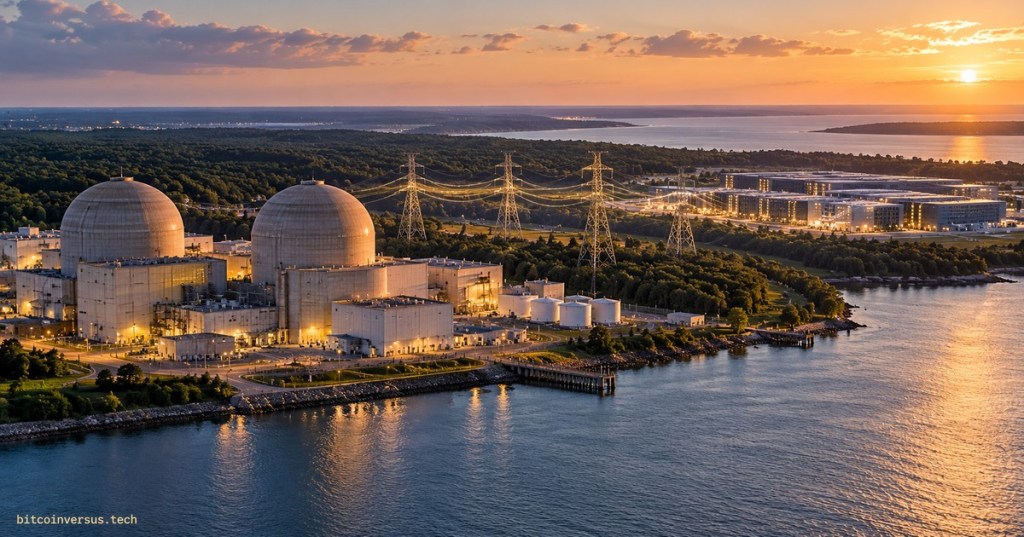
Amazon and Constellation have signed a 20-year power agreement that will support a 190 MW expansion of Maryland’s Calvert Cliffs Clean Energy Center, turning an existing nuclear plant into another piece of the infrastructure race behind cloud computing and AI.
Constellation’s announcement says the agreement covers 690 MW of power, including approximately 190 MW of new emissions-free generating capacity expected between 2030 and 2032. Reuters reported the deal as part of the widening effort by technology companies to secure reliable electricity for increasingly power-intensive computing infrastructure.
The key detail is the 190 MW uprate
Calvert Cliffs already operates two nuclear reactors with roughly 1,790 MW of generating capacity. The new agreement does not simply reserve existing output. It gives Constellation the long-term commercial certainty to pursue an uprate that would add about 190 MW to the plant.
That matters because adding capacity at an operating nuclear site can be materially different from waiting for an entirely new power plant to be designed, licensed and built. The uprate is scheduled to come online in stages between 2030 and 2032, while the broader agreement is also intended to support continued operation of Calvert Cliffs for decades.
BitcoinVersus.Tech has been tracking the same nuclear-compute convergence from several angles, including Amazon’s earlier work with X-energy on nuclear power for data centers. The Calvert Cliffs agreement extends that strategy into a large existing reactor fleet.
Constellation highlighted the agreement in its official X post announcing new emissions-free generation at Calvert Cliffs.
This is not a private wire from the reactor to an Amazon campus
One of the most important details is where the electricity goes. Constellation says all electricity generated by Calvert Cliffs will continue flowing into the PJM regional grid. Amazon and Constellation also signed a related retail supply agreement covering Amazon operations across the 13-state PJM market.
That structure makes this different from a behind-the-meter data center built directly beside a power plant. Amazon is effectively using a long-term commercial commitment to support more generation on the regional system while securing a supply relationship for its own facilities across PJM.
The distinction is important as grid planners wrestle with rapidly rising load. BitcoinVersus.Tech recently examined the projection that U.S. data centers could face a 33 GW power shortfall by 2028. Deals like this show hyperscalers responding by helping finance additional firm generation rather than relying only on new transmission and intermittent resources.
Existing nuclear plants are becoming data-center infrastructure
The larger trend is increasingly clear. AI infrastructure has pushed electricity procurement from a back-office operating expense into a strategic constraint. Nuclear plants are attractive because they can deliver large blocks of round-the-clock output, and existing plants can sometimes add capacity faster than greenfield generation can be built.
That does not remove the engineering and regulatory work. A nuclear uprate still requires equipment changes, plant work and approvals before new megawatts can reach the grid. But the Amazon agreement provides a long-duration customer commitment behind that process.
The technology is also moving toward smaller designs. BitcoinVersus.Tech recently covered a 1 MW nuclear battery heading toward full-power testing, illustrating how the industry is exploring both large-station uprates and much smaller deployable reactors.
Calvert Cliffs shows what the next phase of AI power procurement looks like
The first phase of the AI infrastructure boom focused on GPUs, networking and data-center construction. The next phase is increasingly about the electrical system behind those machines: generation, transmission, substations, interconnection and long-term contracts.
Amazon’s Calvert Cliffs agreement is a strong example because it ties a hyperscaler’s long-term demand to a measurable increase in existing nuclear capacity. The 190 MW uprate will not solve PJM’s power constraints by itself, but it shows how major computing customers are beginning to underwrite the generation upgrades required to keep scaling.
BitcoinVersus.Tech
Advertisement
Editor’s Note
If you value independent technology reporting, consider supporting BitcoinVersus.Tech with a Bitcoin donation: 3C9o19EH5HSiwEPyCTmEKzxhNCbo2X6TTb
BitcoinVersus.tech is not a financial advisor. This media platform reports on financial subjects purely for informational purposes.


Leave a Reply