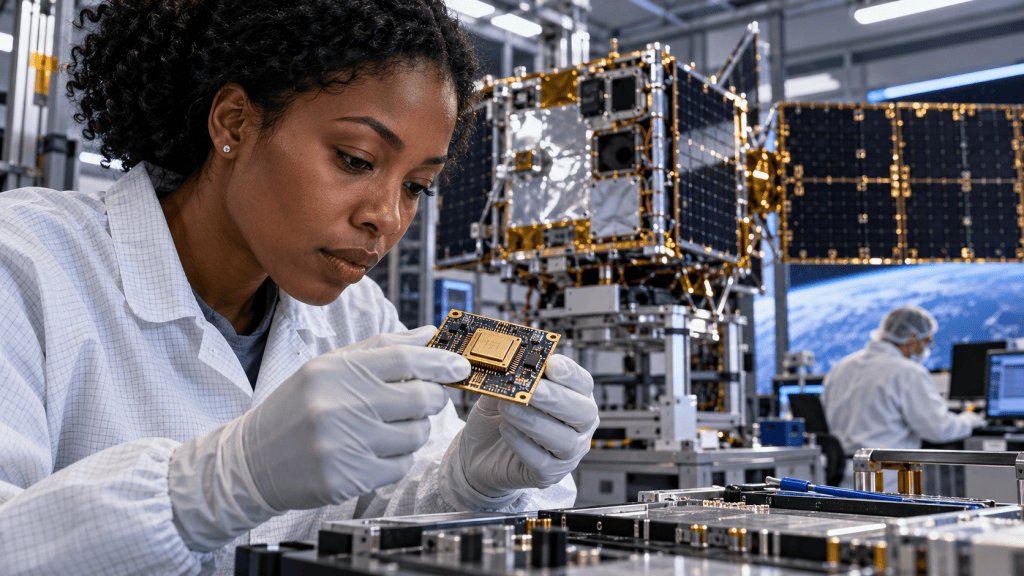
Microchip Technology has acquired Austin-based VORAGO Technologies, adding specialized microcontrollers and microprocessors that are designed to survive radiation and extreme heat. The deal, announced October 9, strengthens Microchip’s position in electronics for satellites, spacecraft, aerospace, defense, and demanding industrial systems.
The companies confirmed the acquisition but did not disclose the price. Microchip says it does not expect the purchase to materially affect its consolidated financial results.
Why Space Needs Different Chips
Ordinary chips can malfunction when energetic particles disrupt their circuits. In a satellite, even a brief error can affect navigation, communications, sensor readings, or control systems. Radiation-hardened components are engineered to tolerate conditions that would threaten ordinary commercial electronics.
VORAGO specializes in radiation-hardened and radiation-tolerant processors. Its devices can operate at temperatures up to 200°C, according to Microchip. The technology is relevant to the same orbital computing trend explored in BitcoinVersus.Tech’s stories on AI chips in space and satellites that process data onboard.
The HARDSIL Advantage
The acquisition also gives Microchip access to VORAGO’s patented HARDSIL process. Rather than relying entirely on protective shielding or complex system-level redundancy, the approach strengthens semiconductor devices during manufacturing. VORAGO says it can provide radiation resilience while preserving compatibility across chip families.
On its product website, VORAGO highlights Arm-based VA4 microcontrollers, VA5 dual-core designs, and a VA7 microprocessor for onboard computing. These parts target different combinations of radiation exposure, performance, power, and mission requirements.
A Bigger Space Electronics Portfolio
Microchip already supplies timing, processing, power, and control components for demanding systems. VORAGO brings additional expertise in radiation-resistant processor design, along with engineering talent and a customer base serving space and defense programs.
The Phoenix Business Journal reports that VORAGO hardware has flown on Blue Origin missions. The purchase comes as more satellites need local processing for autonomy, sensing, and communications, not merely a radio link back to Earth.
Why It Matters
Space computing is not only about putting faster processors into orbit. The hardware must remain dependable through radiation, thermal stress, and long deployments where a technician cannot simply swap a failed board. That makes processor selection, fault tolerance, and firmware validation central engineering decisions.
The same reliability questions appear in terrestrial embedded systems. BitcoinVersus.Tech’s firmware compatibility lesson explains why board revisions, bootloaders, and peripherals must be validated together. In orbit, the consequences of getting that engineering wrong can be much greater.


Leave a Reply