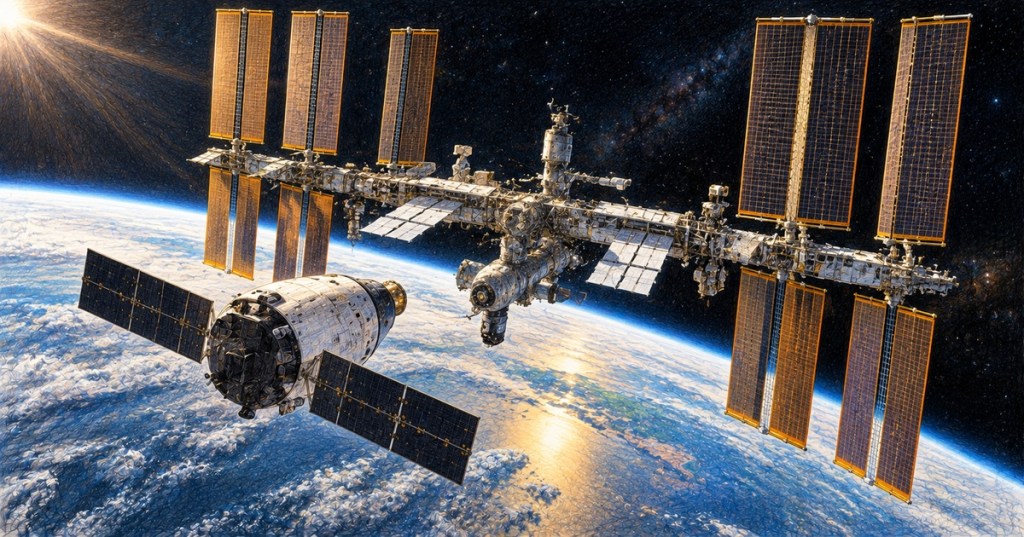
NASA and SpaceX are preparing to launch the final pair of International Space Station Roll-Out Solar Arrays, completing a power upgrade designed to give the aging orbital laboratory substantially more electricity for science and daily operations.
NASA says CRS-35 is targeting 6:33 a.m. EDT on October 13 from Space Launch Complex 40 at Cape Canaveral Space Force Station. The Cargo Dragon mission will carry about 6,300 pounds of supplies, experiments and station hardware, including the final iROSA set.
The solar arrays matter because the station’s original power system has gradually lost output as it ages. NASA says the full iROSA installation will raise ISS power generation by about 30%, giving crews more electrical headroom for experiments, life-support equipment and other station systems.
BitcoinVersus.Tech recently covered Redwire supplying roll-out solar-array technology for Axiom’s future commercial station. That connection shows how flexible-array hardware developed around today’s ISS is already feeding into the next generation of low-Earth-orbit infrastructure.
Space.com reports that Dragon is expected to dock autonomously with the station on October 15 after an approximately 52-hour flight. The mission also carries research involving lab-grown brain models, plant disease, astronaut health measurements and antibiotic-resistant bacteria.
The delivery arrives as NASA prepares for an eventual transition away from the ISS. BitcoinVersus.Tech reported that NASA is already taking proposals for commercial stations that could follow it.
Meanwhile, the existing station remains an active research platform. The recent Crew-13 mission reached the ISS in under eight hours, underscoring how routinely NASA and commercial partners now move people and hardware through low Earth orbit.
CRS-35 is still a scheduled launch at publication time, not a completed mission. If liftoff or docking changes, the timing may move, but the final iROSA delivery itself marks a concrete milestone: one of the ISS’s last major power upgrades before the station enters its final operating years.
BitcoinVersus.Tech is not a financial advisor. This media platform reports on financial subjects purely for informational purposes.
BitcoinVersus.Tech Editor’s Note:
We volunteer daily to ensure the credibility of the information on this platform is Verifiably True. If you would like to support to help further secure the integrity of our research initiatives, please donate using the QR code provided
For best QR-code scanning results, please scan this donation code from a desktop or larger screen



Leave a Reply