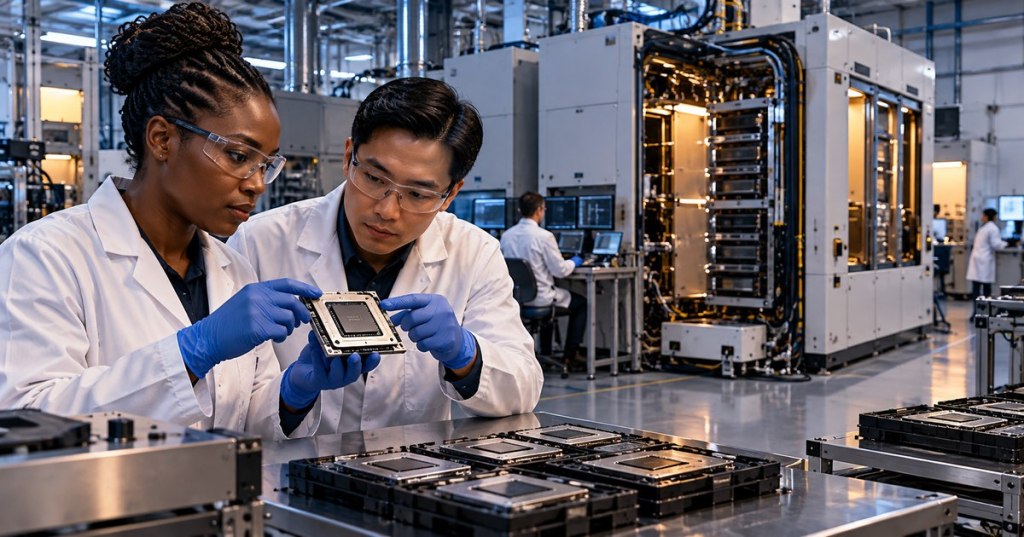
Teradyne has added production-ready burn-in testing to its Titan HP platform, giving AI-chip manufacturers a way to stress high-power processors while controlling each device’s temperature individually. Announced on October 6, 2026, the upgrade combines reliability screening with system-level testing rather than relying entirely on separate banks of heated ovens. The company says the enhanced platform is already deployed in production.
The distinction matters for advanced AI accelerators. A conventional burn-in oven heats a batch of devices for an extended period. Titan HP is designed to run a realistic workload on each processor while holding its junction temperature at a defined target. That creates a more closely controlled electrical and thermal test environment, according to Teradyne’s October 6 announcement.
Burn-In Tests Chips Before They Reach Data Centers
Burn-in is a manufacturing reliability step intended to expose weak devices before shipment. Chips operate under defined stress conditions for a prescribed period; failures detected in the factory can then be investigated rather than discovered after the device has been installed in an expensive server. For background, see BitcoinVersus.Tech’s earlier guide to semiconductor burn-in testing.
Burn-in is not the same as ordinary functional testing. A chip can pass a quick logic test and still have a marginal connection or device defect that becomes visible after prolonged electrical and thermal stress. Nor is burn-in a guarantee of lifetime reliability: the test is designed to reduce certain early failures, not eliminate all later defects.
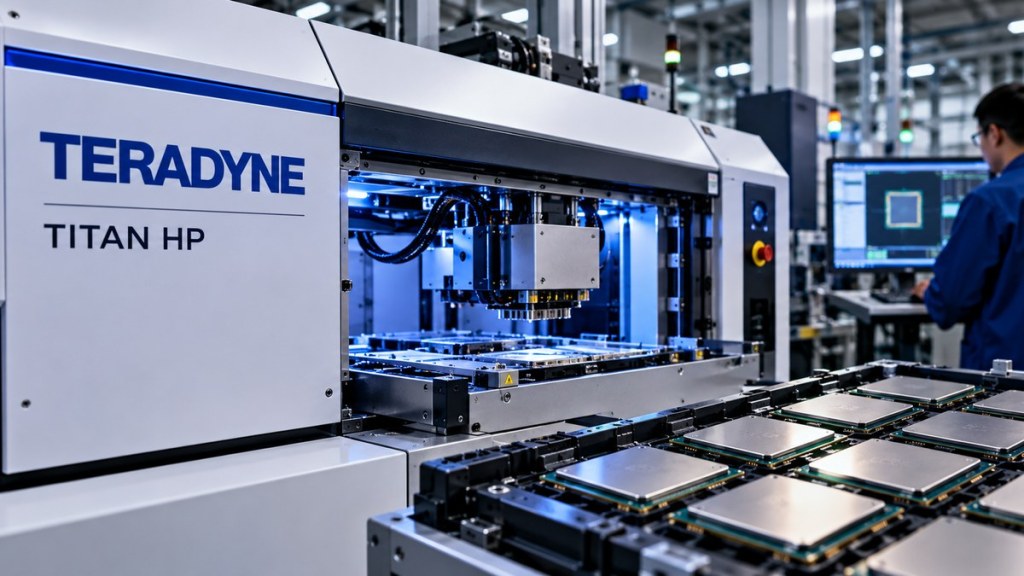
The Important Change Is Per-Device Thermal Control
Traditional oven-based burn-in generally controls the surrounding air temperature. But an accelerator’s hottest semiconductor junction can behave differently from the air around it, especially when the device consumes large amounts of power. Titan HP is designed to regulate each device’s thermal conditions and deliver kilowatt-scale power at the test site, while executing workloads that resemble real use.
Teradyne also says each device can retain one continuous stress-and-test record. That could make it easier for engineers to correlate failures with temperature, power and test history, although the company has not published comparative field-failure data or an independently verified cost-saving figure for this release.
Independent Slots Could Keep Test Lines Moving
One of the platform’s manufacturing features is an asynchronous slot architecture. Each test slot can load, run and finish independently. A processor requiring a long reliability stress cycle does not have to hold every other slot in the same state, and a site can be serviced while the rest of the system continues operating.
That is potentially useful in outsourced semiconductor assembly and test facilities, where production batches mix devices with different thermal limits, power envelopes and test times. Teradyne describes the architecture in its Titan HP product documentation. Its Atlas software supports importing existing test programs, developing new programs and porting them across compatible system-level testers.
Why AI Chips Need More Testing
Modern AI processors combine very large compute dies, high-speed I/O and complex memory systems. Many packages also integrate multiple chips, so a defect can be expensive to discover after final assembly. BitcoinVersus.Tech has covered the growing challenge of semiconductor packaging and the testing requirements of next-generation memory.
An accelerator failure in a live AI rack can affect service capacity, maintenance scheduling and the cost of spare hardware. Testing therefore becomes part of the infrastructure reliability problem, not just a final factory inspection. This is also why the difference between GPU memory, compute and package interconnects matters when engineers isolate a fault.
A separate Semiconductor Engineering discussion with Teradyne’s Ben Mitchel explains why system-level testing is becoming more important as AI processors grow more complex and power hungry. That discussion is company-sponsored, so it should be treated as a technical vendor perspective rather than an independent benchmark.
Watch Burn-In Testing in Practice
The following manufacturing demonstration shows how integrated circuits can be loaded into test sockets and screened under controlled stress. It illustrates the general burn-in workflow, not the Titan HP product itself.
Semiconductor burn-in demonstration showing devices operating under accelerated electrical and thermal stress.
The Industry Is Watching Semiconductor Test Capacity
Semiconductor testing is becoming more important as AI packages become more complex and expensive. Semiconductor journalist Dan Nystedt recently highlighted system-level testing, burn-in and reliability verification as areas moving up in importance across the AI-chip manufacturing chain.
What Comes Next
Teradyne says the enhanced Titan HP is available now and is already operating in production. The company plans to show the platform at the IEEE International Test Conference in San Antonio on October 11–16 and at SEMICON West in San Francisco on October 13–15, 2026.
The unanswered questions are commercial rather than conceptual: how much the integrated workflow reduces total test cost, how it changes throughput for different chip classes, and whether device-level thermal control improves field reliability at scale. The announcement provides no independent comparative data for those outcomes. What is clear is that chip testing is adapting to processors whose power and thermal behavior increasingly resemble entire small systems.


Leave a Reply