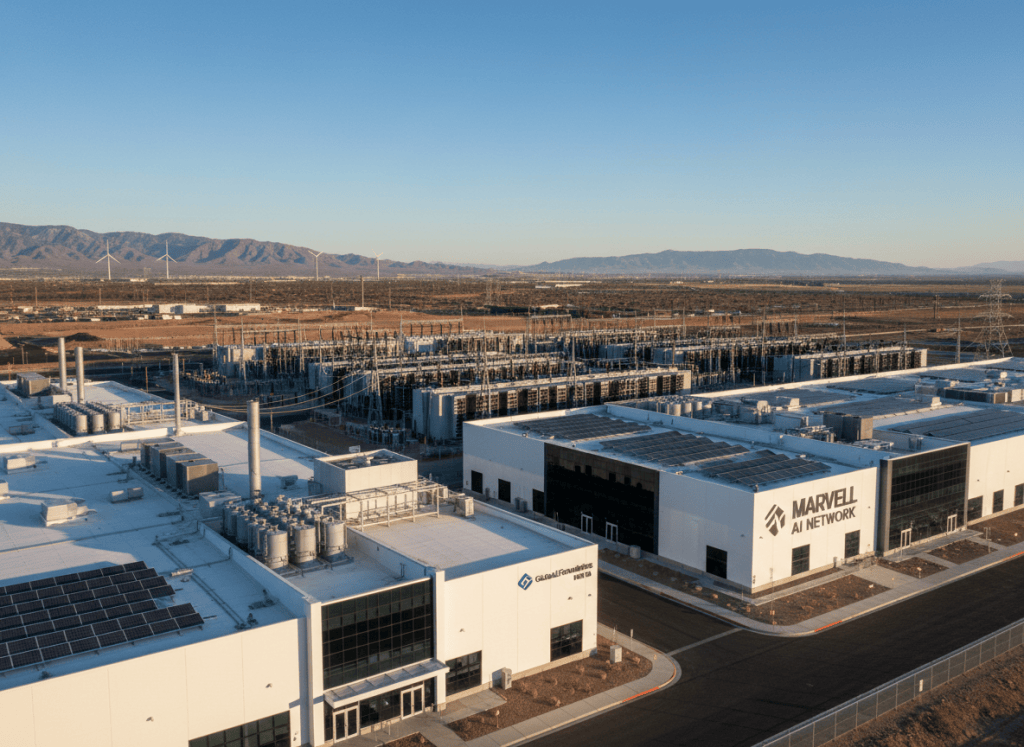
GlobalFoundries and Marvell Technology are expanding semiconductor manufacturing capacity in Vermont for a class of chips increasingly important to artificial intelligence data centers: silicon-germanium devices used in high-speed optical networking.
The companies announced an expanded multi-year agreement on September 17 that will increase capacity for GlobalFoundries’ silicon-germanium, or SiGe, technology at its Burlington, Vermont manufacturing facility. The additional capacity is intended to support Marvell’s growing requirements for pluggable optical transceivers, near-packaged optics and co-packaged optics.
AI data centers need more than faster GPUs
AI infrastructure is often discussed in terms of GPUs and other accelerators, but large clusters also depend on the network connecting those processors. Training and inference systems move enormous quantities of data between accelerators, CPUs and memory. As those systems grow, the speed and energy efficiency of the interconnect can become a major constraint.
That networking transition is already visible in the move toward 1.6T Ethernet and increasingly dense optical links. GlobalFoundries says its current SiGe technology supports 200-gigabit-per-second-per-lane optical connectivity, with a roadmap targeting higher-speed generations.
Why silicon-germanium matters
Silicon-germanium combines conventional silicon manufacturing with germanium to improve high-frequency performance. In optical networking, the technology can provide the signal integrity and power efficiency required by extremely fast electrical and optical interfaces.
GlobalFoundries has manufactured advanced SiGe technology for more than a decade. The company is also working to integrate SiGe with silicon photonics and advanced packaging as data-center architectures move toward near-packaged optics and co-packaged optics.
For readers approaching the subject from the chip-manufacturing side, BitcoinVersus.tech’s semiconductor overview provides additional background on how specialized process technologies fit into the broader semiconductor industry.
Optics are moving closer to the processor
Traditional pluggable optical transceivers sit at the edge of a network switch. Near-packaged and co-packaged optics move optical components progressively closer to the switch silicon. Shortening the electrical path can become increasingly valuable as bandwidth rises because high-speed electrical signaling consumes power and becomes more difficult to maintain over longer distances.
The same physical-layer pressures are behind broader investment in optical infrastructure. BitcoinVersus.tech recently covered Coherent’s PhotonLink platform for AI data centers, another example of vendors redesigning the links that move data through increasingly large compute clusters.
Marvell pushes toward 2nm optical silicon
The manufacturing agreement also arrives as Marvell demonstrates newer optical technology at ECOC 2026. The company announced 2-nanometer demonstrations including 400G-per-lane optical PAM4, an 800G ZR/ZR+ pluggable design and 1.6T coherent technology. Marvell is also showing a 102.4-terabit-per-second co-packaged-optics platform.
Those products are separate from GlobalFoundries’ SiGe manufacturing process, but together they illustrate how many semiconductor technologies are converging inside next-generation optical networks. Leading-edge digital signal processors, analog and RF devices, photonics, packaging and fiber infrastructure all contribute to the final link.
A physical infrastructure story
For data-center technicians, the announcement is another reminder that AI infrastructure extends far beyond the compute rack. Fiber type, transceivers, connectors, signal loss, switch architecture and cable management become increasingly important as link speeds rise. BitcoinVersus.tech’s data-center cabling fundamentals guide covers that physical layer from a field perspective.
The expanded GlobalFoundries-Marvell agreement does not disclose a dollar value or exact production increase. It does, however, commit additional U.S. manufacturing capacity to a technology that both companies expect to become more important as AI and cloud data centers demand higher bandwidth.
Sources: GlobalFoundries; Marvell Technology.
BitcoinVersus.Tech Editor’s Note:
We volunteer daily to ensure the credibility of the information on this platform is Verifiably True. If you would like to support to help further secure the integrity of our research initiatives, please donate here: 3C9o19EH5HSiwEPyCTmEKzxhNCbo2X6TTb


Leave a Reply