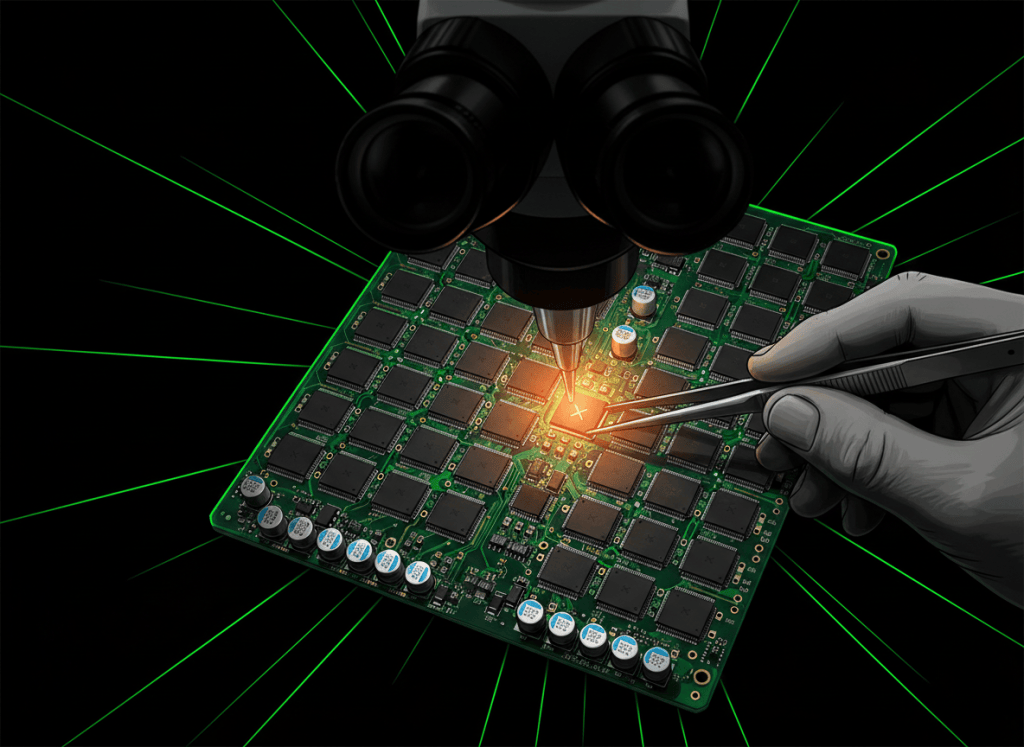
GoMining has shown the chip-level repair work behind keeping industrial Bitcoin mining hashboards online, documenting a failed ASIC replacement at its South Carolina mining farm.
In a September 30 repair video, GoMining shows a technician heating a hashboard until the solder reflows, lifting a failed chip, placing a replacement, cooling the board and testing it again under a microscope.
The sequence is a useful reminder that a mining failure is not always a whole-machine replacement. Bitmain’s troubleshooting guidance says incomplete chip counts, abnormal hashboard signals and unstable chips can require board repair after simpler cable, firmware and power-supply checks are ruled out.
One failed chip can take down a hashboard chain
Modern Bitcoin hashboards use dozens of ASICs arranged into tightly coupled signal and power domains. In many designs, the chips communicate through a serial chain, so one failed device can prevent downstream chips from reporting correctly or leave the board at zero hashrate.
A recent D-Central chip-level repair guide explains why technicians do not begin by randomly replacing silicon. The normal workflow is to isolate the fault through chip counts, voltage-domain checks, clock and reset signals, thermal behavior and test-fixture results before applying BGA rework to the suspected component.
That board-level architecture also explains why BitcoinVersus.tech previously warned that hashboards cannot always be swapped freely between ASICs. Board revision, firmware, control logic, voltage requirements and physical interfaces all matter before a repaired board can return to service.
Chip replacement is precision rework, not a simple parts swap
Once a technician has identified the failed ASIC, the physical replacement still requires tight process control. Heat must be sufficient to reflow the solder without warping the PCB or damaging nearby components. The old package is lifted, the pad area is cleaned, the replacement chip is aligned, soldered and allowed to cool before the board is tested again.
The rework step is especially demanding because mining hashboards run at high power density for long periods. Poor solder joints, damaged pads or incorrect alignment can create an intermittent fault that only appears after the board reaches operating temperature.
BitcoinVersus.tech’s recent coverage of Luxor Commander support for Bitmain HBH1500 hashboards shows how software visibility and hardware serviceability increasingly meet at the board level. A technician needs both diagnostic telemetry and physical repair skills to return a failed board to sustained production.
Repair economics matter at mining scale
At a large mining site, a failed hashboard is stranded capital. The chassis may still have a functional power supply, fans and control board, yet a single board can remove a meaningful portion of the machine’s hashrate until it is repaired or replaced.
That is why board repair belongs inside the broader economics of mining operations. A technician who can identify one failed ASIC, restore the signal chain and validate the board under load can often recover hardware that would otherwise sit idle or enter a replacement queue.
The same logic is visible across the architecture BitcoinVersus.tech mapped in its comparison of Bitmain, Canaan, MicroBT and Bitdeer ASIC designs: performance depends on the complete system, but the hashboard remains the component where the SHA-256 work is physically performed.
A repair bench is part of mining uptime
GoMining’s video compresses the repair into a short sequence, but the real value is the operational context. Mining uptime is not only about power contracts, cooling and firmware. It also depends on whether a site can diagnose failed silicon and return hashboards to service without waiting for an entire machine replacement.
For technicians, the process sits at the intersection of electronics troubleshooting and production operations: verify the symptom, isolate the failing domain, identify the chip, perform controlled rework, then test the board again before it goes back into the miner.
BitcoinVersus.Tech
Advertisement
BitcoinVersus.Tech Editor’s Note:
We volunteer daily to ensure the credibility of the information on this platform is Verifiably True. If you would like to support to help further secure the integrity of our research initiatives, please donate here: 3C9o19EH5HSiwEPyCTmEKzxhNCbo2X6TTb
BitcoinVersus.tech is not a financial advisor. This media platform reports on financial subjects purely for informational purposes.


Leave a Reply