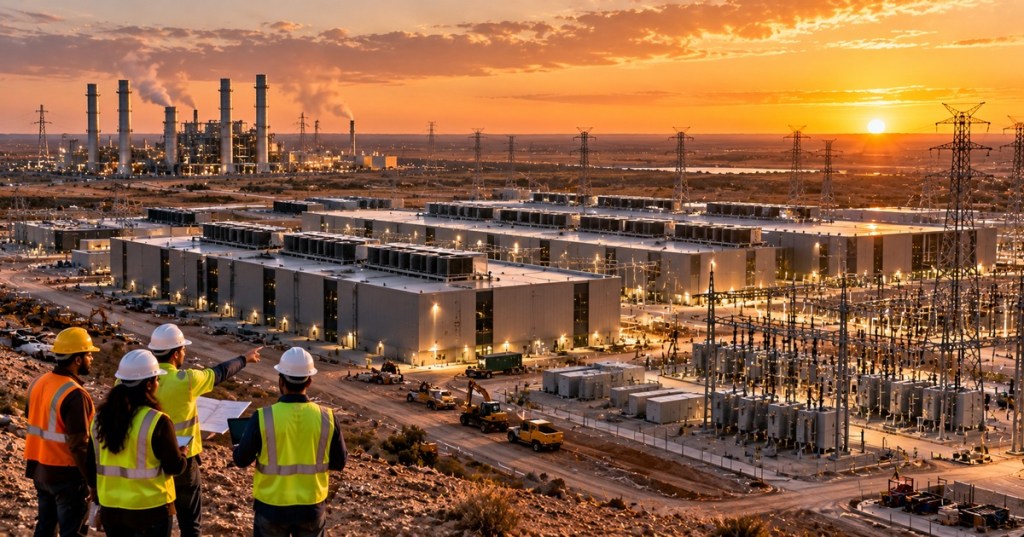
New Era Energy & Digital has put a $116 million standby letter of credit behind the power contract for Phase 1 of its Texas Critical Data Centers project in Ector County, Texas. In the same SEC filing, the company said it is now pursuing direct leases with hyperscale tenants rather than developing the project through a joint venture with a data center developer.
Key Takeaways
- The agreement was signed October 7, 2026 and disclosed in an SEC filing on October 8.
- Macquarie Bank issued a $116 million standby letter of credit in favor of Luminant ET Services, a Vistra affiliate.
- The letter of credit supports New Era subsidiary TCDC PowerCo’s obligations under the Phase 1 power purchase agreement.
- The company shifted its development strategy toward negotiating hyperscale leases directly instead of relying on a data center developer joint venture.
- No hyperscale tenant has been named and no signed tenant lease was disclosed in the filing.
The primary source is New Era Energy & Digital’s Form 8-K. The filing says TCDC PowerCo LLC and Texas Critical Data Centers LLC entered into a reimbursement agreement with Macquarie Bank Limited on October 7.
Under that agreement, Macquarie caused a $116 million standby letter of credit to be issued to Luminant. That credit support is tied to the power purchase agreement supporting the first phase of the West Texas campus.
The Letter of Credit Is Heavily Collateralized
The financing is not simply an unsecured promise from a bank. The SEC filing says the reimbursement obligations are backed by first-priority security interests in cash collateral that must remain at no less than 102% of the undrawn letter-of-credit amount.
At issuance, that worked out to about $118.3 million of cash collateral. New Era says $60 million came from draws under existing Macquarie term loans, while about $58.3 million came from cash held by TCDC PowerCo and Texas Critical Data Centers.
If the letter of credit is drawn, PowerCo must reimburse Macquarie and pay interest at 12% per year. The structure also includes a 1% fronting fee at issuance and a 2% annual letter-of-credit fee. New Era issued warrants for 413,055 common shares to the lender with an exercise price of about $7.26.
The Bigger Change Is the Leasing Strategy
The financing details matter, but the strategic change in Item 8.01 may be more important. New Era says it has begun pursuing leases directly with hyperscale tenants for the Texas Critical Data Centers project instead of seeking to develop the project through a joint venture with a data center developer.
That is a meaningful shift from the structure New Era described earlier in 2026. In January, the company announced a co-development partnership with Primary Digital Infrastructure for a roughly 1-gigawatt-plus hyperscale campus. At the time, New Era said the partnership would help bring institutional development, capital and tenant relationships to the project.
The new filing does not say that every previous commercial relationship has ended, and it does not identify which hyperscalers New Era is talking to. It does say the company now believes owning the site and having Phase 1 power under contract puts it in a position to negotiate tenant leases directly.
Phase 1 Has Up to 207 MW Under Contract
Two weeks before the new SEC filing, New Era announced a 20-year power purchase agreement with a Vistra affiliate for a minimum of 200 MW and up to 207 MW of firm contracted power for Phase 1. The company says power is expected to become available in the third quarter of 2027 from Vistra’s 1,180 MW natural-gas-fired generation facility next to the project.
That power contract helps explain why a $116 million letter of credit matters. Large-load power agreements often require substantial credit support before a project reaches operation. The new filing shows the amount of capital New Era is committing simply to secure the commercial obligations behind Phase 1 power.
BitcoinVersus.Tech has been tracking the same power bottleneck across Texas. Satoshi Energy recently mapped 1.2 GW of ERCOT projects inside a 5+ GW data-center pipeline, showing how quickly large-load requests are stacking up around available generation and transmission.
West Texas Is Turning Power Into Data Center Real Estate
TCDC is part of a broader shift in West Texas where land, natural gas, transmission access and private power development are being packaged into AI infrastructure projects. The value is increasingly tied less to the land itself and more to how quickly developers can deliver dependable megawatts.
BitcoinVersus.Tech recently covered Project Star pairing a multibillion-dollar Texas power buildout with a planned 5 GW AI campus. That project is much larger, but the logic is similar: developers are trying to turn secured energy supply into hyperscale-ready compute capacity.
What the Filing Does Not Confirm
The October filing does not disclose a signed hyperscale tenant, tenant rent, lease duration, construction start for a specific data hall or a final total project cost. It also does not guarantee that the planned hyperscale lease negotiations will produce an agreement.
New Era itself lists the ability to attract tenants, negotiate leases on acceptable terms and obtain project financing as risks. The company also says it expects to refinance outstanding term-loan borrowings in the near future.
An independent Texas data center public-record tracker separately flagged the October 8 filing and noted that New Era’s shift toward direct hyperscale leasing leaves the tenant name, lease terms and final buildout details open.
Why the Filing Matters
For AI data center projects, announcements about gigawatts are easy. Binding power obligations, cash collateral and tenant contracts are harder. The new filing provides concrete evidence that New Era has now put more than $100 million of credit support behind the first-phase power deal.
That still does not make TCDC a completed hyperscale campus. It does move the project further from concept toward financed power infrastructure, while also giving New Era more direct exposure to both the upside and the execution risk of negotiating hyperscale leases itself.
BitcoinVersus.Tech also recently examined how regulators are pushing large data centers to shoulder more of the infrastructure costs their demand creates. The TCDC filing shows the private-market version of that same reality: before a server rack goes live, enormous amounts of capital can be tied up just securing the electricity behind it.
Bottom Line
New Era’s October 8 filing confirms two important changes at once. The company now has a $116 million letter of credit supporting its Phase 1 power obligations, and it is shifting toward direct hyperscale tenant leasing instead of relying on a developer joint venture structure.
The next documents to watch are a signed hyperscale lease, refinancing details and any construction or power-delivery milestones tied to the 207 MW Phase 1 agreement. Until those appear, the project remains a large, heavily capitalized development rather than an operating hyperscale campus.
Editor’s Note: The $116 million letter of credit, collateral requirements, fees, warrants and direct-leasing strategy are confirmed in New Era Energy & Digital’s October 8, 2026 SEC filing. Statements about future tenants, refinancing, construction and project scale remain forward-looking unless separately completed or disclosed.
Support independent reporting: BitcoinVersus.Tech volunteers daily to help keep its research verifiably true. Bitcoin donation address: 3C9o19EH5HSiWEPyCTmEKzxhNCbo2X6TTb.
BitcoinVersus.Tech is not a financial advisor. This media platform reports on technology and financial subjects for informational purposes.


Leave a Reply