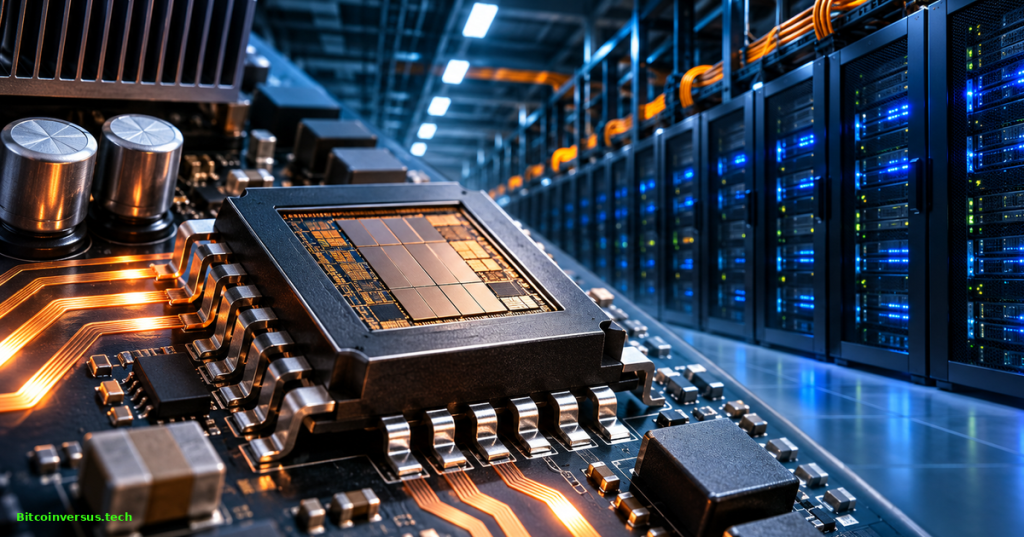
Artificial-intelligence processors consume substantial electrical power, but their computing cores operate at low voltages. Power semiconductor devices convert, regulate and deliver electricity from facility equipment through server racks and onto the processor package. Faster accelerators create demand for efficient conversion, compact voltage regulators and circuits that respond to abrupt changes in GPU current draw.
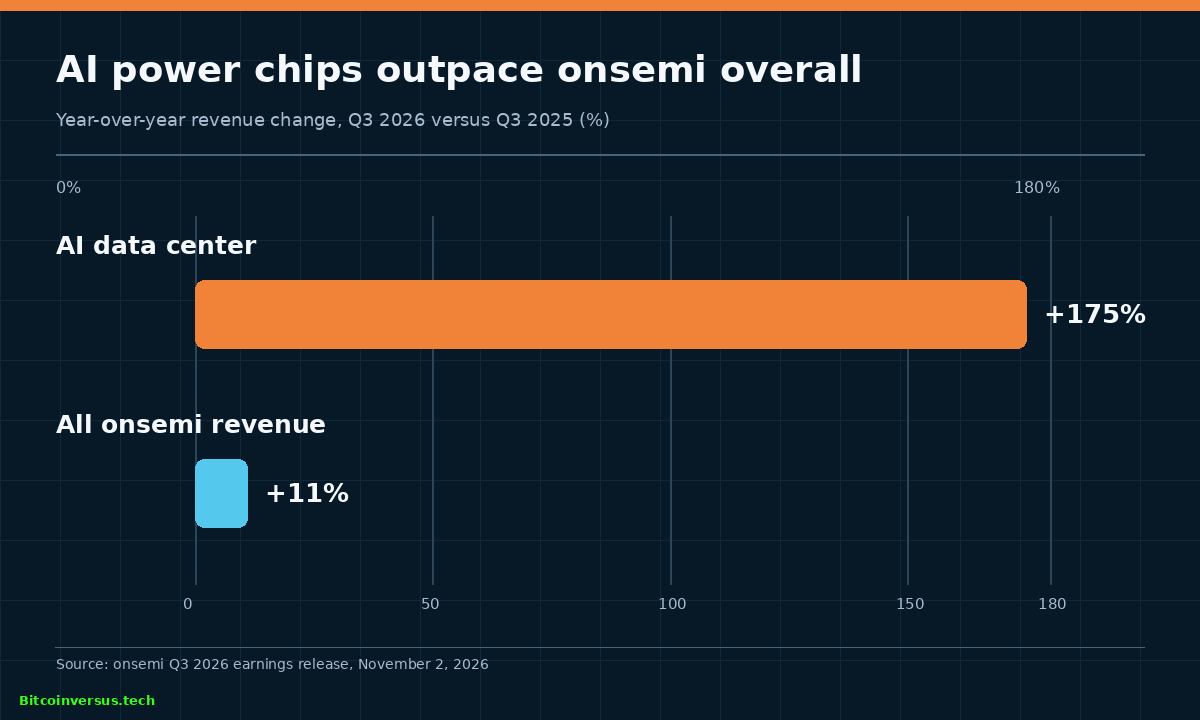
Against that backdrop, onsemi reported $180 million in AI data-center revenue for its third quarter of 2026, a 175% increase from the year-earlier period and 39% above the preceding quarter. Total company revenue rose just 11% year over year to $1.7223 billion. The quarter ended October 2; results were announced November 2.
AI is growing faster than the overall business
AI infrastructure accounted for approximately 10.5% of reported quarterly sales, calculated as $180 million divided by $1,722.3 million. The rapid percentage increase therefore describes a relatively small, fast-growing revenue category rather than a 175% expansion of the entire semiconductor company. onsemi’s investor presentation separates AI data centers from automotive, industrial and other end markets for greater visibility.
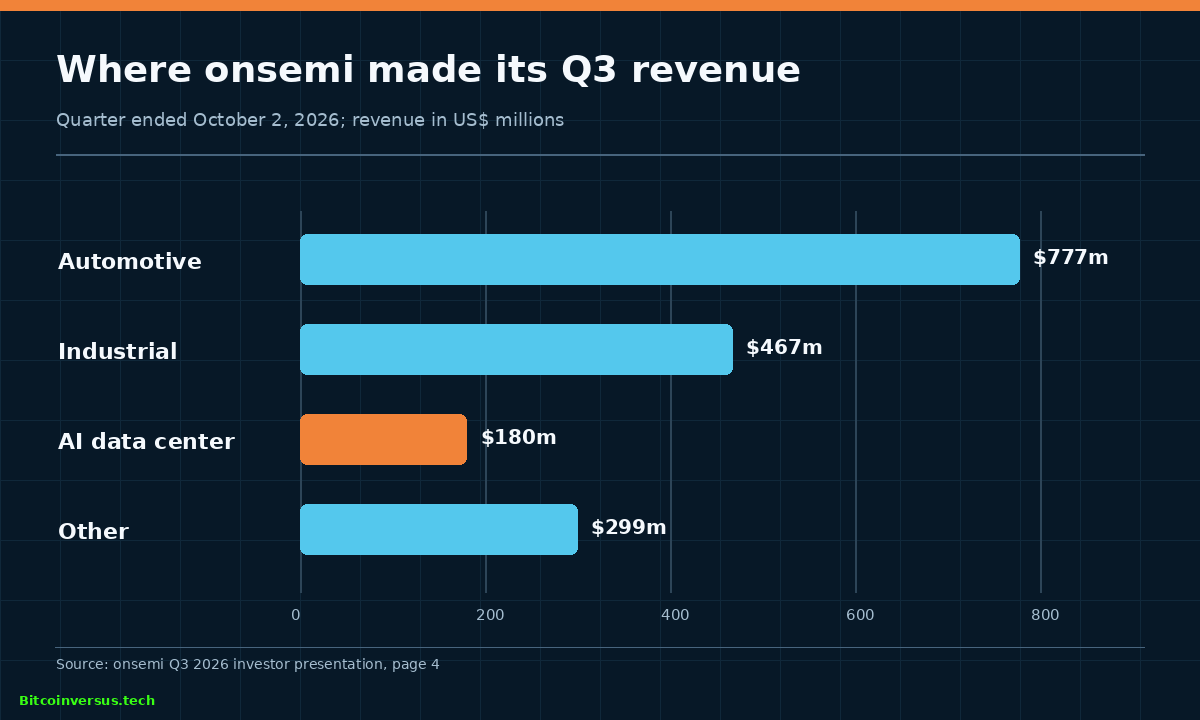
Automotive generated approximately $777 million in the quarter, industrial $467 million, AI data centers $180 million and other applications $299 million. Figures are rounded to whole millions, making their combined total differ slightly from the more precise consolidated revenue. The end-market breakdown should not be confused with reporting business units, where the Power Solutions Group generated $889.9 million, Analog and Mixed Signal Group $597.3 million, and Intelligent Sensing Group $235.1 million.
Power delivery is moving closer to AI processors
The engineering opportunity extends beyond selling more conventional power devices. A GPU may receive high-voltage direct current at the rack level, step down to intermediate voltages on compute trays and finally use point-of-load regulation near the processor. Losses, heat, footprint and transient response become increasingly important as rack power rises. BitcoinVersus.Tech previously covered three competing 800 VDC rack architectures addressing related infrastructure constraints.
On November 2, onsemi announced an agreement to acquire Ferric for $600 million in cash, with up to $175 million in additional performance-based payments. Ferric develops integrated voltage regulators that combine switching, control and magnetic components into compact packages. onsemi says the approach can reduce board area by 50%–70% compared with conventional discrete solutions, a company claim rather than an independently verified result across products. The deal had not yet closed when announced.
Related designs include onsemi’s Embedded Power Platform, which integrates power components into silicon-based packages. Rival suppliers are competing along the same electrical path: Vertiv and Infineon’s supply agreement illustrates demand for silicon and silicon-carbide power devices across AI infrastructure.
A stronger quarter does not settle the long-term outlook
GAAP gross margin reached 41.4%, compared with 37.9% a year earlier, while operating cash flow increased 23% year over year to $516 million. Free cash flow was $489 million, up 31%. Management forecasts fourth-quarter revenue of $1.715 billion–$1.815 billion, but guidance is not a completed sale.
onsemi also raised its 2030 AI data-center revenue target by $500 million to more than $3 billion following the Ferric agreement. Acquisitions, customer qualifications, competing voltage-regulation technologies and spending cycles could change that trajectory. The company’s separate Synaptics transaction remains another proposed strategic investment, not realized earnings. For engineers and investors, the meaningful next measurements are sustained AI revenue, operating margins and validated efficiency gains in deployed power systems—not the growth rate alone.
Primary sources
onsemi Q3 2026 earnings release (November 2, 2026); onsemi Q3 investor presentation; SEC earnings exhibit; Ferric acquisition announcement (November 2, 2026).
Editor’s Note: All quarterly figures, end-market classifications and forward-looking statements were checked against onsemi’s November 2 release, its investor presentation and SEC filings. The two original charts present company-reported data on zero-based scales. The conceptual 1200 × 630 cover depicts generic power electronics and servers, not a documented onsemi installation. No independent benchmarking of power density, AI customer revenue or video playback is claimed.
Support BitcoinVersus.Tech
To contribute an optional 5,000 satoshis, scan the original BitcoinVersus.Tech donation QR below with a compatible Bitcoin wallet. On a phone, display the article on another device or use a wallet’s supported saved-image scanning feature. Verify the payment destination and amount in the wallet before sending.

We volunteer daily to ensure the information on this platform is Verifiably True. If you would like to support the research, please scan QR code.


Leave a Reply