
A miniature robot made from folding panels can crawl, turn, roll, jump and clamp onto objects by changing its shape under an external magnetic field. Researchers at Wuhan University report the experimental design in a Nature Communications paper published November 6, 2026. In a November 20 university update, the team described a key advantage: the robot can stay closed around an object after the driving field stops.
The important innovation is not a tiny onboard artificial-intelligence processor. Its folded geometry acts as a physical controller, allowing one structure to switch between two mechanically stable configurations. The result is a promising laboratory demonstration, not a clinical robot or commercially qualified inspection tool.
Related historical research: Ohio State and Georgia Tech demonstrated magnetically controlled origami microrobots in 2020. The video does not depict Wuhan University’s 2026 device. Watch on YouTube.
Two stable shapes, several ways to move
The design uses bistability: its folding structure has two configurations that can remain stable without being constantly held in place by an external actuator. Think of a snap-through mechanism that rests on either side of a mechanical energy barrier. Small changes to a magnetic field can make the current shape deform; a stronger magnetic pulse can push the structure across the barrier into its other stable shape.
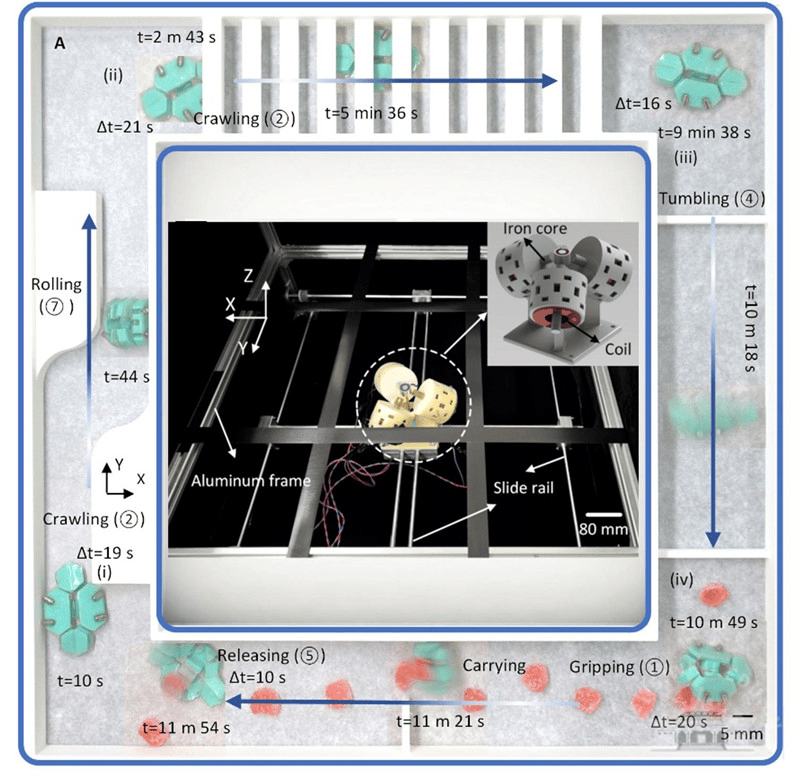
According to the peer-reviewed article, the researchers demonstrated crawling, turning, tumbling, scampering, jumping and rolling, as well as self-grasping and object capture. They developed a large-workspace actuation setup with comparatively nonuniform magnetic fields. Rather than demanding a tightly uniform field throughout a small operating region, the robot’s mechanics encode part of the response.
That approach reduces one control requirement but does not make the machine independent of its environment. External magnetic-field equipment still supplies actuation. Control precision, field strength, material durability and behavior in complex surroundings remain engineering questions.
A grip that holds after the magnet switches off
The robot can close its folded structure around an object and hold the object without continuously energizing the driving field. Wuhan University reports experimental captures of spheres, cubes, tetrahedrons and live silkworm pupae samples. It also says the closed grip endured drop impacts and resisted pulling forces. The term self-locking describes a mechanical hold, not an unlimited source of energy or proof of medical safety.
Researchers can inspect the original proof instead of relying on a promotional clip: the journal’s supplementary movies S4 through S8 document open-state locomotion, switching, closed-state movement and track navigation. The underlying study lists analytical models, numerical simulation and physical testing.
Engineering context: Brigham Young University shows an origami-inspired magnetic hinge and deployable antenna in a 2025 video. It is a separate research project, not a recording of the Wuhan robot. Watch on YouTube.
Why folded mechanics matter beyond a lab
Compact robotic mechanisms could one day help inspect tight industrial spaces or move through constrained passages. Biomedical ideas, including sampling or targeted delivery, remain proposals. The Wuhan team explicitly lists materials development, fluid-environment testing, imaging integration and further miniaturization as unresolved work before possible internal-body use.
The broader engineering theme links to BitcoinVersus.Tech coverage of air-powered soft robots, wearable robot-hand teaching systems, tactile robotic manipulation, neural control of robot motion and insect-scale flying robots. Each addresses a different obstacle: physical actuation, sensing, learned control or onboard electronics.
Verification: Huang and colleagues published the peer-reviewed study on November 6; Wuhan University’s November 20 summary describes the tests and remaining limitations. The magnetic robot is a research prototype; clinical deployment, independent performance certification and commercial availability have not been established.
We volunteer daily to ensure the credibility of the information on this platform is Verifiably True. If you would like to support to help further secure the integrity of our research initiative, please scan the QR code below.



Leave a Reply