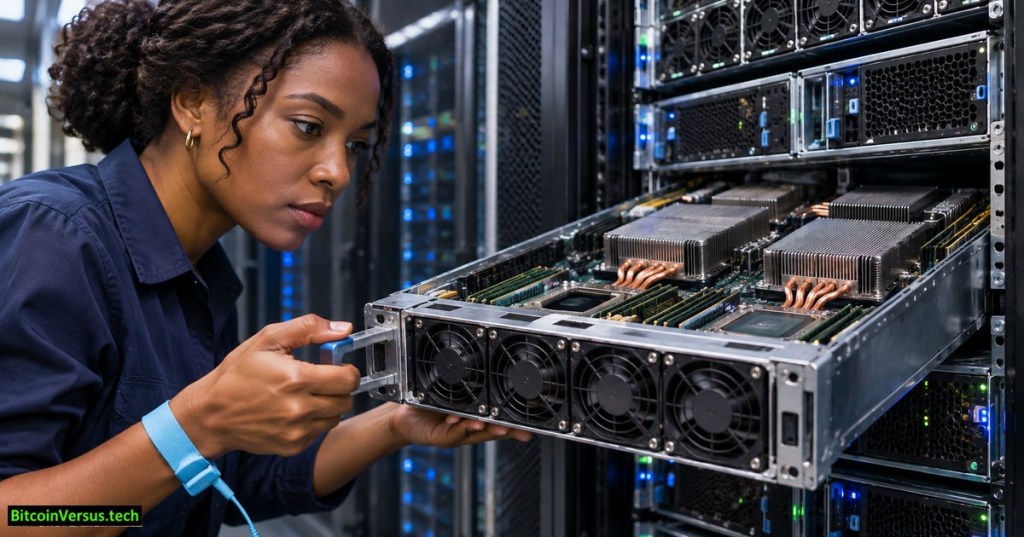
Dell has introduced a way to pack considerably more central processing power into an air-cooled AI data center: the PowerEdge M8825. Announced during SC26 on November 16, 2026, the AMD EPYC-based server is specified for up to 512 CPU cores and 1,024 threads per node. Dell says the system targets agentic AI and other CPU-intensive work. Importantly, the core figures come from preliminary product specifications, not an independent production benchmark.
An independent 2026 Dell Technologies World hardware tour covers the company’s wider server and cooling roadmap. It predates the M8825 announcement and is not a demonstration of the new node. Watch directly on YouTube if the embedded player is unavailable.
Why 512 CPU cores matter when AI headlines focus on GPUs
GPU accelerators carry the bulk of large-model matrix computation, but AI clusters also depend on CPUs. Processor cores schedule jobs, move data, handle API requests, orchestrate agents and manage storage and network services. Where a workload contains thousands of relatively small tasks, CPU parallelism can become a bottleneck even with expensive accelerators available.
The stated 1,024 threads represent simultaneous hardware execution contexts, not 1,024 physical CPU cores. Higher thread counts do not guarantee a proportional speedup: memory bandwidth, cache capacity, software synchronization, I/O limits and per-core performance all affect delivered throughput. Dell has not supplied independent M8825 benchmarks establishing real-world results for those workloads.
The air-cooling claim comes with rack-level constraints
Dell’s plan places the M8825 in dense Open Rack-style deployments without requiring direct liquid cooling at the processor node. According to a November 16 technical report from StorageReview, Dell’s preliminary rack planning spans 35 kW to 75 kW per rack and contemplates up to 46 nodes per rack, depending on configuration, power budgets and thermal limits. Those are design claims, not a guarantee that every existing air-cooled facility can support the densest configuration.
For scale, 46 fully populated 512-core nodes would contain 23,552 CPU cores. The arithmetic is straightforward; achieving the theoretical count would still require sufficient electrical capacity, exhaust-air management, service clearance and network uplinks. Comparable density questions appear in BitcoinVersus.Tech’s reports on GIGABYTE’s liquid-cooled 5,120-core system and NVIDIA’s 192-CPU Vera rack. The cooling approaches are different, so neither is a direct apples-to-apples efficiency result.
AMD’s official Helios presentation explains the wider CPU, GPU, networking and ROCm platform strategy. Helios is a separate rack-scale architecture, not the Dell M8825. Watch directly on YouTube if the embedded player is unavailable.
One chip platform, several types of AI infrastructure
Dell’s SC26 announcement pairs the M8825 with modular AMD Instinct MI350P GPU configurations built on PowerEdge XE7745 and R7725 servers. At the larger end, Dell is also preparing an AMD Helios rack with 72 MI455X GPUs and a manufacturer-projected 2.9 exaflops of low-precision AI throughput. The GPU performance claim derives from AMD’s internal analysis; it should not be confused with the M8825 CPU core count.
The engineering pattern is modularity. Operators can allocate air-cooled CPUs to orchestration and data services while putting accelerator-heavy training and inference in specialized GPU racks. Our previous reporting examined Supermicro’s PCIe Gen 6 all-flash storage server and HPE’s high-core-count EPYC servers, two adjacent pieces of the same infrastructure challenge.
Availability and what to check before deployment
StorageReview reports Dell is targeting the first half of 2027 for the M8825. The announced specifications remain preliminary, and Dell has not established broadly available pricing, measured power per node or an independently audited workload-performance advantage. Buyers should request finalized configurations, supported memory capacity, per-node wattage, acoustic and inlet-temperature limits, thermal derating data, firmware support and realistic rack-density calculations before designing a production hall around the announcement.
Sources: Dell’s November 16, 2026 AI Factory announcement; StorageReview’s technical launch coverage; Dell’s May 2026 PowerEdge platform background.
Media note: The 1200 × 630 featured cover is original photorealistic editorial artwork depicting representative server hardware, not a photograph of the M8825. The video embeds are authentic third-party/manufacturer background materials, not footage of an operational M8825 deployment. Actual embedded playback has not been independently verified.
We volunteer daily to ensure the credibility of the information on this platform is Verifiably True. If you would like to support to help further secure the integrity of our research initiative, please scan the QR code below.



Leave a Reply