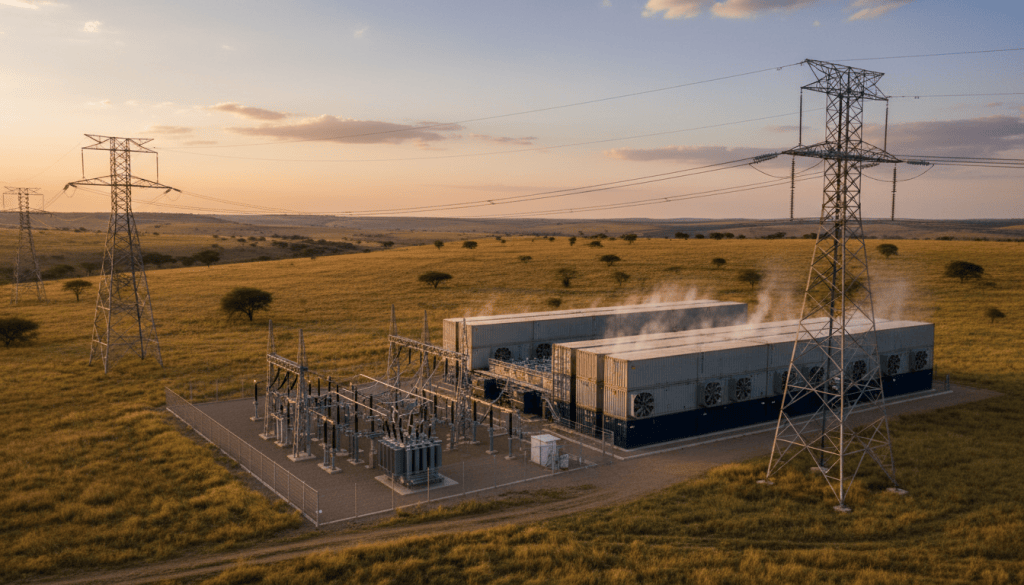
South Africa is considering a two-year electricity tariff pilot that could allow Bitcoin miners and other flexible industrial customers to buy surplus grid power at reduced rates. State utility Eskom proposes a benchmark of approximately R1.20 per kilowatt-hour for qualifying customers in the highest-voltage category of the southern transmission region. The proposal remains subject to approval by the National Energy Regulator of South Africa (NERSA).
Bitcoin mining is an interruptible electrical load: specialized ASIC computers perform SHA-256 calculations to compete for block rewards, but operators can temporarily stop machines when electricity becomes expensive or scarce. The proposed tariff would reward that flexibility rather than guarantee continuous cheap electricity. NERSA’s published regulatory dashboard identifies the pilot as a consultation item, not an approved commercial tariff.
A 12-to-16-hour operating window
The consultation framework targets approximately 12 to 16 hours of operation daily, with 8 to 12 hours of curtailed or discouraged consumption. Electricity prices would depend on transmission zone, voltage level and time of use. Customers connected below 500 volts would be excluded. The R1.20 benchmark therefore cannot be applied indiscriminately to every prospective mining site.
At 1 megawatt of constant electrical demand, a miner operating 16 hours would use 16,000 kWh daily. At the illustrative R1.20/kWh energy rate, that represents R19,200 in daily energy charges, before network, capacity, demand, taxes and other fees. At 12 hours, the equivalent energy charge is R14,400. The calculation illustrates tariff exposure, not a complete mining operating budget.
BitcoinVersus.Tech previously explained how demand charges affect large power users. Those costs matter because a seemingly low energy rate can still be uneconomic after grid charges, machine depreciation, labor and cooling are included.
Ten megawatts of initial interest, 500 MW of potential expansion
According to details attributed to NERSA’s consultation paper, two cryptocurrency mining companies expressed interest in approximately 10 MW of initial combined demand, with potential expansion as high as 500 MW. Interest does not represent a signed electricity supply agreement, installed ASIC fleet or approved grid connection. The prospective expansion is fifty times the initial stated demand and remains conditional.
Eskom estimates that surplus grid capacity may reach 5 to 7 gigawatts during certain periods, partly because solar generation can reduce demand for centrally supplied electricity. A flexible mining load could absorb electricity that would otherwise be unused, but the available surplus changes by hour and location. The grid benefit depends on accurate metering, dispatch controls and reliable curtailment.
The economics resemble questions already raised in BitcoinVersus.Tech’s examination of Texas four-coincident-peak charges and whether mining can stabilize electricity networks. Curtailment capability is valuable only when it is delivered under enforceable operating rules.
Approval and consumer protections remain unresolved
Regulatory questions include whether other flexible industries should qualify, how quickly miners must shut down, and whether discounted electricity could shift costs to ordinary customers. NERSA’s public process listed an October 23 written-comment deadline and a November 3 hearing; reporting indicates a decision is expected December 7. A completed hearing is not evidence of tariff approval.
The proposed pilot is also distinct from a long-term power purchase agreement: a discounted, interruptible tariff does not necessarily provide firm delivery around the clock. Until NERSA publishes its final decision, full charge schedule and technical curtailment requirements, claims of guaranteed profitable Bitcoin mining in South Africa would be premature.
Editor’s Note: The pilot’s regulatory status was checked against NERSA’s September 2026 project dashboard. Tariff and operational details were cross-checked with TechCentral’s October 2 reporting and the cited NERSA consultation-paper address. The consultation PDF could not be independently opened during publication, and the November 3 hearing outcome could not be verified. Figures describe a proposal, not an enacted tariff. The editorial image is AI-generated.

To donate 5,000 satoshis, open the QR on a second screen and scan it with a compatible Bitcoin wallet. On mobile, use another device or your wallet’s supported saved-image QR scanner. Confirm the destination before transferring funds.
We volunteer daily to ensure the information on this platform is Verifiably True. If you would like to support the research, please scan QR code.


Leave a Reply