
Google’s Project Zero security research team has shortened its standard vulnerability disclosure window to 90 days and announced two further reductions, reaching 30 days on January 3, 2028. The November 13, 2026 policy replaces a system allowing 90 days for remediation plus another 30 days for patch rollout. Google says faster AI-assisted bug discovery and exploit development now demand more rapid responses from software vendors. Crucially, the 30-day deadline is not effective today. Project Zero’s original policy announcement details the staged transition.
Original November 13 statement from Project Zero leader Natalie Silvanovich announcing the updated policy. The post links directly to Google’s primary policy document.
A deadline for disclosure, not a guarantee of repair
Under the new Full X framework, Project Zero will publish technical vulnerability details a fixed number of days after notifying the affected vendor, whether a fix is ready or not. A patch issued on day 47 under Full 90 does not necessarily trigger immediate publication; details are scheduled for day 90. An unpatched issue can also become public on day 90, potentially exposing users until vendors and customers respond.
The rule applies to vulnerabilities reported through Project Zero’s own coordinated disclosure process. It is not a worldwide government requirement or a universal deadline imposed on every software maintainer. Google’s goal is to create stronger, predictable pressure to ship fixes and reduce the time users remain exposed.
SmartChart: the disclosure window contracts in stages
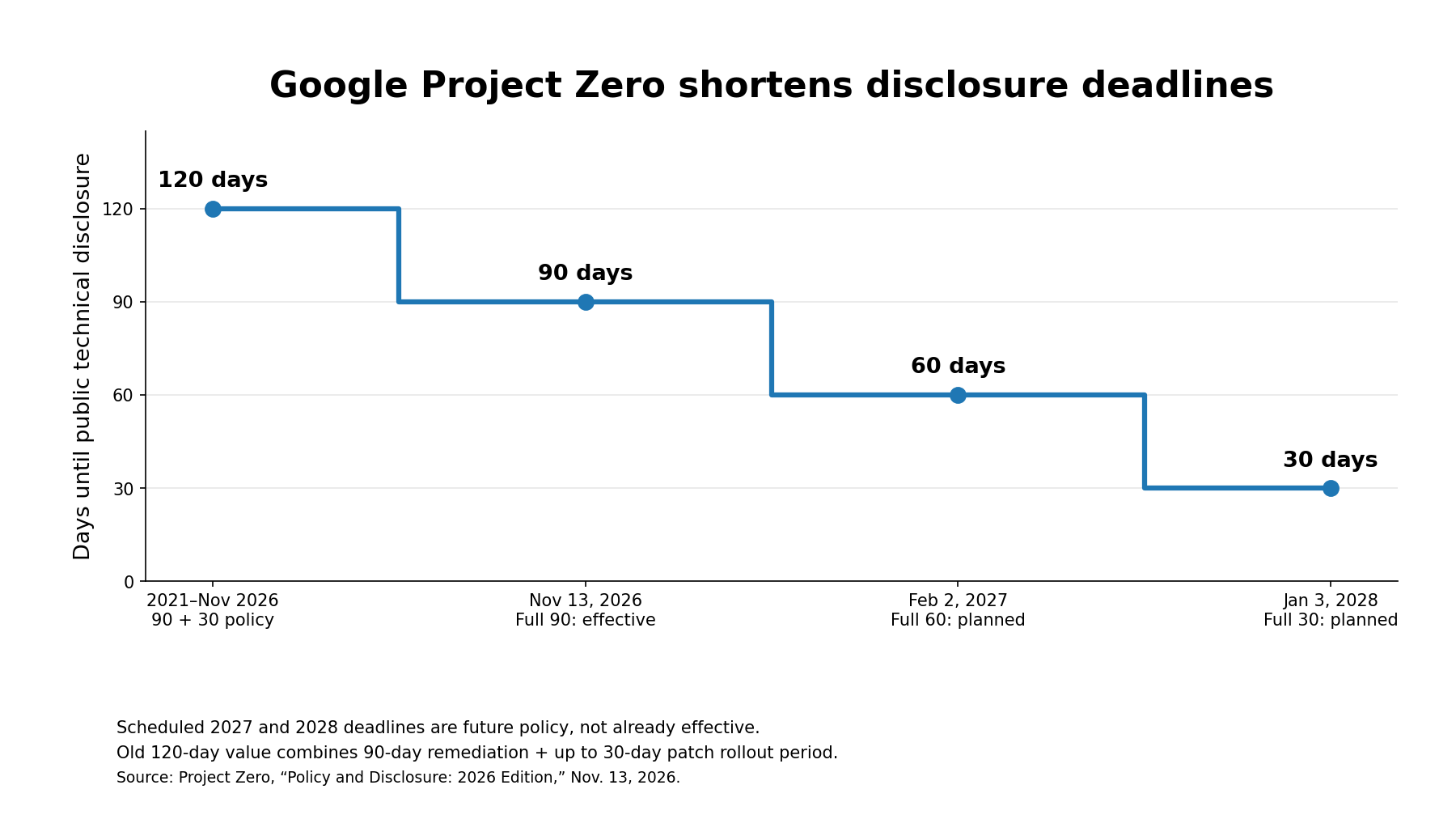
Three chart choices were evaluated: a categorical bar chart, a Gantt timeline and a step chart. The step chart best represents policy windows that change at distinct announcement dates. The older policy’s 90 days plus up to 30 days of rollout becomes Full 90 from November 13, 2026, then Full 60 on February 2, 2027, followed by Full 30 on January 3, 2028. The outer standard window would eventually fall by 75% compared with the previous 120-day allowance. The figures are policy deadlines, not measured averages of repair speed.
AI forces researchers and vendors to reconsider timing
Project Zero argues large language models help researchers discover flaws faster, while also making it easier for attackers to reverse engineer a freshly released patch. Once a fix ships, comparing old and new code may reveal the vulnerability before every downstream product or user has updated. The delay between the release of a fix and its installation is the patch gap, a problem explored in BitcoinVersus.tech’s Patch Tuesday explainer.
Black Hat’s October 2024 talk, “Project Zero: Ten Years of Make 0-Day Hard,” features Natalie Silvanovich explaining the team’s research, patching challenges and disclosure history. Archival background, not footage of the November 2026 announcement.
Related developments illustrate the stakes. Prior coverage examined AI-assisted vulnerability discovery and automated exploit research against older Firefox releases. Laboratory exploits and benchmark results do not, by themselves, establish widespread real-world compromise. Google’s policy argument concerns the shrinking margin between discovery, patch publication and potential abuse.
What happens when a fix is not ready?
The shortened clock has trade-offs. Early public details can help defenders assess exposure and demand repairs, but publication before remediation can also give attackers a usable roadmap. Project Zero says vendors warned that an immediate move to 30 days could cause rushed fixes or discourage remediation. Its phased rollout is intended to let security teams improve their release infrastructure without abruptly moving every newly reported issue to a one-month deadline.
Special handling remains for vulnerabilities already exploited against real users, public disclosures and vendor-requested early publication. Google’s standing guidance calls for a seven-day deadline for confirmed in-the-wild exploitation, while rare exceptions may apply where delayed release would prevent serious harm. Those rules differ from the standard Full 90 clock.
The practical test is delivery to users
A shorter published timetable matters only when vendors can reproduce reports, validate fixes, backport patches and distribute updates rapidly. Enterprise administrators must identify affected dependencies and deploy updates without breaking production. Reports on Apache HTTP Server fixes and automated remediation tools show why the operational side of vulnerability handling remains central. A smaller disclosure window increases urgency, but safe testing, recovery plans and real deployment evidence remain essential.
Primary documents: Google Project Zero’s November 13 policy announcement, current disclosure policy and official FAQ. Scheduled deadlines are policy commitments, subject to future revision.
Editor’s Note: We volunteer daily to ensure the credibility of the information on this platform is Verifiably True. If you would like to support our work and help further secure the integrity of our research initiatives, please scan the QR code below to donate 5,000 sats.

Disclaimer: BitcoinVersus.tech publishes independent educational journalism, not personalized security, legal, financial or investment advice. Vulnerability disclosures can change quickly. Consult official vendor advisories and qualified security personnel before modifying production systems.


Leave a Reply