The most important security update for an enterprise may address a flaw disclosed years ago rather than a newly discovered bug. Trellix’s November 2026 CyberThreat Report, introduced on November 4, examines security telemetry collected between April and September. Its Helix detection data show declining activity for five selected known vulnerabilities between the second and third quarters, but rising counts for two application-related flaws.
A separate network-sensor dataset recorded approximately 1.2 million detections associated with a 2022 F5 BIG-IP vulnerability during the six-month reporting window. The figure describes detection events, not a million successful compromises or unique vulnerable servers. Featured image: an archival CISA Live video graphic about risk-based security updates.
September 29, 2026: CISA’s explanation of risk-based patching provides regulatory and operational context.
SmartChart #14: Which detection counts changed?
A dumbbell chart links two measurements of the same category. The seven pairs below compare Trellix Helix detection counts in the second and third quarters of 2026. Connecting the endpoints makes both the magnitude and direction of change apparent without implying that measurements were collected continuously between them.
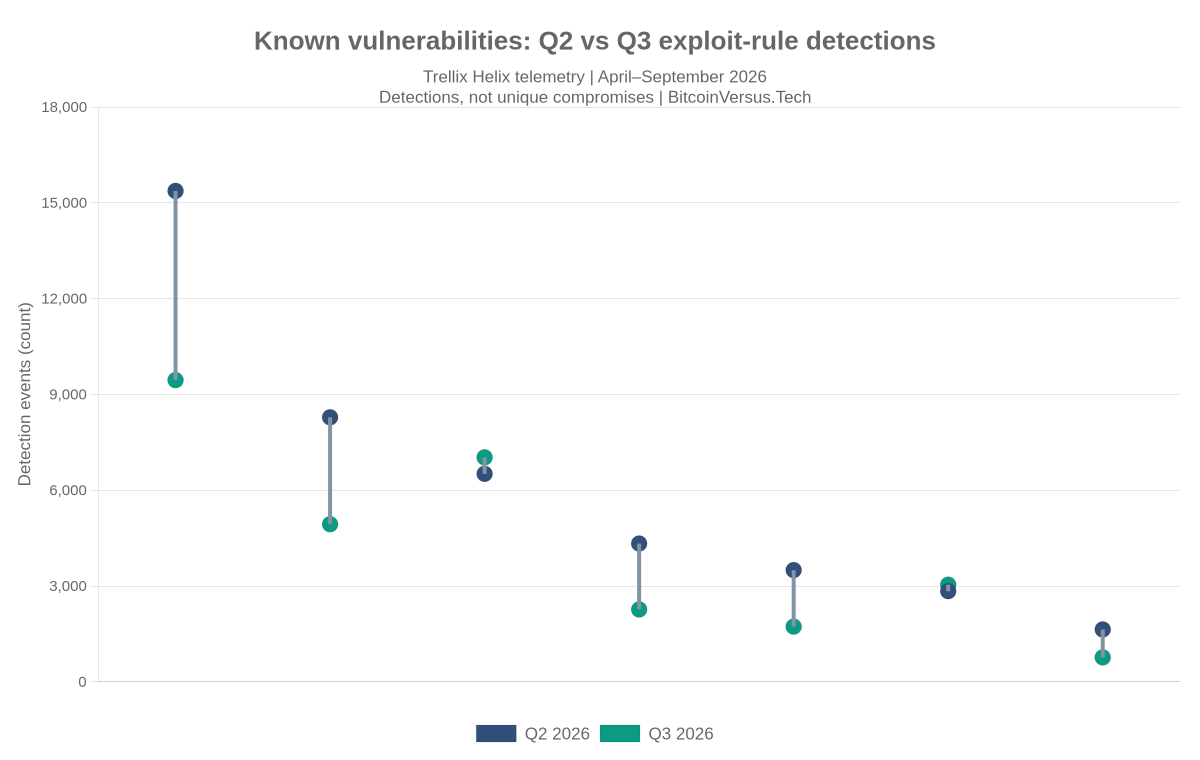
Apache HTTP detections fell from 15,372 to 9,447. Confluence increased from 6,512 to 7,029, and React2Shell increased from 2,838 to 3,041. The remaining four categories declined. These comparisons describe selected detection rules within one monitoring platform; they do not establish changes in global attack prevalence.
Why old vulnerabilities persist
Enterprise software is rarely replaced as soon as an update becomes available. A network appliance may support multiple business applications, and an unexpected restart can interrupt remote access or production traffic. Dependencies, limited maintenance windows and compatibility testing can lengthen the interval between publication of a security fix and its installation. Some organizations also operate equipment that has reached the end of vendor support.
Internet-facing services deserve particular attention because external exposure changes the potential consequences of an unpatched system. An internal vulnerability can also be dangerous, especially where access controls are weak. A useful inventory therefore includes software versions, ownership, external reachability, support status and the importance of the workloads each system serves.
Archival Black Hat 2025 interview with CISA officials discusses critical-system defense and known exploited vulnerabilities.
Prioritizing remediation instead of counting patches
CISA’s June 10, 2026 Binding Operational Directive 26-04 announcement requires federal civilian executive branch agencies to prioritize remediation according to risk. Other organizations can adapt the principle to their own infrastructure without assuming the federal deadlines automatically apply to them. A practical queue combines documented exploitation, asset exposure and business impact. Where updates must be deferred, isolation and restrictions on network access can reduce risk until remediation is possible.
Our previous coverage of Google’s disclosure deadlines, industrial-network vulnerability discovery, Apache security updates and Windows patch volume illustrates why discovery, disclosure and remediation are separate stages. Changes in sensor coverage or detection rules may affect quarterly comparisons, so local security teams should measure exposure reduction and verified remediation rather than rely on vendor detection totals as a universal risk score.
We volunteer daily to ensure the credibility of the information on this platform is Verifiably True. If you would like to support to help further secure the integrity of our research initiative, please scan the QR code below.



Leave a Reply