
The networking hardware connecting artificial intelligence accelerators is becoming a substantial source of semiconductor revenue. On November 23, 2026, Semtech announced fiscal third-quarter sales of $423.0 million for the period ended October 25. Its signal integrity segment generated $182.4 million, compared with $81.6 million in the equivalent quarter a year earlier, an increase of approximately 124%.
The company’s quarterly SEC filing attributes approximately $88.7 million of the segment’s $100.8 million annual sales increase to data center products. That contribution illustrates the growing importance of moving information efficiently between processors, memory systems and network switches. Featured image: Semtech’s company product illustration, cropped from its data center product page.
Semtech’s July 2026 discussion of 200G signal integrity challenges provides engineering background; it predates the earnings announcement.
SmartChart #10: Comparing three semiconductor business segments
Grouped vertical columns compare the same three reporting segments over equivalent 13-week fiscal quarters. Signal integrity generated roughly 30.6% of total sales in fiscal Q3 2026 and 43.1% in fiscal Q3 2027. The comparison uses reported revenue, not hardware shipments or electrical performance.
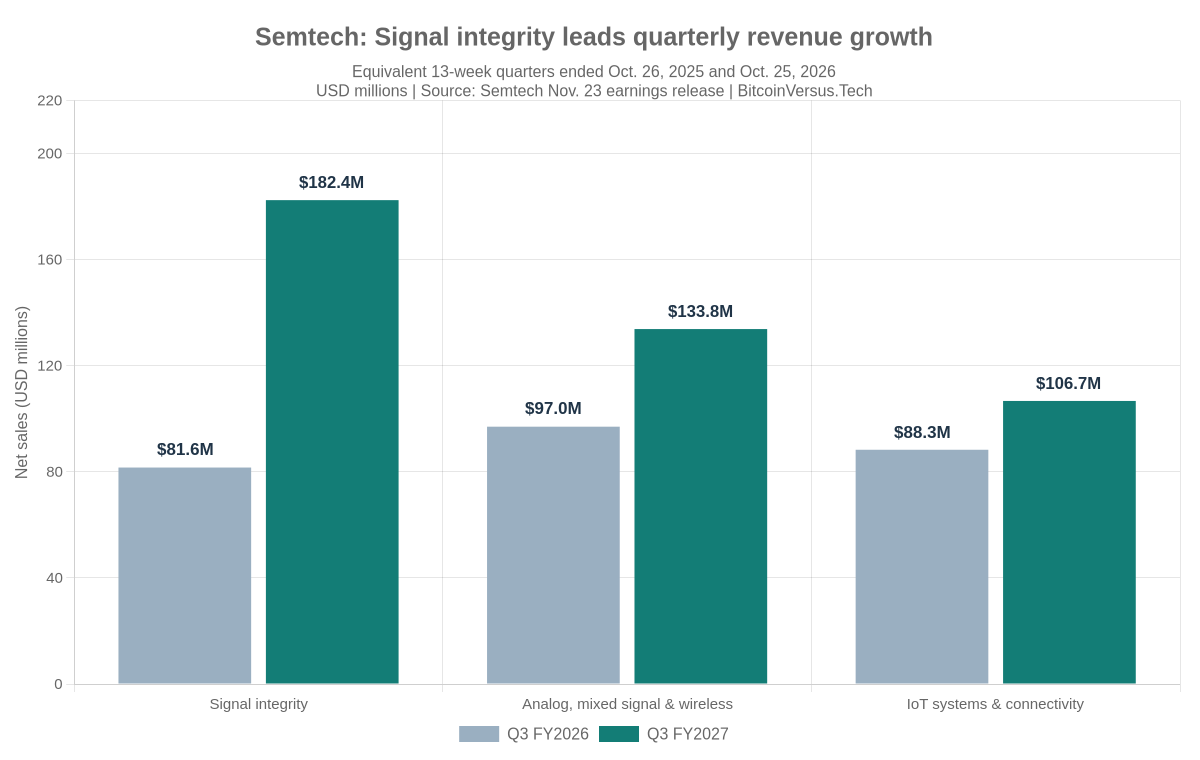
Signal integrity accounted for approximately 64.6% of the company’s $156.0 million increase in total quarterly sales. Analog mixed signal and wireless revenue also expanded, from $97.0 million to $133.8 million, while IoT systems and connectivity advanced from $88.3 million to $106.7 million. The largest gain was therefore concentrated in signal integrity rather than evenly distributed across businesses.
Why high-speed links need analog electronics
At high signaling rates, circuit traces and copper cables attenuate some frequency components more strongly than others. Reflections, noise and timing errors can distort received symbols. Equalizers compensate for frequency-dependent losses, while optical transmitters require laser drivers and receivers require transimpedance amplifiers to convert small photocurrents into usable electrical signals.
Semtech’s data center product portfolio includes components for 400G, 800G and 1.6T optical modules. Linear pluggable optics can reduce the processing required inside a module by relying more heavily on the host’s signal conditioning. The resulting power savings depend on link length, host design, noise margins and required error performance; they are not universal across deployments.
June 2026 Semtech technical discussion of 200G linear optical reach addresses those link-budget considerations.
Networking demand and the limits of a quarterly comparison
Management reported data center revenue of approximately $145 million during its earnings call, about 34% of total quarterly sales. The company’s next-quarter outlook anticipates $480 million in total revenue, plus or minus $5 million, but that fiscal quarter contains 14 weeks rather than 13. Comparing headline quarterly totals without adjusting for period length can overstate sequential momentum.
Related coverage includes Semtech’s optical module content strategy, near-package optical production, Eliyan’s optical chiplet architecture and Tower and Semtech’s SiGe manufacturing expansion. The financial results indicate commercial demand for connectivity components, but they do not establish the energy efficiency or reliability of any particular AI cluster.
We volunteer daily to ensure the credibility of the information on this platform is Verifiably True. If you would like to support to help further secure the integrity of our research initiative, please scan the QR code below.



Leave a Reply