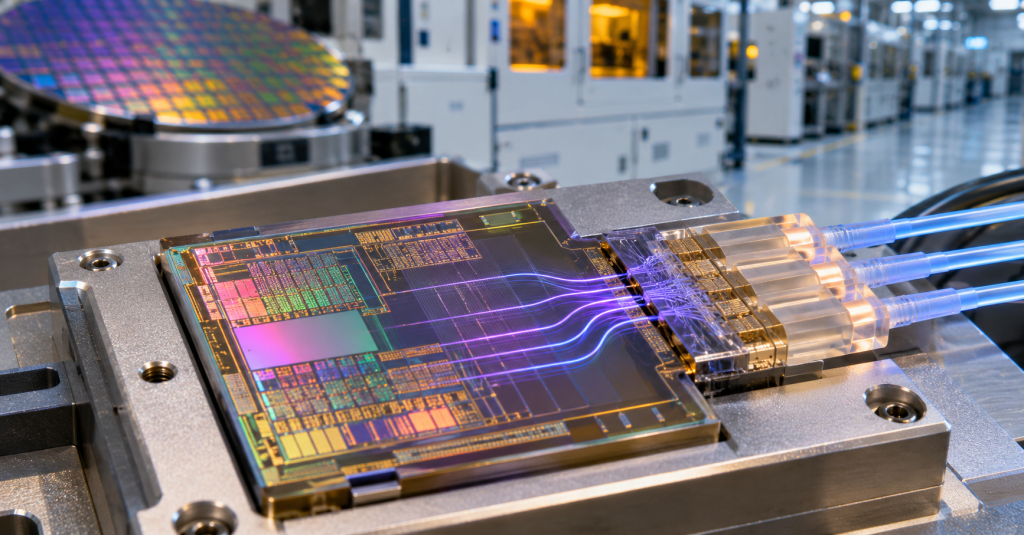
MIGDAL HAEMEK, Israel, and SUZHOU, China — November 3, 2026. Tower Semiconductor and Innolight announced a manufacturing milestone for near-package optics, moving their first optical interconnect device into early production on Tower’s 200-millimeter silicon-photonics process at its California factory. The companies also reported multiple designs taped out on a newer 300-millimeter platform, extending their partnership toward future AI data-center connections.
The joint announcement describes Innolight’s first near-package optics product using Tower’s PH18M process at its U.S. California fab. A tape-out indicates a chip design has been finalized for fabrication, not that a finished device has passed customer qualification or entered volume shipment. Neither company disclosed a production-unit count, pricing, data rate, customer commitment or measured power-per-bit improvement.
Video: Background explainer on silicon photonics and optical interconnects, previously used in BitcoinVersus.Tech’s Tower–Semtech coverage. It provides technology context rather than footage of the newly announced Innolight device; independent playback verification is pending.
Why move optics closer to the processor?
AI clusters must move large volumes of data between processors, switches and memory systems. Conventional pluggable optical transceivers sit at a network port, requiring electrical signals to travel across part of a circuit board before reaching the optical conversion stage. Near-package optics (NPO) moves the optical engine closer to the main chip package, potentially shortening high-speed electrical paths and reducing signal-loss and power-delivery challenges.
Tower said NPO devices may integrate 16 or more optical channels on a single device. Its silicon-photonics process can combine multiple functions, including wavelength multiplexing and demultiplexing, on one chip. Higher integration raises the importance of manufacturing yield, thermal management, optical coupling and device testing. The companies did not publish independent benchmark results proving that their particular device outperforms a conventional pluggable module.
Production milestone, not a finished AI network
The distinction between early production and mass deployment is central. Tower’s 200-mm line is processing the initial design, while its 300-mm platform supports additional future products. Scaling wafer diameter may provide manufacturing opportunities, but economic gains depend on defect density, die size, process utilization, packaging yield and sustained customer orders.
The collaboration follows a broader shift toward denser optical connections. BitcoinVersus.Tech previously reported on Coherent’s 6.4T PhotonLink near-package optics and Credo’s optical interface proposal. Related alternatives include Astera Labs’ long-reach optical PCIe links, which target different interconnect requirements.
Tower also has a recent history of expanding analog connectivity production. Its October partnership with Semtech focused on silicon-germanium capacity for data-center connectivity. Silicon-germanium electronics and silicon-photonics optical engines solve related but distinct parts of the signaling problem; their capacities and performance figures should not be combined.
For Innolight and Tower, the next measurable steps are qualified customer designs, published electrical and optical performance, production yields and shipment volumes. NPO offers a possible route to denser AI infrastructure, but packaging complexity, repairability, thermal constraints and competing pluggable optics remain material tradeoffs. The announcement establishes a manufacturing transition, not a verified deployment across commercial AI clusters.
BitcoinVersus.Tech
BitcoinVersus.Tech Editor’s Note: We volunteer daily to ensure the credibility of the information on this platform is Verifiably True. If you would like to support our work and help further secure the integrity of our research initiatives, please scan the QR code below to donate 5,000 sats. For best results, scan the QR code from a laptop or larger screen.

Bitcoin address: 3C9o19EH5HSiwEPyCTmEKzxhNCbo2X6TTb. On a phone, open the QR image on another screen or copy and verify the address in your wallet before sending.
BitcoinVersus.tech is not a financial advisor. This media platform reports on financial subjects purely for informational purposes.


Leave a Reply